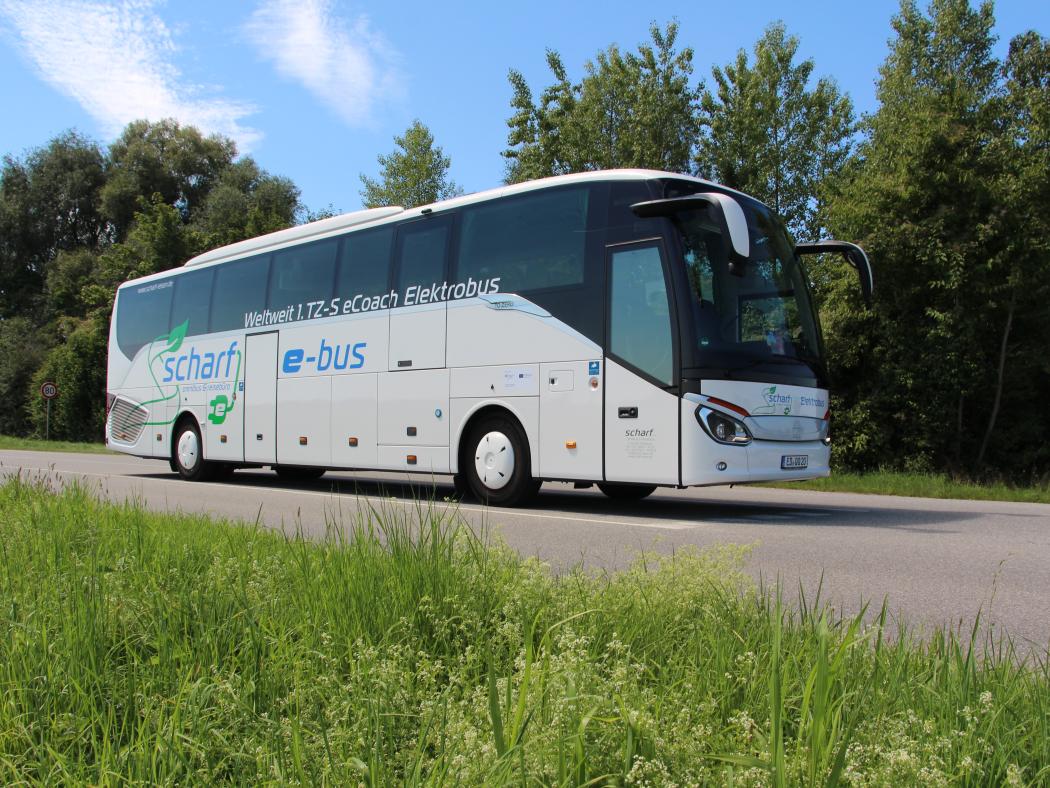
Voith, as a globally active technology group, offers solutions for drive technology as well as components for hydropower plants and the paper industry. Drive technology deals with solutions for various heavy industries such as construction and mining, with regard to mobility among other things with different drives for trucks, buses and off-road vehicles. In collaboration with the vehicle manufacturing company To Zero Electric Vehicles from Rausdorf/Erfurt and on behalf of the Erdinger omnibus company Scharf, the drive expert with 158 years of corporate history has now converted a diesel long-distance coach to electric mobility. The electric coach of the type TZ-S eCoach is, according to the report, one of the first retrofit projects of this kind in Germany. The part of the technical planning and implementation was taken over by To Zero, Voith supplied the electric drive system VEDS (Voith Electrical Drive System).
Bei der Umrüstung wird der bisherige Dieselmotor mit Getriebe durch das speziell auf die Anforderungen von Reisebussen zugeschnittene VEDS ersetzt. Der E-Motor soll eine Spitzenleistung von 410 kW (etwa 557 PS) erreichen – und damit sogar mehr Power als der originale Verbrenner zur Verfügung stellen. Den Angaben zufolge arbeitet das System bereits erfolgreich in elektrischen Neufahrzeugen und wurde "schon mehrfach für seine Effizienz und Nachhaltigkeit ausgezeichnet". Die
Leistung steht über den gesamten Drehzahlbereich verzögerungsfrei zur Verfügung, heißt es – was für zügige Beschleunigung und sicheres Überholen auf der Autobahn sorge.
„In addition, our VEDS is characterized by its high efficiency and reliability. All of these are qualities that it has already demonstrated in other retrofit projects. Most recently, for example, with the Transdev Group in Schwäbisch Hall,“
says Holger Seefelder, Vice President Sales EMEA at Voith.
Battery package with 420 kWh capacity
Second decisive factor for a retrofit is the battery technology. In the retrofitted bus, a battery package with a total capacity of 420 kWh provides the energy needed for long ranges. It consists of several modules that find their place in the vehicle where the diesel drive train and the peripherals were previously: part of the battery units moves into the former engine room in the rear, another part uses some sections of the luggage compartment, Voith describes the concept.
„We have optimized the packaging in such a way that neither the passenger cabin is impaired nor the luggage volume drops drastically. Both the seating capacity and the payload remain almost completely intact,“
says Michael Pfeffer, CEO and founder of To Zero.
Assistance and safety systems remain fully functional
Also important: The existing driver assistance
and safety systems of the TZ-S eCoach electric bus – from ABS and lane-keeping assistant to emergency braking and turning assistant – are to remain fully functional after the retrofit. The coach thus continues to meet all legal requirements, offers the usual passenger comfort and sufficient range for daily travel.
„And not least, the retrofit brings many more sustainable and economic advantages compared with a new purchase. For example, it conserves valuable resources, saves investment costs and avoids the availability problem or long lead times,“
emphasize Martin and Andreas Scharf, owners and managing directors of Scharf Reisen. In this way, the strict requirements of the Clean Vehicles Directive (CVD) and Germany's climate targets in the transport sector are met.
About the Voith Group
Founded in 1867, Voith today employs around 22,000 people, 5.2 billion euros in revenue and locations in over 60 countries worldwide, making it one of Europe’s large family-owned companies. The corporate division Voith Turbo, as part of the Voith Group, is specialized in drive technology and tailor-made services, alongside the other divisions of hydropower and paper production.
About To Zero
The Thuringian company has set itself the task of converting diesel buses to electric propulsion and has developed a special TÜV-certified retrofit kit for this purpose. By
2030, the company argues for the retrofit, at least 48 percent of bus fleets must be emissions-free according to the EU Green Deal and Germany's Climate Protection Act in the transport sector. That means concretely 38,000 buses alone in Germany to come closer to the target "CO2 reduction of 55 percent." Yet, according to To Zero, not that many electric buses can be produced by then: at most a quarter could be produced by bus manufacturers.
Now the company has set itself the goal of electrifying at least 5,000 buses by 2028. Among the corresponding bus models with a range of about 400 kilometers are versions from the brands MAN, Mercedes-Benz and Setra. An upgrade that takes only a few weeks, as emphasized by To Zero, costs about half of a new electric bus, reduces operating costs by up to 50 percent – and up to 80 percent of the costs are eligible for subsidies. Other advantages: by continuing to use existing vehicles resources are conserved, there are longer operation times and less maintenance effort to be observed and the drive is 75 percent more efficient than a diesel version. The retrofit company promises fast charging: 300 kilometers of range are already reached after less than an hour of charging.


