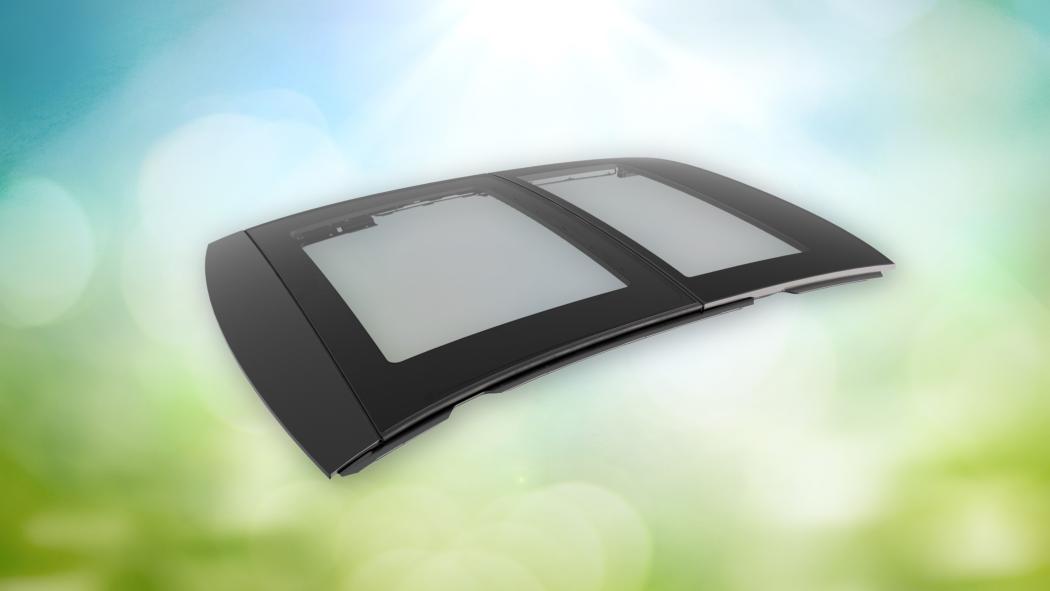
The supplier group Webasto, according to media reports, plans to increasingly focus on its core business of panoramic roofs for vehicles in the future. As reported, the economically troubled company is to undergo comprehensive restructuring, the exact design of which is still open. Parallel to negotiations with the stakeholders, product development at what it claims to be the "world market leader for roof systems" continues. At Auto Shanghai 2025 in late April, the Upper Bavarian company presented its latest roof technology for the first time. The design-optimized solution combines environmentally friendly concepts with comfort and is intended to contribute to decarbonization. The manufacturer claims a 30 percent reduction in CO2. The company further reports:
"Webasto's 'Greener Roof' shows how innovative ideas in the automotive industry can drive not only sustainability but also design. The new roof system dispenses with aluminum, rethinks mechanics - and can be flexibly integrated into electric vehicles."
According to the product description, in the future, the production of energy-intensive materials such as steel, aluminum, or glass will be replaced by optimized manufacturing processes that have lower emissions of gases responsible for global warming. Emissions of the respective gas are compared with CO2 in their impact and are accordingly indicated as reference values in CO2 equivalents (CO2e). Innovations that can have an emission-reducing effect include not only the manufacturing process but also the design: "The engineering team at Webasto shows how sustainable vehicle components can already be implemented through design," according to the manufacturer.
Webasto advertises its "greener roof" as a radical redesign that can be modularly integrated into a wide range of vehicle architectures and whose "strengths will particularly come into play in battery-electric models."
The Car: Masses of Steel and Aluminum
Jan Henning Mehlfeldt, a member of the
six-person board at Webasto responsible for the global roof business, writes about which factors in the automotive industry's value chain must be considered when setting out to reduce CO2 concentrations in the atmosphere:
"In addition to CO2 emissions caused, for example, by burning fuels, material production plays a significant role in the decarbonization of the automotive industry. A modern vehicle, for instance, consists of over 600 kilograms of steel and up to 100 kilograms of aluminum."
These are the main components by weight. The conglomerate of substances that ultimately forms a car consists of a variety of different materials such as cast iron, composites, glass, and elastomers – whose manufacturing process also consumes a lot of energy. For example, the production of conventional steel used in vehicles already induces chemical processes from which CO2 is emitted.
Many alternative materials, however, can only be produced with high energy and cost expenditure, resulting in less CO2, raising the question of profitability. Therefore, Webasto has decided to effectively reduce the CO2 emissions of vehicle components, independent of the material industry.
Material Replacement
This method places a central role on the "smart use of materials." This means: wherever possible, replacing substances whose production or use leads to CO2 emissions with others that have lower emissions. Mehlfeldt describes Webasto's approach to designing its new roof with the following words:
"The Greener Roof was radically redesigned: instead of rigid frame structures made of steel, CO2-reduced technical plastics are used wherever possible. These are only supplemented with steel components where necessary to achieve technical performance, such as stiffness."
Thoughtful Cut
Additionally, not only the material production itself but also the design should be efficiency-oriented - which can lead to savings of over 60 percent in production waste, for example, when
cutting steel sheets. "This not only saves material costs but also reduces resource consumption and energy use in manufacturing," says Mehlfeldt.
Additionally, they have managed to produce the product completely without aluminum, which was used, for example, in the opening mechanism. New solutions have also been devised here, allowing the mechanics to be "completely rethought" and enabling lighter and more space-saving integration into existing components.
Optimized CO2 Footprint
The company, which generates about 80 percent of its sales from roof systems and otherwise operates in the "Electrification" sector, achieves with its new solution a reduction of about 30 percent in CO2 equivalents (CO2e) compared to previous solutions. Additionally, the Greener Roof's lower weight is intended to improve the performance of the entire vehicle – especially in battery-electric versions:
"A lighter roof system potentially means more range – a key criterion for customers and manufacturers."
The car roof manufacturer, which currently employs around 15,000 people worldwide and also develops roofing solutions for boats, envisions saving even more CO2 through the use of "green" steel. Such highly iron-rich material is produced avoiding CO2 emissions, for instance, using renewable energy and hydrogen instead of fossil fuels.
More Room to Move
The comfort is also not supposed to suffer due to the new development – on the contrary, the Green Roof would offer the vehicle occupants more space, light, clarity, and thus a significantly improved driving experience:
"Especially in electric vehicles, whose floor structure is usually higher than in internal combustion vehicles, every additional centimeter of headroom becomes a valuable argument."
The new development is not limited to use in certain vehicle models and does not require any special constructions otherwise. The system is modular and can thus be transferred to various vehicle platforms. And the necessary
connectivity has also been considered: "This makes it particularly attractive for automobile manufacturers who rely on flexible solutions that can be integrated into existing production processes – including all necessary interfaces to vehicle electronics and sensor technology."
Focusing on a CO2e-Neutral Future
For its solutions, the company, founded over 120 years ago, collaborates with vehicle manufacturers from the early stages – and the innovations are designed for durability: "The new concept is not an isolated innovation," says manager and business economist Mehlfeldt, "but a building block for CO2e-neutral mobility of the future."
Webasto wants to orient its product development to sustainable processes right from the start – and not only consider the environment when it comes to recycling. Design also plays an important role in this. Mehlfeldt: "The transformation to a climate-compatible vehicle architecture must also include the supplier industry."
And the corporate group has adjusted to exactly this concept – with a "practical, market-ready solution approach," which is intended to serve as a basis for future ideas. "Ecological thinking and technological excellence," says the roofing expert, "do not have to be mutually exclusive but ideally inspire each other."
Webasto is headquartered in Stockdorf, Upper Bavaria, south of Munich, and is, according to its own accounts, among the world's 100 largest automotive suppliers. More than 15,000 employees are currently employed at over 50 locations, most of them in Europe as well as in China and the USA. The majority of the company's activities focus on roof systems, with about 20 percent related to the electrification of vehicles and solutions around thermal management such as auxiliary heaters. Target groups are manufacturers of passenger cars, commercial vehicles, and boats, as well as dealers and end customers. In 2024, sales of around 4.3 billion euros were