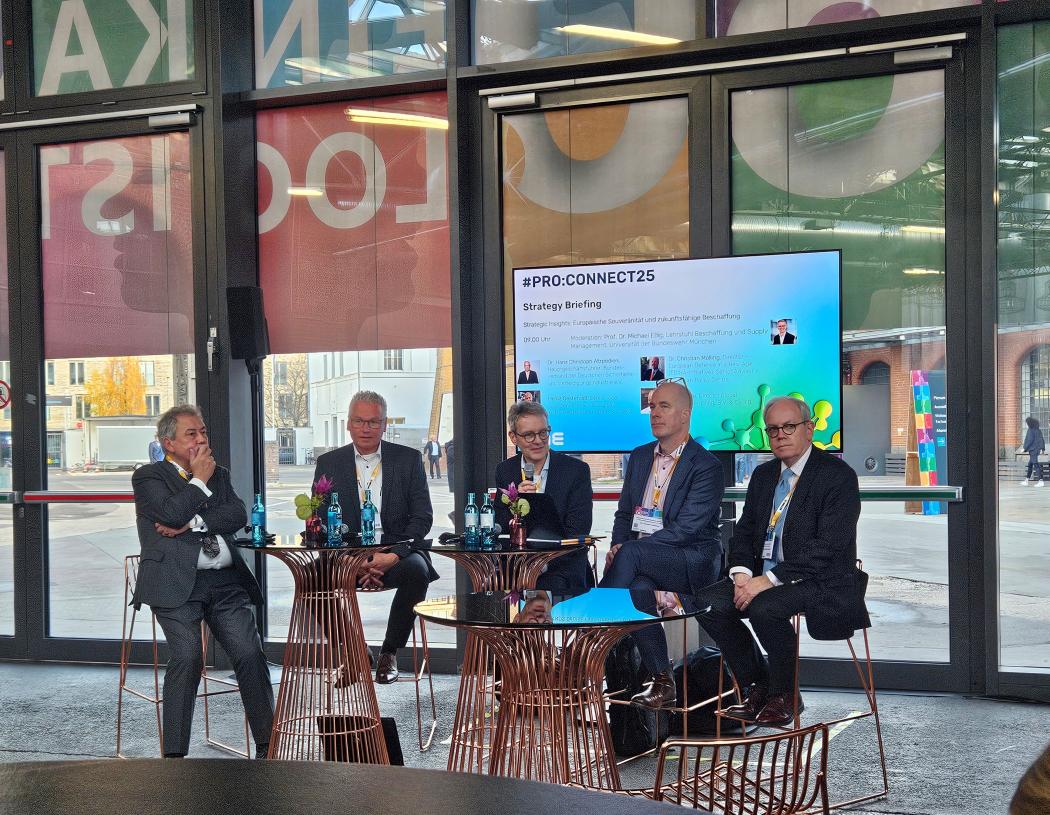
"European sovereignty and future-proof procurement" were the focus on November 13 at the "Strategy Briefing" at the BME Symposium in Berlin. The expert roundtable in the Marlene Bar, moderated by Prof. Dr. Michael Eßig of the University of the Bundeswehr, was offered for the first time at the congress and drew strong public interest. The central question: Which supply chains are needed to build Germany's defense capability and safeguard Europe's sovereignty?
"The defining economic policy principle in the Federal Republic is currently changing. The state is increasingly intervening in the markets," said Dr. Christian Mölling, Director of European Defence in a New Age.
Society is meanwhile preparing to adjust to a new conflict order as a "New Normal." The defense industry, at the center of
this development, does not operate according to market-driven logic, but in case of doubt prioritizes the resilience of the supply chain over price. Often, in a military context, national procurement quotas of more than 90 percent are required.
How can the ramp-up succeed?
Dr. Hans Christoph Atzpodien, CEO of the Bundesverband der Deutschen Sicherheits- und Verteidigungsindustrie e.V. (BDSV), spoke of a "dim transitional phase" between "no longer peace and not yet war," in which the Federal Republic finds itself. He welcomed the loosening of the debt brake for defense spending by the federal government and underlined the urgency of development:
"It is undisputed among experts that by 2029 the defense economy in Germany must be able to function completely resiliently. The question is only: How
do we manage the upscaling?"
Together with the BME, the BDSV is currently building a platform to bring suppliers and end users in a military context together.
How much manufacturing depth is needed?
Frank Ohle, Director Global Procurement at the warship specialist NVL, and Heinz Oestervoß, Senior Vice President Procurement & Logistics at KNDS Deutschland, reported from their purchasing practice. Both stressed that they already source more than 90 percent of their purchasing volume from Germany. In terms of manufacturing depth, however, both pursue different goals:
"We are considering bringing certain parts of our production – such as cable runs – back into the company. After all, a ship contains several hundred kilometers of cables," Ohle explained.
"Until now we have a very high manufacturing
depth, extending down to the clamps. But we cannot manage that anymore in light of the growing dimensions of the orders," said Oestervoß. "Whether you build 40 Leopard main battle tanks or 1,000, is a huge difference. Additionally, the KNDS manager notes that the production sites in Munich and Kassel are limited insofar as they are located near residential areas. "We are looking for additional sources, and we are open to outsourcing the production of whole systems," he said.
Software-defined Battlefield
Needs in the defense sector exist in the framework of the "Software-defined defence" of the Bundeswehr also on the software side:
"It already has everything to do with software today," summarized Christoph Atzpodien from the BDSV. "One must imagine the battlefield as a completely