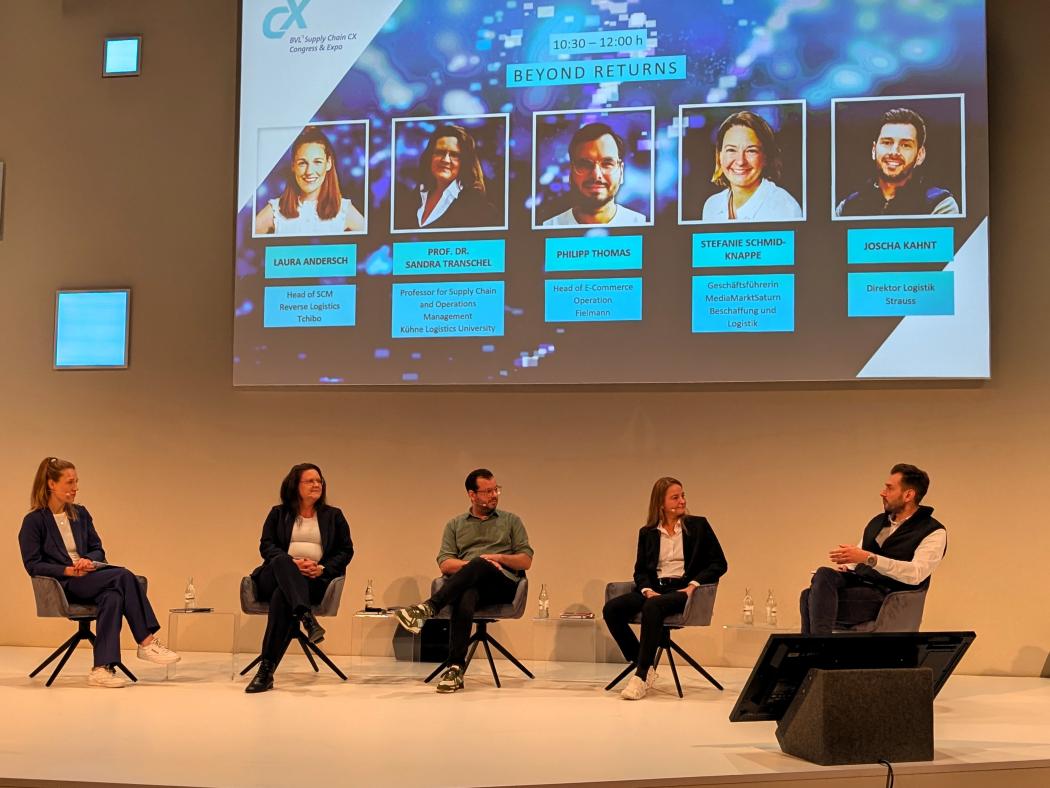
Returns are a nuisance for most trading companies, because they often cause costs and high effort – also because not all products can or may be resold afterwards. On possible ways out of this dilemma, representatives from science and commerce discussed on the occasion of the Supply Chain CX 2025, which is still taking place in Berlin until 24 October, within the framework of the session "Beyond Returns: The Reinvention of the Value Chain through Intelligent Returns Management".
First, the panel addressed the question of the extent to which reusable packaging influences returns processes.
Prof. Dr. Sandra Transchel, Professor of Supply Chain and Operations Management at the Kühne Logistics University (KLU), assumes that the importance of reusable packaging in online retail across the entire online market will gain significant importance over the next ten to 15 years. Nevertheless, the scientist recommends engaging with the topic now.
"It makes sense to put this on the agenda as long as top-down pressure is not yet too high, and to create a bottom-up basis, for example
through suitable return systems," said Transchel.
Currently, the topic of reusable packaging – particularly in connection with the returns process for many retailers for financial and procedural reasons – remains a challenge, as Joscha Kahnt, Director of Logistics at Strauss, explained.
"We tested reusable shipping packaging as part of a pilot project, but had to suspend the topic for the time being. Merely cleaning the packaging was very cost-intensive."
Transchel therefore regards the construction of full ecosystems for reusable packaging as essential. In particular, she has parcel, express and courier service providers (KEP service providers) in mind.
"Small stand-alone solutions will not suffice here, because throughput does not reach the necessary threshold. But if large parcel service providers, such as the Austrian Post, offer merchants the possibility to use reusable packaging and to outsource the necessary services such as cleaning, then the solutions will also be financially viable."
At the eyewear manufacturer Fielmann, digital support is used to optimize returns processes. Returns portals, from the perspective of Philipp Thomas, Head of E-Commerce Operation,
help to establish standards in the process and thereby improve the shopping experience.
"We can automatically issue refunds through these solutions, so that customers do not have to wait long for their money," explained Thomas. Standards also help the omnichannel retailer with the reconditioning of goods. "We process every return manually and with professional hands. Most of our staff in this area are trained opticians. This enables us to achieve a refurbishment rate of more than 80 percent."
The electronics and household goods retailer MediaMarktSaturn sees returns primarily as an important signal from its own system, as Stefanie Schmid-Knappe, Managing Director of MediaMarktSaturn Beschaffung und Logistik GmbH, explained.
"Returns show us first and foremost that a process within our system does not fit properly. That offers opportunities above all. Because whoever reads returns correctly can not only learn a lot but also increase their own value creation."
According to the expert, returns deliver valuable data points and act as an early warning system for existing problems.
"If we see that a particular product
is returned again and again, we have to ask what is not right with it. Is it the merchandise itself, or do we perhaps not describe it well enough?" said Knappe-Schmid.
To turn returns into profits, MediaMarktSaturn aims to handle as many online returns in-store as possible. That would not only attract customers into the shops, but would also have further advantages.
"Both sides receive immediate feedback – this keeps us close to our customers, and they in turn feel heard. In addition, it can usually be clarified on-site what is not right with a device. In the best case, either a repair or an exchange is possible."
The workwear specialist Strauss also wanted to make its returns processes smoother. Therefore the company decided to process its returns at two independent locations. This is intended to guarantee process redundancy and resilience and to enable a more dynamic deployment of staff. In addition, the company is currently expanding its network of micro-logistics centers abroad. This should serve customers in their native language and reduce