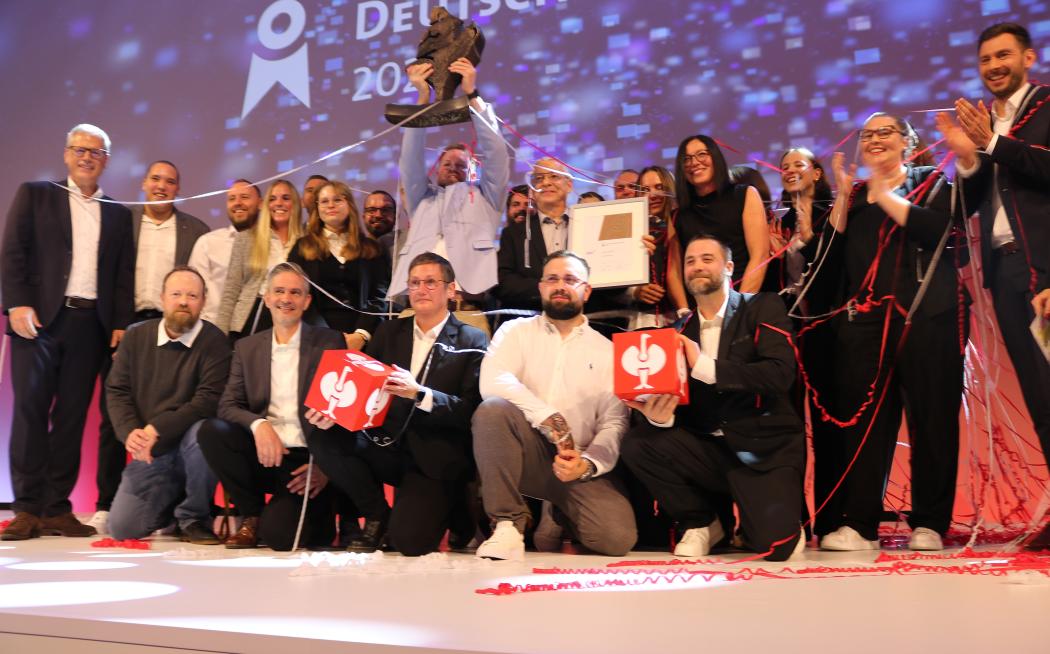
The "Logistics Next Level" project from the workwear brand Strauss impressed the jury and was awarded the German Logistics Prize 2025 during the BVL Supply Chain CX in Berlin on the evening of October 22. Already in 2015 the family-run company had won the prize with the project "Stargate", and in 2020 Strauss reached the final with the "CI Factory" in Schlüchtern.
“We didn't just want to renew our logistics, but revolutionize it,” said COO Matthias Fischer about this year's winning project "Logistics Next Level". The existing logistics center in Biebergemünd dated from the 1990s and was no longer future-proof – the aging facilities consumed a lot of energy and the processes were still largely analog. The analysis, according to the statement from the Bundesvereinigung Logistik, quickly showed: A new build would be associated with the highest costs and the most CO2 emissions, and would also take a lot of time. The Brownfield revitalization, by contrast, had a viable investment framework and a shorter implementation time; it saves 26,000 tons of CO2 compared with a new build. A photovoltaic system and geothermal energy contribute to self-sufficiency.
Renovation while in operation
However, the renovation while in operation posed high demands on planning, qualification and risk management. Parts of the process could temporarily be outsourced to the sister site in nearby Schlüchtern.
A total of 55 million euros were invested, which could be financed from equity. With a doubling of shipping capacity, unit costs fell – Fischer cites a return on investment of 4.8 to around five years.
Reduced weekly working hours, with full pay
A new control center coordinates daily around 45,000 shipments. The order throughput time fell from four hours to 40 minutes, the error rate was reduced by 80 percent, customer satisfaction today stands at 98 percent. Automation and digitization with state-of-the-art equipment are one pillar of the success. Emerging data flows immediately back into forecasts, capacity management and maintenance planning, thereby increasing the stability of the processes. The auditing team and the jury were also impressed by the embedding of the project in the entire team. The workforce was involved from the start and could co-determine many topics such as shift planning, break times and workplace design. The renovation times were used for training at the modern Schlüchtern site. For employees, especially positive: the efficiency gains allowed reducing weekly working hours from 40 to 37.5 hours—with full pay.
In sum, Strauss impressed the jury, with LOGISTIK HEUTE represented by editor-in-chief Matthias Pieringer, with the integrated approach of Brownfield, technology, ecology and social dimension. The combination of asset preservation, networked automation, AI-assisted control and active employee participation creates measurable
effects in performance, quality and sustainability. The project is thus a robust model for companies that want to develop future-proof logistics in view of scarce space, rising requirements and high cost pressure.
The winning concept from Strauss will be presented on Thursday (23 Oct) at 14:30 on the Deep Dive Stage in the Expo Area at the BVL Supply Chain CX 2025.
The other finalists for the German Logistics Prize 2025 were Siemens and Tchibo.
Finalist Siemens - Smart, scalable and sustainable solution with AI
Increasingly many small packages, changed customer ordering behavior, highly fluctuating customer demands, increased cost pressure and ambitious sustainability goals – these were the challenges of the Logistics Center Erlangen (LC), which is a central hub for the worldwide shipping of Siemens components for the drivetrain.
The solution: A comprehensive transformation while in operation with a focus on digitalization and automation. Four AI-based innovations are at the center, and enable the automation: An algorithm forecasts the optimal carton size, robots can autonomously pick even unknown objects, an AI-assisted packing logic ensures optimal placement in the carton and an automatic depalletizing enables seamless integration into the overall process.
“Today the entire process from material handling to labeling and getting the small packages ready for shipment is fully automated,” said Dr. Ekine Aristizabal. As Head of the Logistics
Center in Erlangen, she initiated and guided the transformation. “We owe the high efficiency of our processes for small packages to the new Pick & Pack line with its productivity increase of 124 percent and the shipping line with even 300 percent productivity increase,” said Aristizabal. The jury and auditors were convinced by the linking of several state-of-the-art techniques into a highly efficient overall concept.
Finalist Tchibo – “The Power within Retoure”
The ever-changing and diverse products from Tchibo pose a special logistics challenge – especially for returns. They are regarded in retail as a major cost factor. Tchibo has changed the perspective and placed returns at the center of its omnichannel network. At the logistics site in Cheb, Czech Republic, Tchibo developed the project "The Power within Retoure", which intelligently interlocks online business and returns.
Almost 850,000 returns per week have to be processed; they are part of the business model. Through an automated system with 300,000 bags, 27 percent of returns go directly into a new package, 55 percent of the returns are already available in the webshop again after 30 minutes. In total, 96 percent of the returned items can be offered to customers again. “For us, returns are not the end of a product cycle, but a new beginning,” said Laura Andersch, Head of SCM Reverse