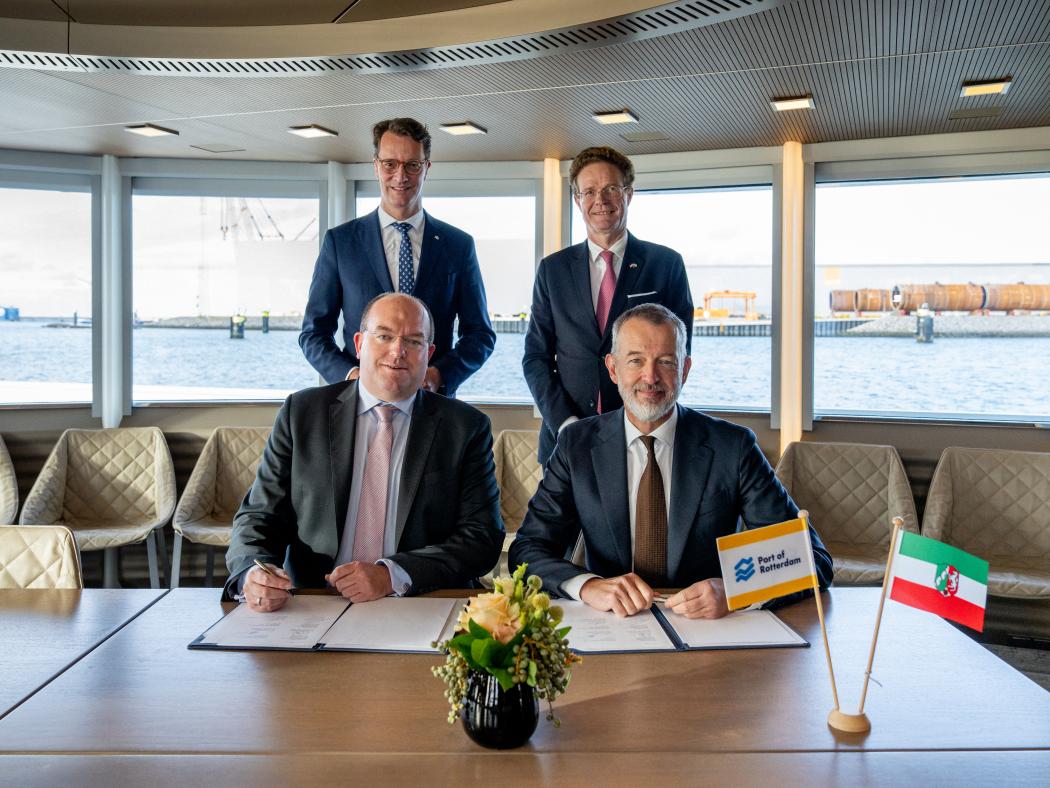
The ports in Duisburg and Rotterdam are continuing their close cooperation: in the presence of Hendrik Wüst, Prime Minister of the State of North Rhine-Westphalia (CDU), a new Letter of Intent (LoI) was signed on October 31. According to a press release, the two European logistics hubs aim to reinforce their goal to jointly develop sustainable transport corridors via the waterway transport mode as well as forward-looking initiatives for the energy transition – with regard to the industry and the supply chain between and within Rotterdam and Duisburg.
NRW Prime Minister Hendrik Wüst:
“The Port of Rotterdam, as Europe’s largest seaport, and the Port of Duisburg, as the world’s largest inland port, together make a decisive contribution to the industrial future of North Rhine-Westphalia. Both ports
will in the future become central hubs for hydrogen and CO₂ and thus important partners on our path to a climate-neutral industry.”
Rotterdam and Duisburg stand in a time of global upheaval as representatives of a strong, interconnected Europe, Wüst expressed his conviction. “Your cooperation is a signal of confidence: When we modernize infrastructure and deepen partnerships, we secure the future viability of our continent – economically, ecologically and in terms of security policy,” said Wüst.
New Focus: Export of CO2
A central new building block of the cooperation is, according to the companies, the export of CO2. For the “hard-to-abate” industries, this is of decisive importance, because decarbonization of these industries via CCUS (Carbon Capture, Utilization and Storage) would not be possible without strong ports
and efficient transport chains, argue the cooperation partners. The ports of Duisburg and Rotterdam want to create the prerequisites for cross-border CCU/CCS activities, i.e., the targeted capture, storage and utilization of carbon dioxide.
A further focus of the agreement between the two ports lies in strengthening the Rhine Corridor as a cross-border sustainable logistics axis, the statement says. The Rhine Corridor forms the backbone of European industrial supply and enables an efficient, sustainable link of production sites to international markets.
Bundling of Know-how
“We face major challenges that we can tackle much faster, more efficiently and intelligently together,” emphasizes Duisport CEO Markus Bangen. “Especially in the areas of energy transition and sustainable logistics it is crucial that we pool our expertise and develop joint, cross-border solutions.
Logistics is a team sport – and the Port of Rotterdam is our ideal partner.”
“Currently, 13 percent of Europe’s energy demand is imported via Rotterdam,” said Boudewijn Siemons, CEO of the Port of Rotterdam Authority. “These are still mainly fossil energy carriers, but in the long term we want to become Europe’s import port for renewable energies. Inland shipping, and thus our cooperation with Duisport, plays a special role in the further transport of these energy carriers. Therefore the waterway needs a strong lobby, and we are pleased that Prime Minister Wüst’s visit to Rotterdam sends a clear signal here.”
The two ports had already signed a Letter of Intent in 2022 for cooperation in the areas of rail and hinterland development, digitalization and the