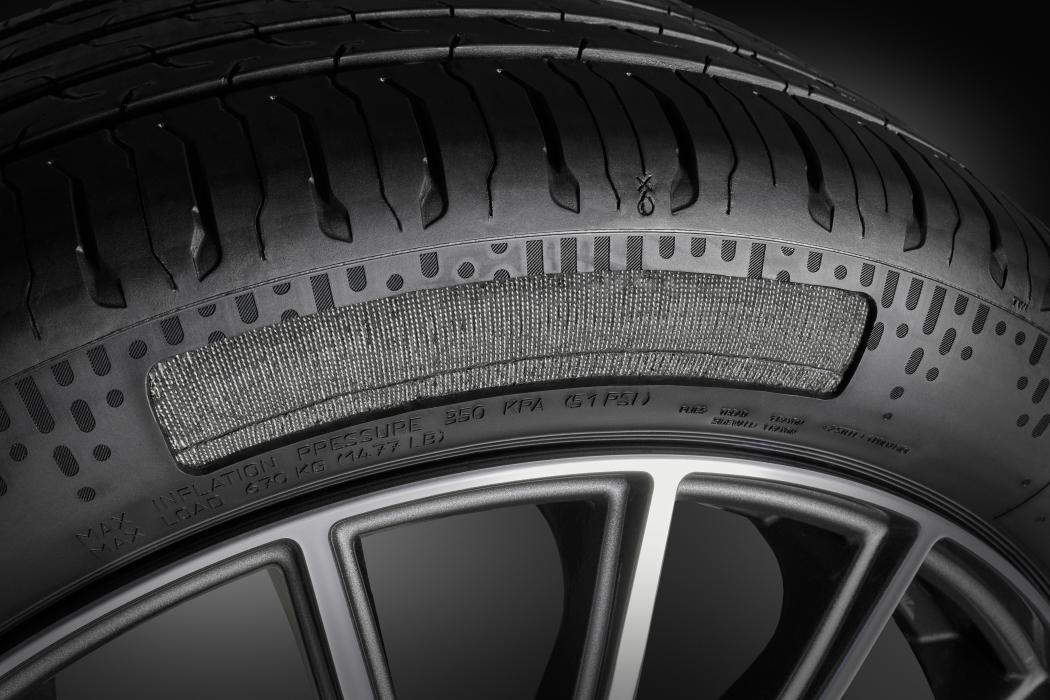
According to its own statements, Continental is pushing the use of renewable and recycled materials in tire production and is strongly committed to the principles of a circular economy. Suppliers—as it is said—are also to be motivated to develop and provide increasingly sustainable materials that can be used in tire manufacturing.
5-year target
In 2024, the share of renewable and recycled materials in Continental's tire production stood at an average of 26 percent. The aim is to increase this figure to at least 40 percent within the next five years.
A focus is placed on identifying and introducing sustainable alternatives for raw materials used to reinforce tires — i.e., materials that are intended to ensure dimensional stability and performance over the tire's entire service life.
These would consist mainly of steel and textiles, which account for about 18 percent of the materials used in passenger car tires. For commercial vehicle or specialty tires, the share could be even higher according to the manufacturer.
'Reinventing the Tire'
The use of more sustainable materials is to be strengthened, for example recycled steel and polyester yarns made from reprocessed PET bottles. The so-called Cokoon-adhesion
technology is also considered a more sustainable manufacturing method.
Additionally, across all raw material groups, the company is pursuing innovative alternatives such as synthetic rubber from used cooking oil, resins from biobased waste materials, and silica from rice husk ash.
"We are not reinventing the wheel—but the tire: with more sustainable materials and more environmentally friendly production processes," emphasizes Dr. Matthias Haufe, Head of Materials Development and Industrialization in Continental's Tire Division, and adds: "The rubber is not the only decisive factor. We are also focusing on those materials that give rubber its shape and make tires stable and safe."
According to Haufe, recycled steel and polyester yarns from processed PET bottles are of great importance for a more sustainable tire production. With each material alternative, Continental moves one step closer to the goal of using at least 40 percent renewable and recycled materials in tires within the next five years.
Recycled steel
Both for performance and safety of a tire, steel and polyester are essential. In commercial vehicle or specialty tires, for example, the carcass is reinforced with high-strength steel cords. These are supposed to provide very good durability, high
load-carrying capacity, and retreadability.
Steel is also used in reinforcement wires in the bead core of passenger car, commercial vehicle, and specialty tires. They are meant to keep the tire securely on the rim and run along the circumferential edges of the rubber bead.
Steel cords are also processed in the belt layers of passenger car, commercial vehicle, and specialty tires — to improve load-bearing resistance, tread stability, and ride comfort, the tire manufacturer explains.
In addition, they are expected to reduce noise emission and contribute to increasing the fuel efficiency of internal-combustion vehicles and to extending the range of electric vehicles. The share of recycled steel should continue to be increased in Continental's portfolio, according to the information.
Recycled PET
Also increasingly used for sustainability is polyester as a textile material. Polyester yarn from recycled PET bottles is used to reinforce passenger car tire carcasses and to improve the stability of the rubber bead. The carcass material of a tire can be made from up to 15 recycled PET bottles, depending on tire size.
The polyester yarn is processed into a textile cord that is meant to absorb the forces
of the tire inner pressure and to remain dimensionally stable even under high loads and temperatures.
Together with textile manufacturer Otiz, the so-called ContiRe.Tex technology has been developed to create a special polyester yarn from recycled PET bottles. The application is expected to reduce CO₂ emissions in PET tire cord fabric by about 28 percent compared with fossil alternatives.
The polyester yarn is currently used in passenger car serial tires such as the UltraContact NXT. The recycled PET bottles would be sourced exclusively from regions where there are no closed bottle recycling loops.
"What is decisive for greater sustainability is not only which materials we switch to—but also what we consciously forgo," says Haufe.
Cokoon adhesion technology
Continental has also developed, together with Kordsa, a bonding-system standard for textile-rubber connections that is said to be more environmentally friendly. The bonding is enabled without the use of resorcinol and formaldehyde in the textile dipping bath.
According to their own statements, both companies have made this Cokoon adhesion technology available to all tire manufacturers and their suppliers as a royalty-free open-source solution — to advance sustainability across the entire industry, it is said.