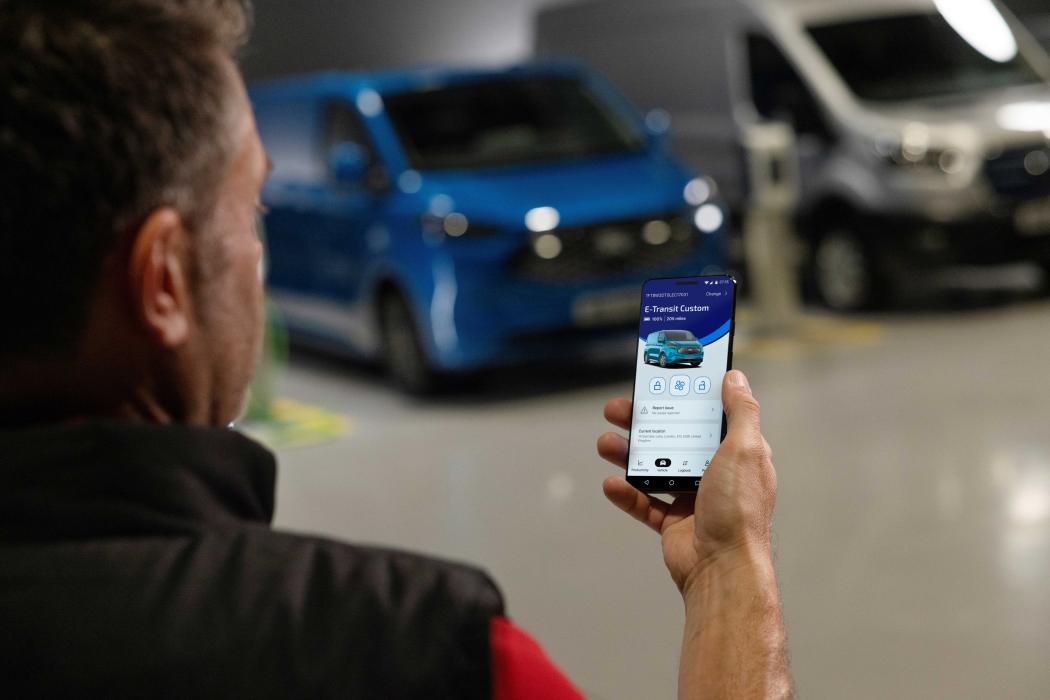
The commercial-vehicle manufacturer Ford Pro commissioned 3,000 van drivers and 150 fleet managers in Europe and the United States to survey the use of vehicle data, and found that more than a third of drivers and a quarter of fleet managers do not view the data from their connected vehicles on a daily basis. This leaves significant potential untapped.
"Data is also regarded as digital gold in the commercial-vehicle industry. The increasing collection and use of vehicle data is transforming the entire sector and driving it forward at the same time," the manufacturer outlines the problem.
In Europe, more than 29.5 million vans are on the road today. By 2028, most of them are expected to be equipped with modems, according to the forecast. However, companies would not come close to exploiting the optimization potentials enabled by data usage.
This results in squandered time and money, according to the manufacturer. According to the study “Knowledge Gap in Fleet Data: Much Potential for Productivity,” a lack of knowledge—especially in smaller companies—as well as concerns about data protection hinder efficient use of data from connected commercial vehicles or fleets.
The study provides indications to understand customers' attitudes toward data usage and their accompanying reluctance. Among respondents, deficits emerged especially in three areas:
- Value creation: Almost half of the van drivers (46 percent) and a quarter of fleet managers (25 percent) do not tap the potential of vehicle condition data in daily operations. They do not use it, for example, to plan upcoming maintenance — even though respondents place high priority on the good technical condition of their
- vehicles.
- Knowledge: Worldwide, less than a third (32 percent) of van drivers and a little more than half of fleet managers (57 percent) know "a lot" about how they can use telematics to save time and money. Among drivers of small businesses (one to ten vehicles), the share falls to one in ten of respondents.
- Privacy: 94 percent of van drivers and 97 percent of fleet managers express concerns about data privacy and data security.
Maintenance information
By daily analysis of the data that a modem-equipped vehicle can capture, fleet operators can be informed about potential maintenance or repair needs, the manufacturer advertises. An additional advantage: the authorized service workshop can order all required parts in advance based on the vehicle data.
In this way, downtime for workshop visits should be minimized and better planned. In addition, fleet managers can use services, for example from Ford Pro, to track the trips of their vans to optimize routing, receive real-time safety warnings, and conduct driver training. According to the provider's estimates, companies can reduce planned and unplanned stand times of vans by 60 percent through smarter vehicle maintenance and monitoring.
"The data of connected corporate vehicles are the key to managing fleets more efficiently. They essentially act as a fitness tracker for the fleet and help optimize the efficiency of both vehicles and drivers, since they provide both real-time updates and cumulative data for deeper analyses and broader operational insights," emphasizes Hans Schep, General Manager Ford Pro Europe.
The new study, in his view, shows a gap between the most experienced users who leverage the opportunities
of connected data and those who still rely exclusively on traditional management tools and do not tap the data's potential for time and cost savings. "As an industry, we must close this gap—and quickly," Schep appeals.
Connectivity drives the transformation
Connected vehicle data drive a rapid transformation across the entire commercial-vehicle sector in 2025. Berg Insight forecasts a strong rise in active fleet management systems in Europe from 16.3 million units in 2023 to an expected 27.6 million in 2028.
Ford Pro already provides software, charging, maintenance and financing solutions for commercial vehicles through which customers can optimize their fleet productivity. The commercial-vehicle specialist continues to expand its offering and customer base. In Q2 2025, the manufacturer increased the number of paying subscribers to almost 757,000, representing a 24 percent growth compared with the same period a year earlier.
Privacy concerns
Worldwide, 94 percent of van drivers and 97 percent of fleet managers express concerns about the privacy and security of their data. At the same time, the survey found that connected commercial vehicles enjoy the greatest trust compared with other data-collection software – more than mobile phones, laptops, passenger cars and household devices.
The provider had obtained ISO 27001 certification in 2025, the internationally recognized data-security standard. This confirms that the company effectively protects its customers' data and processes it securely. As a company as a whole, it does not sell customer data to third parties. In addition, it is the only manufacturer whose vehicles display on-screen an icon showing when a driver shares data.
"The automotive industry must better explain the true value
of data from connected vehicles," says Jeremy Gould, Director Ford Pro Intelligence Europe.
The study clearly shows that the described "gaps" exist particularly in small and medium-sized enterprises (SMEs). This finding is also worrying because a prior Ford Pro study published in cooperation with the Centre for Economic and Business Research (Cebr) had already found that SMEs account for around 99 percent of all businesses in Europe. With their vans, they contributed around one trillion euros to GDP across Europe in 2023.
"We give vehicle operators all the tools they need so that they can fully exploit the possibilities of connected data for their business," sums up Hans Schep.
Thus, the "Ford Pro Intelligence Platform" is to provide a comprehensive overview of fleet operations based on data collected from vehicle components, sensors, dashcams and charging devices for electric vehicles, Schep continues to outline.
Case study: How Lloyds British benefits from the Ford Pro Mobile Service
How companies can benefit is demonstrated by a practical example: The inspection and certification service provider Lloyds British operates a fleet of 70 Transit Custom vans in the United Kingdom. The company maintains fleet productivity using "Ford Pro Telematics Essentials" and ensures maximum uptime of the vehicles.
Its fleet managers would securely log into the vehicle system and could determine, from real-time data, which fleet vehicles needed service or repairs. For most maintenance or repairs, they can then use the provider's mobile service teams — at a time and place that suits their drivers. In this way, Lloyds British's fleet could save or avoid up to 60 days of downtime.