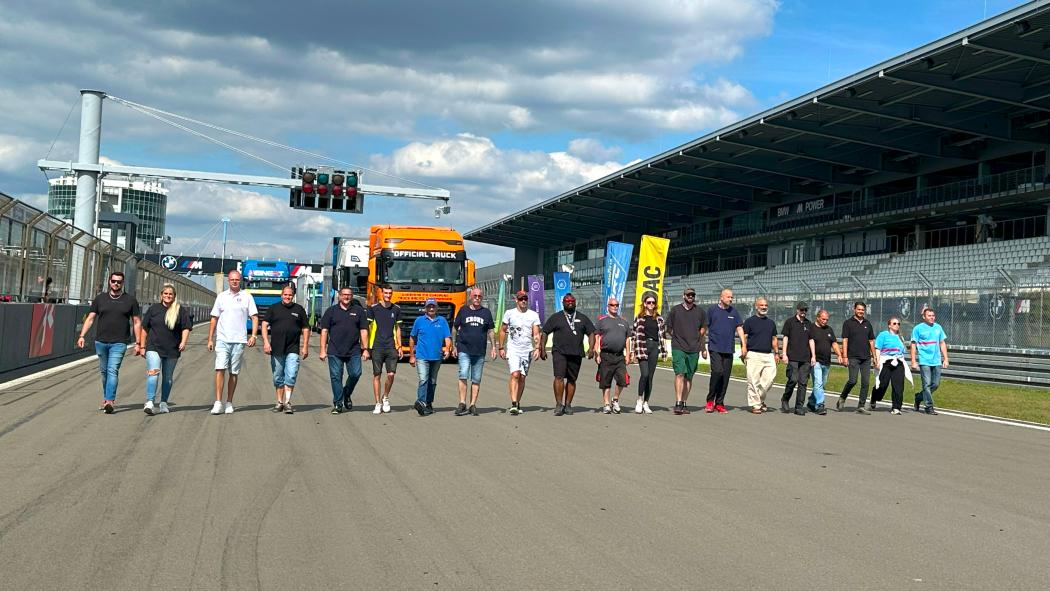
The annual Truck Grand Prix at the Nürburgring is famous for the contest of strength among the strongest trucks on the former Formula 1 track. But this summer motorsport event of the heavyweight class has, over time, become an attraction for truck fans in several respects. For example, around 60 commercial vehicle industry companies use the truck race as a platform to showcase their products in a kind of small trade fair.
The more than 130,000 visitors can, for instance, look forward to a selection of commercial vehicle tires and products related to the aftermarket. And an accompanying festival serves as a varied entertainment program for young and old. As a new type of competition, Krone Nutzfahrzeuge this year 2025 introduced its Truck Efficiency Run with truck semi-trailers. The successful premiere is reported by the Lower Saxony initiator in a press release. In addition, on the Eifel site, the performance of Krone's eTrailer was showcased, which is intended to represent a sustainable trailer technology.
Not strength and speed, but efficiency in focus
On the legendary race track this year, not only horsepower-powered tractors competed, but whole semi-trailers – however, the objective of the 40-tonner showcase is not speed. Trailer manufacturer Krone describes its Truck Efficiency Run as a “new kind of competition for truck drivers.” And describes its event on the website in the following words: “This is not about who is fastest – but who drives most efficiently.”
Thus, the focus is on the opposite of the skills required for
the traditional truck race. It is less about, under use of all forces, presence of mind and reaction speed, mastering an extraordinary race as the fastest; but with this kind of dexterity, professional drivers are required to make the everyday handling of the truck semi-trailer as mindful and as power- and fuel-saving as possible. Or in short, as it says in the YouTube video about the event: “Some goals are not reached with full throttle, but with brains.”
Thus, the vehicle brand should also not play a role – the focus is solely on the driver's ability. “How well do you use the potential of your truck?”, Krone puts it succinctly. On the event website, the purpose of the competition reads as follows:
“Each driver shows their skill and talent from daily professional life and how much strategy and precision are necessary to optimize consumption and to use the efficiency of their vehicle to the fullest. In doing so, each participant competes against the values of their own vehicle – brand comparisons are out.”
Participants from all over Germany
The first race in this framework was successfully conducted according to Krone's press release. The winners were each separately declared in the three drives Diesel, Gas and Electric. In the first category, diesel-substitute-powered tractor units with HVO (Hydrotreated Vegetable Oil) were allowed; in the second category, those powered by Bio-LNG, and in the third, electric vehicles with fuel cells.
Professionals from all over Germany came to the competition. Here, less emphasis is
placed on speed as in the racing competition; the aim is to reach the finish as energy- and fuel-efficient as possible through clever maneuvering with the tractor-trailer. The organizer summarizes: “Real efficiency is not only in the data sheet – but based on the interplay of driving style and technology.”
The venue for the semi-trailer competition as part of the Truck Grand Prix in mid-July 2025 was now the Nürburgring Nordschleife, also called the “Green Hell,” because the track is considered one of the most demanding in the world. At a length of exactly 24.358 kilometers there are more than 70 bends and a height difference of 300 meters to overcome. “The track remains the gold standard for vehicle and driver tests,” the competition's website states. “In the Truck Efficiency Run, it becomes a stage on which drivers must prove their skills in the real world – not with speed, but with skill, precision and efficiency under real conditions.”
Deliberate driving style counts
From the three drive types, as the most efficient drivers Colin Guppy of Hövelmann Logistik in the Diesel category, Lukasz Marszal of Reinert Logistics in the LNG category and Rolf Isermann von der DuvenbeckUnternehmensgruppe in the Elektro category were crowned as winners.
“All three impressed with a conscious, forward-looking driving style and demonstrated how much efficiency potential can be unleashed in everyday life – regardless of the vehicle or drive system used,”
reports Krone. What prompted the company to launch this new kind of competition is explained by
Simon Richenhagen, Marketing Director at Krone Trailer:
“With the Efficiency Run we wanted to show how transport efficiency can be measured under real conditions – and how decisive the person behind the wheel is.”
After all, technology alone is of no use without “experienced hands” capable of exploiting the potential of the vehicles. “The positive response confirmed to us: This topic is moving the industry exactly at the right time.”
Measured results were by the FIA (Fédération Internationale de l’Automobile), the international umbrella association of automobile clubs based in Paris. It states that, by combining the two areas of consistency and efficiency, a Performance Index was determined. In terms of consistency, a constant speed matters; in terms of efficiency, the actual consumption compared with the official manufacturer figures scores.
In addition to the actual competition, a special product drew attention on the track presented by the Werlte-based trailer manufacturer: the electrified eTrailer, which Krone developed in collaboration with Trailer Dynamics, also participated outside the scoring. This trailer supports any tractor regardless of propulsion by an e-axle that recovers braking energy via recuperation, and can thus, according to the provider, also contribute to saving power. Krone summarizes:
“When propulsion technology meets anticipatory driving, an efficiency potential emerges that already works today. Its saving potential, depending on the usage profile, between 40 and 50 percent of fuel, demonstrates impressively how intelligent trailer technology can significantly reduce CO2 emissions in freight transport.”
On the competition website and on YouTube there is a video of