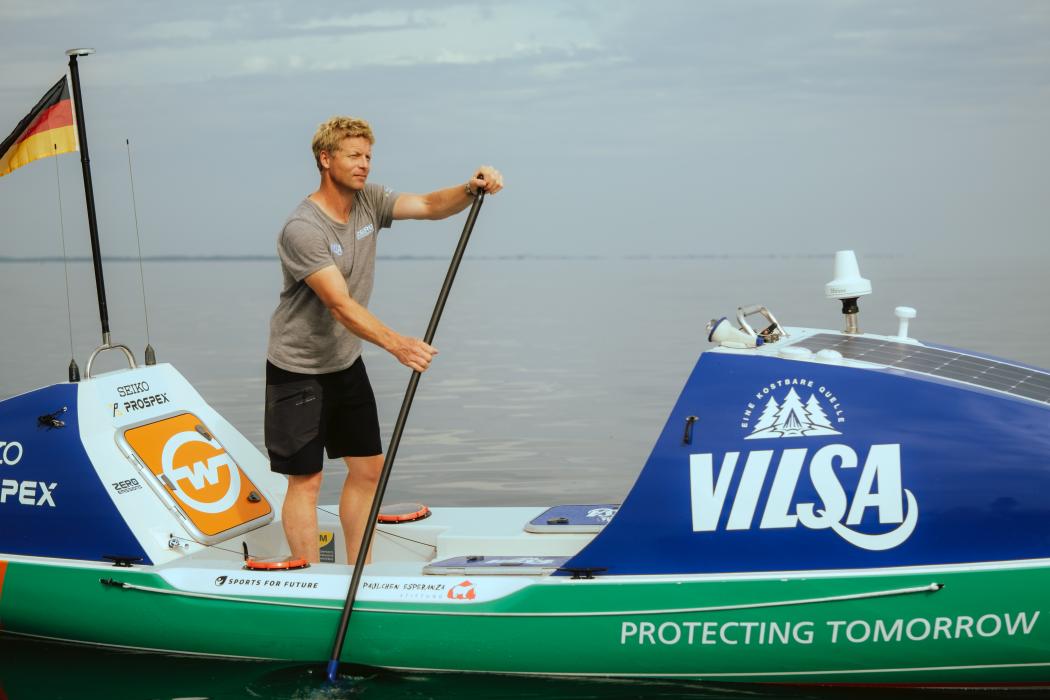
Michael Walther began an Atlantic crossing on a stand-up paddleboard over the weekend in Lagos, southern Portugal. The extreme athlete from Kiel intends to travel solo and without a support boat roughly 6,000 kilometers to French Guiana. The planned route runs via the Canary Islands and Cape Verde.
Expedition with a scientific approach
With his undertaking, Walther is aiming, according to Gebrüder Weiss, to draw attention to the consequences of
climate change for the world’s seas. At the same time, he collects scientific data for marine research. On board his specially designed board he carries, among other things, a hydrophone that records sounds from marine animals.
The board is modeled on the construction of offshore rowing boats and offers a sleeping area of about two square meters in the bow. The equipment includes about 200 kilograms of food, a liferaft,
a medical kit, and tools. For navigation Walther uses GPS, a chart plotter, a satellite phone, and a radio.
Logistical support by Gebrüder Weiss
Before the crossing could begin, Gebrüder Weiss organized the transport of the board from Germany to Portugal. The company has been supporting Walther for several months and takes on, in addition to logistical tasks, also communications measures around the project.
After completion of the crossing, Gebrüder
Weiss will bring the board back to Germany by sea freight. For this, the company states that it uses a certified insetting process, in which the CO2 emissions are not offset via external offset projects, but are reduced directly in the transport chain. Sustainable fuels are used.
Live tracking on the Internet
The progress of the Atlantic crossing can be tracked online. For this, live tracking is available at the


