On 17 and 18 September 2025, BG Verkehr, as the competent statutory accident insurance for the transport sector, together with the Prevention Section in Transport of the International Association for Social Security (IVSS), organized the industry conference "Training drivers – Gamechanger for Safety and Success." Occupational safety experts showed there how to design driver training so that it is not just a "dull compulsory event".Over 100 participants attended on site at the BG Verkehr headquarters in Hamburg, 110 more had registered for online participation.
More than just a compulsory event
Training/instructions are mandatory under Paragraph 12 of the Occupational Safety and Health Act, according to the organizers. But if they were to become a dull compulsory event, they could miss the objective.
„We must get closer to the employees again with the training“, demanded Wolfgang Witzke, chairman of the Representative Assembly of BG Verkehr and longtime trainer for drivers at the waste-management company Remondis at the end of the industry conference.
In many companies in the transport sector the topic is less popular. Usually the training obligation is fulfilled, but it is often treated by both the companies and the employees as a mere compulsory event.
Broad benefits
Martin Küppers, Head of Occupational Safety and Regulations at BG Verkehr, pointed to a fairly broad benefit also with regard to efficient work processes:
“Basically, it’s not only about safety and health, but
also about proper workflows, efficient working practices and behavior with the customer. All of these are core processes of every company. Safety and health are always part of it,” said Küppers.
With regard to the trainings, there are, however, a few challenges, for example the multilingualism of the profession and of the drivers. This makes knowledge transfer demanding.
Organizationally it is complex for long-distance transport companies to gather drivers at one location for a training. During the conference, several approaches were shown to overcome the problems:
Directly at the workplace
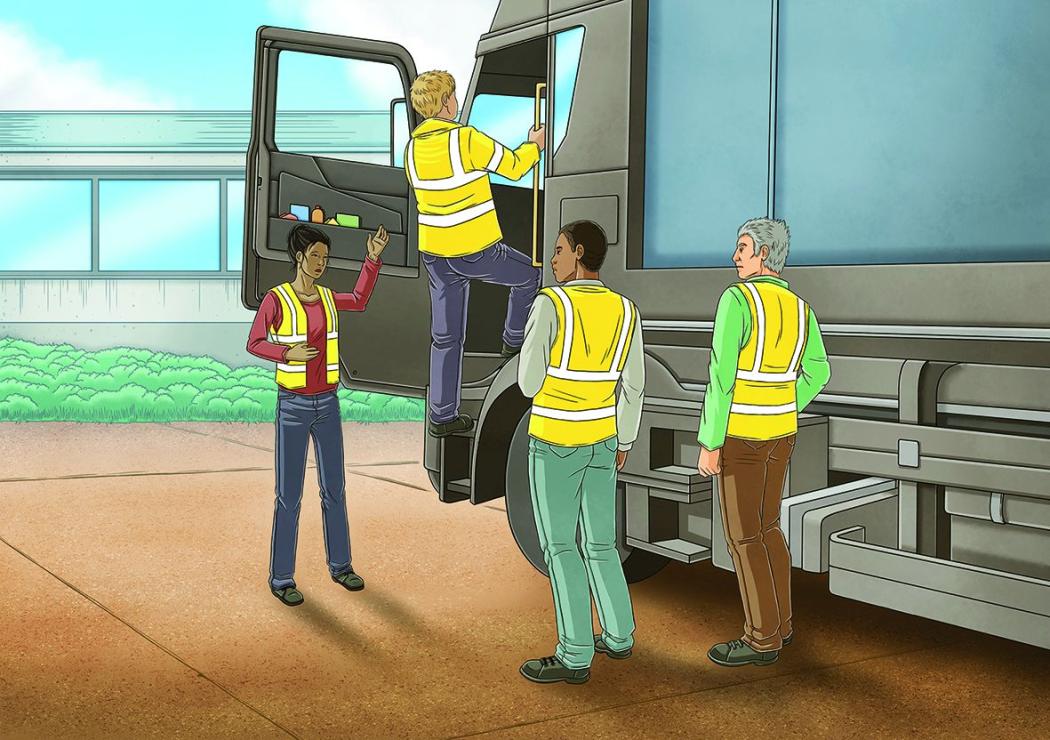
BG Verkehr recommends conducting the training at the workplace, thus for drivers mainly at the vehicle. The teaching method follows the motto “Explain, demonstrate, have them imitate.”
Right time and right place
Training sessions on Friday shortly before the end of the shift or on the otherwise non-working Saturday are rather unpopular among drivers and, according to the occupational safety experts, do not create a good learning atmosphere. If this is not possible otherwise, an attractive framework should be created, for example a joint meal or a subsequent company celebration.
Interactively train
According to the experts, training should offer the opportunity to ask questions. A learning-outcome assessment, whether written, oral or electronic, is also considered an interactive element.
Include one's own accident history
During the training there should be a link to one’s own work environment. This is provided when accidents
or near-misses from one’s own company become the subject of the training. It is advisable to train promptly after the incident.
Use technology
During the industry conference, several examples of effective use of technology were cited. For instance, the express delivery service provider Weinhut GmbH uses artificial intelligence (AI) to translate trainings into other languages. The forwarding company Ansorge works with a service provider using dashcams and AI to give their drivers feedback on selected driving situations. In addition, some companies use small learning programs on tablets for supplementary knowledge transfer on the go.
Use media correctly
Films are indeed a useful medium to support trainings. However, drivers should not be left to it alone, according to the occupational safety experts. At the industry conference Cemex Logistik GmbH showed what a modern training film could look like – the construction materials transport specialist company involves the influencer Sabrina ("Trucker-Babes").
BG Verkehr materials
BG Verkehr offers training for managers, safety professionals and safety officers of its member companies. On its website, free materials such as training cards and animation films are available for use in training.
Multilingual offerings
Drivers whose mother tongue is not German must understand the training, therefore AI can be used as translation assistance in some companies. Additionally, other employees who share the same mother tongue and who have been working longer in Germany could help as translators. To
improve understanding, explaining the work processes in the work environment (show, explain, have them imitate) and multilingual training media also help.
Provide thorough instruction
In order to safely operate the respective equipment, a detailed briefing is mandatory – whether it is a new vehicle, a driver assistance system used for the first time, or an unfamiliar forklift. With driver assistance systems, it is sometimes not clear how the systems operate and when they intervene. In addition to uncertainty and lack of acceptance, there could even be consequences of willfully deactivating the driver assistance system.
Hit the right tone
Andreas Drews from SVG Service and South Region Sales vividly stated that one should not always “rattle the coffin lid” at once. Excessive doom-mongering does not go over well, just as an overly admonishing tone or even a command tone. Because this could create a defensive attitude. The best approach is to present the message professionally, in a dialog-oriented and positive manner, the advice says.
The trainers are the key
At the conference it was also emphasized that those in leadership roles should act as role models. They are the key people for the success of the training. They should therefore not appear bored, irritated, or disinterested in the contents, because this would be disastrous for success. It is important to lead by example or, if necessary, to hire an occupational safety specialist