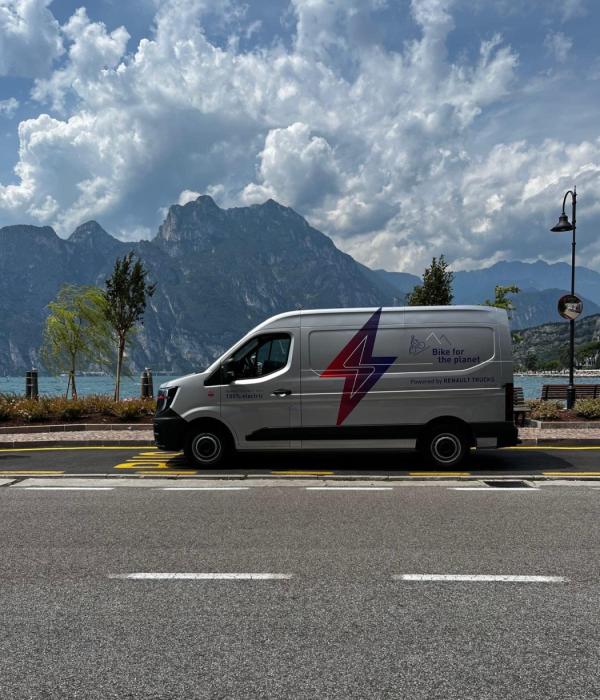
The Canadian fleet telematics provider Geotab has demonstrated in an analysis of over three million trips that the range significantly decreases with increasing speed, especially at summer temperatures around 30 °C and speeds between 80 and 130 km/h. At that point, air resistance plays a decisive role—far more than the air conditioning, according to the evaluation. For instance, an electric van with a 65 kWh battery can travel about 230 km at 80 km/h. At 97 km/h, it’s only 195 km, 166 km at 112 km/h, and barely 142 km at 128 km/h. This means almost 40 percent less range due to faster driving, summarize the telematics experts.
This effect is also seen in sedans, although somewhat less pronounced. The range decreases by about 28 percent at higher speeds, from 446 km at 80 km/h to 322 km at 128 km/h. This has a physical correlation: air resistance increases with the
square of the speed. Those who drive twice as fast face four times the air resistance and consequently consume much more energy—far more than an air conditioner.
"Drivers hesitate to turn on the air conditioning in warm weather. But our data shows that the greatest range losses are primarily caused by high speeds," explains Charlotte Argue, Senior Manager for Sustainability at Geotab. "Driving just 16 to 24 km/h slower can increase the range by more than 20 percent, depending on the vehicle."
Influence of the Air Conditioning at Low Speeds
In the summer, the influence of high temperatures is particularly apparent at low speeds when air resistance plays little role. In such situations, the constant energy demand of the air conditioning becomes more significant. The faster you drive, the less relevant the outside temperature becomes compared to the energy needed to maintain speed.
"Modern electric vehicles have ever larger batteries and
easily manage most everyday routes with a single charge, even in commercial use," adds Argue. "Nevertheless, the range, whether of electric or combustion vehicles, remains a dynamic value. It always depends on the temperature, route profile, traffic, and, of course, the driving style."
What Helps in the Summer: Increase Range Without Compromising Comfort:
- Reduce speed. Even small adjustments often bring significant improvements. In many vehicles, reducing the speed from 113 to 97 kilometers per hour can increase the range by 10-20 percent. In addition, speed limits should always be observed.
- Pre-cool the interior. Use the air conditioning while the vehicle is still plugged in. This relieves the car battery, keeping the range intact. Many cars can even be pre-cooled remotely via an app.
- Use the air conditioning efficiently. It is advisable to fully cool the interior first until the initial heat has dissipated. The air conditioning consumes about 20 times more
- energy than the ventilation, so the recirculation mode should mainly be used afterward. If available, a seat-only cooling can save more energy compared to cooling the entire interior.
- Drive gently. Use regeneration, avoid abrupt acceleration or heavy braking. If the level of regeneration can be adjusted manually, the highest possible setting should be chosen.
- Park in the shade. Vehicles should not be parked in direct sunlight if possible. Ideal parking spots for the summer are underground garages or parking garages, but trees or covered charging stations can also be good alternatives. Additionally, connecting to charging stations allows for cooling the battery and interior with energy from the grid.
- Avoid fast charging in the heat. Direct current fast charging (DCFC) can, especially in great heat, negatively affect battery life due to the combination of heat and high power. Therefore, if possible, electric car drivers should opt for slow and gentle charging at