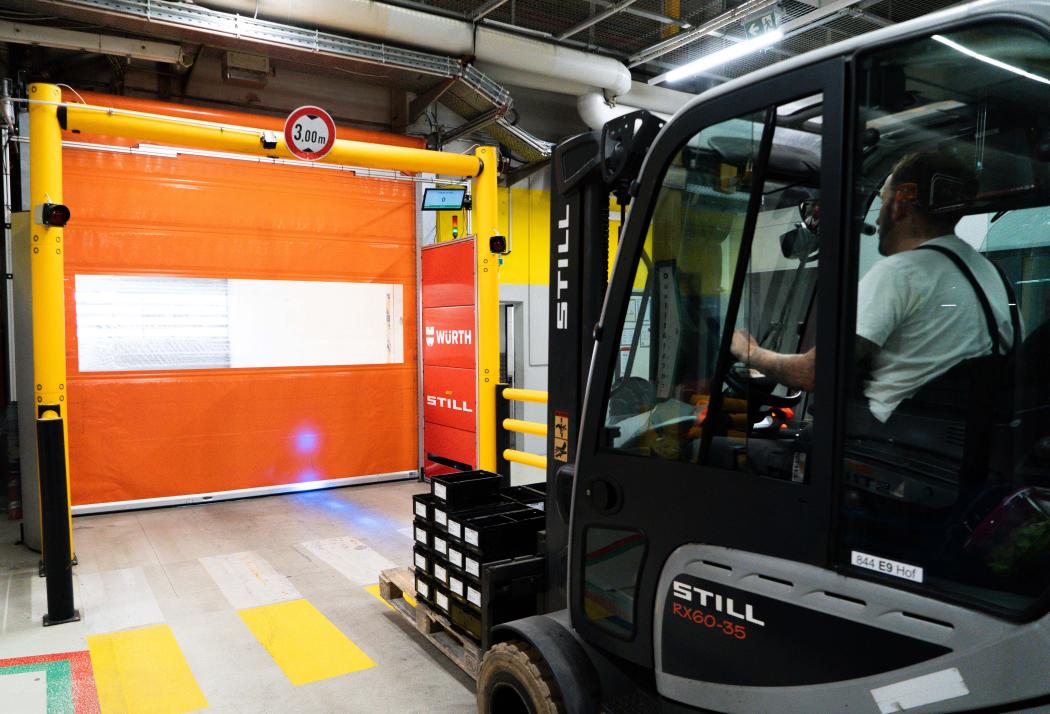
Still GmbH has been organizing the supply of fastening elements with Würth Industrie Service GmbH & Co. KG for many years. The Hamburg-based company develops and manufactures forklifts, storage and handling equipment, as well as networked systems for intralogistics. These products contain a large number of small components: screws, nuts, washers, wheel bolts, clamps or screw plugs.
Each of these parts serves a specific function, for example in wheel mounting or in the securing of lines. If such a part fails or is missing in assembly, it can disrupt the production process and, in the worst case, lead to delays in delivery.
The procurement of these so-called C-parts is regarded as challenging. They are inexpensive, but diverse, and their demand fluctuates frequently. At the same time, missing parts can lead to costly production stoppages. Those who order and manage these components manually invest a lot of time and are prone to errors. Still therefore sought a system that triggers replenishment automatically, keeps inventories transparent, and makes demand fluctuations visible in a timely manner.
Modular supply solutions for C-parts: From Kanban to the digital tool
Since 2010 the company has worked closely with Würth Industrie Service in this area. Würth specializes in C-parts management and offers
modular supply solutions that can be adapted to different production environments.
The partnership began with a classic Kanban system and has grown technically and organizationally over the years. Today Still uses several digital tools that automate and simplify the material flow.
A core building block is the RFID-supported Kanban system. Kanban containers are equipped with transponders that automatically report when their contents are running low. This eliminates manual order submissions. In 2020 Still additionally introduced Würth's “iPLACER.” This battery-powered module can be flexibly mounted at workplaces or shelves and autonomously triggers replenishment orders. Employees no longer have to initiate the replenishment themselves, but can focus on assembly and manufacturing.
RFID Gate “iGATE” records containers on material trains
For recording larger quantities of containers, since 2022 the so-called “iGATE” from Würth has been in use. The system is installed at a passage for material trains. When a train passes the gate, it can detect up to 100 Kanban containers simultaneously and automatically report them as empty. This eliminates the time-consuming manual scanning of each individual container.
Sensor-controlled scale “iSCALE” measures the weight of the small parts
In 2023 Still complemented its material provisioning with the iSCALE system. This is a sensor-controlled scale that is connected to
the Kanban container. It continuously measures the weight of the stored small parts. If stock falls below a defined value, a replenishment order is automatically triggered. This allows Still to detect fluctuations in consumption early and avoid bottlenecks. At the same time, manual stock-taking, which ties up a lot of time in traditional warehouse structures, is eliminated.
“CPS miDROPSHIP” Integrates partner companies into Kanban
In addition to these automation steps, the integration of external suppliers also plays a role. Through the system “CPS miDROPSHIP,” Würth directly integrates selected partner companies into Still’s existing Kanban system. These suppliers fill the Kanban containers in their own warehouses, equip them with the necessary labels, and deliver them directly to the Hamburg site. Würth takes over stocking the shelves there. In this way, parts not included in Würth’s portfolio can also be integrated into the digital supply chain.
Through the collaboration with Würth, Still aims to reduce the effort for purchasing and logistics, while increasing supply security and improving transparency about inventories. Automated replenishments and digital data capture save time and reduce the risk of stockouts. At the same time, the material flow can be adapted to fluctuating production needs without requiring additional storage space.
According to Michael Grosser,
who is responsible for C-part management at Still, automation has noticeable effects on daily work: needs are managed in a lean manner, orders run largely automatically, and the coordination effort declines. For production this means more predictability and fewer unplanned downtime.
Flexible supply chains, efficient inventory management, and careful resource use
The partnership between Still and Würth Industrie Service is designed for the long term. Würth provides its own team to support the KION Group, to which Still belongs, and develops the systems further together with the Hamburg-based manufacturer. Both companies are working to integrate digital technologies such as RFID and weight sensing even more into production logistics and to adapt the procurement of small parts to future requirements. This includes, for example, more flexible supply chains, more efficient inventory management, and careful use of resources.
Even beyond the collaboration with Würth, the Hamburg-based Still is strongly focused on digitalization and warehouse optimization—both for itself and for its customers: At LogiMAT, for example, a new control portal for forklift trucks and extended devices of the “Xcellence Line” were presented. In 2024, safety, process optimization, and sustainable battery solutions were the focus. With fuel cell production and refurbishing, Still also advances sustainable solutions. (Source: Würth, own


