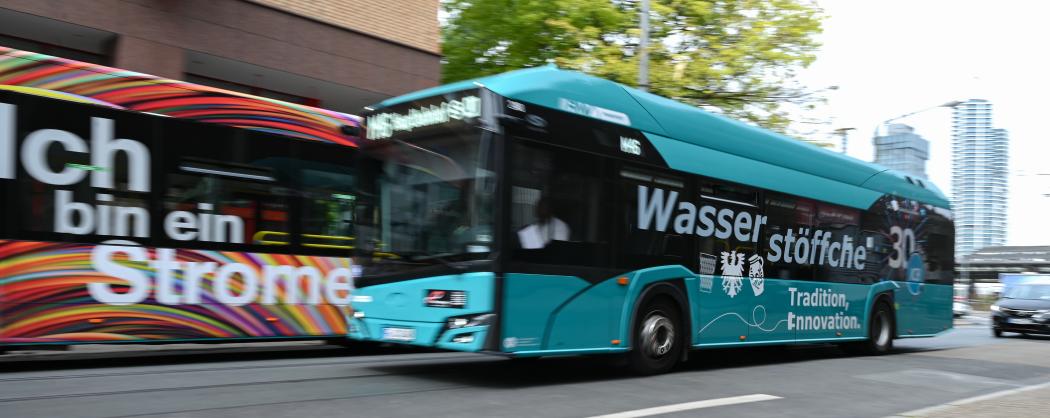
The city of Frankfurt is also pushing the expansion of public transport with city buses classified as emission-free. Numerous battery-operated versions are already shaping the cityscape. At the same time, the electromobile public transport is represented by a more expensive variant, where the electricity is generated from hydrogen in a fuel cell. Such hydrogen buses in the solo variant have been operating in the Main metropolis since 2022. Now, by the end of August, nine more of a new generation will be added – for the first time as articulated buses, funded by the state of Hesse with 2.3 million euros.
20-minute refueling time
As reported by the Landesdienst Hessen of the German Press Agency (dpa/lhe), as well as the operating company ICB itself, the 18-meter-long buses of the type Solaris Urbino 18 hydrogen with space for 113 passengers and a range of about 350 kilometers will be deployed on the heavily frequented Metrobus line M32 between Westbahnhof and Ostbahnhof. The savings potential in CO2: 95 tons per year, according to the operator. The refueling time at a hydrogen filling station is expected to be around 20 minutes – usually significantly shorter than the charging time for e-buses.
The Frankfurt route operation is organized by the local transport company Traffiq and the municipal bus company ICB. The latter will now extensively test the new fleet for technical
functionality before commissioning, but also scrutinize the safety equipment and the complex software architecture. For the overall concept, interior fittings were also developed in collaboration with partners: for example, the deliberately reduced color scheme and strong light-dark contrast are intended to improve orientation.
Bridging with diesel buses
According to its own information, ICB, which has been a Frankfurt bus company for 30 years and is a 100% subsidiary of Stadtwerke Frankfurt am Main Holding GmbH, operates 48 “locally emission-free vehicles” with the new articulated buses, with the number of hydrogen types even predominating: the company states 32 hydrogen and 16 battery versions. “This corresponds to more than 20 percent of the total fleet of around 220 vehicles.” The ambitious goal now is to completely switch the fleet to alternative drives “by the early 2030s”. To bridge the gap, ICB will “also deploy 52 diesel buses in the leasing operation”, with the plan being to use them from mid-2026 for a period of up to five years.
Transport Minister Kaweh Mansoori (SPD) commented on the motivation for using the generally more expensive and complex mobility variant, as early as June 2025 within the framework of the state initiative “Strom bewegt”, which was organized at the behest of the Hessian Ministry of Transport for the exchange on alternative drive technologies:
“Our aim is reliable, affordable, and sustainable public transport.
And the future cannot be envisioned without climate-friendly, innovative solutions. Currently, there are over 200 buses with various alternative drive technologies on Hesse's roads.”
Of these, according to Monsoori, over 90 percent are battery-electric and only a few operate on hydrogen. The benefit for citizens is seen in better air and less noise – “thus improving concrete living conditions, while people can still comfortably reach their destinations,” advocated the lawyer, who serves as Deputy Prime Minister and Hessian Minister for Economic Affairs, Energy, Transport, Housing, and Rural Areas and sits for the SPD in the Bundesrat. Experiences from all over Hesse have proven the practicality of both technologies.
Targeted funding programs
At the “Strom bewegt” event, it was also highlighted that Hesse is taking a leading role in this matter: further acquisitions of the mentioned type are supported through targeted funding programs by the Hessian Ministry of Transport. Within this framework, since 2017, 66 electric buses with batteries or fuel cells have already been put on the roads, and the establishment of 90 charging points and a hydrogen filling station has been supported with funds that interested municipalities and transport companies can apply for through Innovationsförderung Hessen. Regarding the costs: according to media reports, the ten solo hydrogen buses introduced in 2024 and operated in Frankfurt each required approximately 640,000 euros. As reported by the Frankfurter Rundschau
at the time, the Federal Ministry of Transport funded the 6.4 million euros acquisition with a total of 2.88 million euros.
While ICB quotes Mobility Councillor Wolfgang Siefert (Greens), that the bus model now being deployed is supposed to be brought onto the streets “in large parts of Frankfurt” by the end of 2030, according to a report by the Frankfurter Neue Presse, the politician opposed it due to high costs: a price of nine million euros is stated for the nine articulated buses.
So far, the trend towards e-buses seems not to change when choosing between these and hydrogen fuel-cell propulsion. The dpa reports the result of its own survey, according to which conventional battery-electric buses are widespread in Hessian cities, unlike hydrogen fuel-cell buses. Thus, the Darmstadt transport company HEAG Mobilo currently operates 54 e-buses, Kassel uses about 12, Offenbach 36. In Fulda, there are currently seven, with six more already ordered.
Hydrogen not always practical
Some also turn away from the technology based on their own experience. Wiesbaden has decided not to pursue the hydrogen bus strategy further. “Unfortunately, we had to recognize that the technology does not fit Wiesbaden under the given circumstances and have realigned the fleet strategy,” quotes the transport company ESWE. Nevertheless, there are about 120 battery-operated e-buses in operation there – and, for some months now, an e-articulated bus