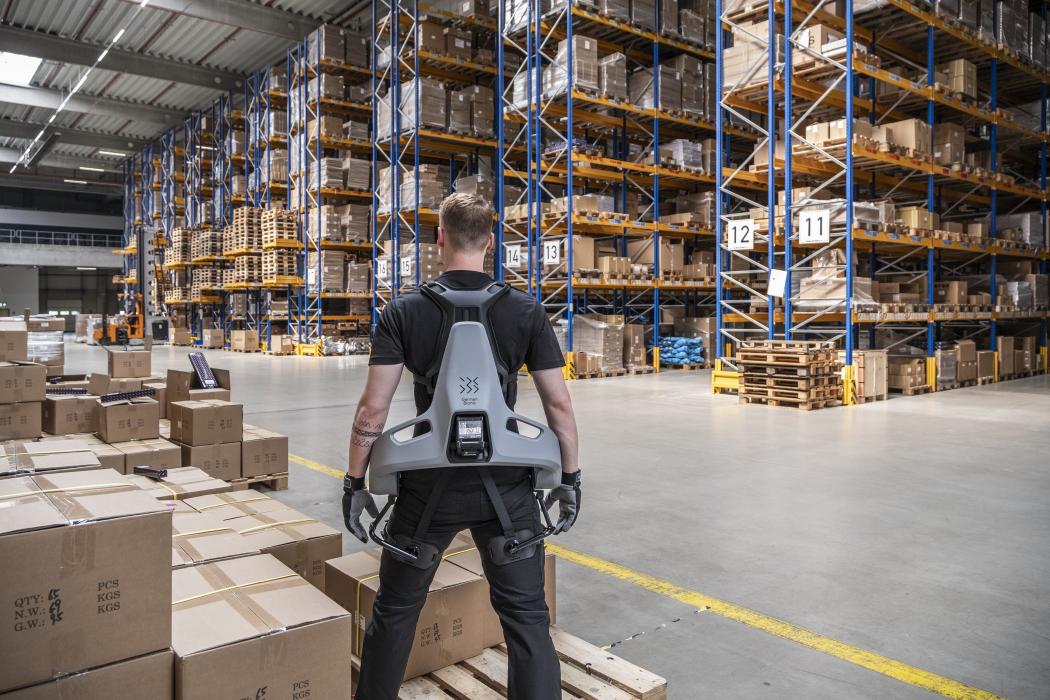
Musculoskeletal disorders – particularly injuries caused by heavy lifting and repeated strain – among employed individuals in the EU lead to productivity losses of up to two percent of the gross domestic product, according to an Elsevier study. The demographic shift is also straining the labor market. According to forecasts by the EU Commission, Europe's working-age population will decrease from 265 million in 2022 to 258 million in 2030. Exoskeletons, wearable robots, are intended to help make physically challenging tasks less burdensome and prone to injury in this context.
The Augsburg robotics company German Bionic recently unveiled its exoskeleton model "Exia," which, according to the manufacturer, is fully controlled by Augmented AI, meaning complementary Artificial Intelligence. It was developed based on
billions of real application data from industry, manufacturing, logistics, airports, retail, and healthcare. The Exia is designed as a universal solution and can be flexibly used in almost any work environment – including logistics. It is said to provide exoskeleton support with up to 38 kilograms of dynamic relief.
“The Exia is groundbreaking in the field of Human Augmentation,” says Armin G. Schmidt, CEO and co-founder of German Bionic. “Our technology is based on years of development work, the experiences of all the many workers who are already working with our technology, and also on billions of data points from real working life. The Exia does not simply react, nor does it only think along."
Precise support thanks to application data
The Exia is intelligent from the start, as it is based on extensive data from different real work situations, according to the provider. Therefore, it recognizes how people individually and in the context of their specific tasks lift, carry, bend, and move, according to the company. This practical knowledge is supposed to enable precise support from the very first use. Furthermore, the AI-native architecture and over-the-air updates form the basis for the Exia to continuously learn more, according to German Bionic. With each use, the exoskeleton is supposed to become more precise and effective, tailoring its behavior more finely to the conditions in the job and the people who perform it.
The digital backbone of the application includes, among others, the
"Smart Safety Companion," a digital twin that is supposed to recognize risky movements in real-time and promote safe behavior. The "German Bionic Connect App," according to the provider, allows users to control personal device settings via smartphone, retrieve analyses, and use coaching playfully. The cloud-based analysis platform "German Bionic IO" provides ergonomic insights through an intuitively operable dashboard and enables monitoring of activities and fleet management.
All exoskeletons are complemented by the "German Bionic Connect App," which has been further developed. It is available for iOS and Android and provides detailed performance data, such as the number of steps taken, weight lifted, and usage time, according to the provider. Through a bidirectional communication channel, the app enables direct feedback and qualitative