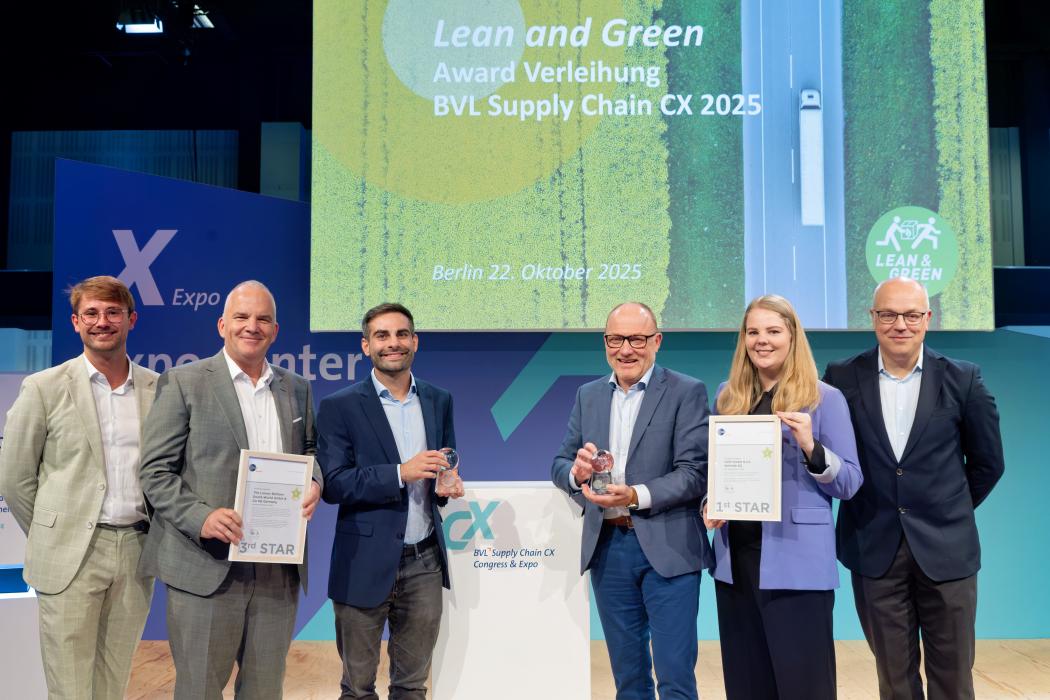
At this year's Supply Chain CX, GS1 Germany, as host of the Lean and Green Initiative in Germany, awarded Lorenz and Hipp on October 22 for their CO2 reduction in warehousing and logistics processes. Lorenz received, according to a press release, the Lean and Green 3rd Star, Hipp was honored with the Lean and Green 1st Star.
The Lean and Green Initiative aims to help companies systematically reduce logistics-related greenhouse gas emissions. The basis for the award consists of documented measures and results verified by the SGS Institute Fresenius.
Lorenz: 3rd Star for a 38.49 percent CO2 reduction
Through the consistent optimization of its supply chain and energy processes, Lorenz has reduced its CO2 emissions since 2014 by 38.49 percent. This success is based on targeted measures in the core areas of transport efficiency, warehouse logistics, and energy management.
- Efficiency gain in transport: The company achieves higher utilization
- of load carriers by switching to CCG2 pallets and increasing the number of pallet layers. At the same time, Lorenz reduced transport frequency while maintaining constant volume and selectively deployed Type 3 long trucks for relocations to further increase efficiency.
- Newly oriented warehouse logistics: As part of a strategic adjustment, Lorenz changes the supply to central warehouses for selected customers. A deliberately reduced delivery frequency optimizes route planning and reduces resource use, while supply security remains guaranteed at all times.
- Sustainable energy management: At the Neunburg vorm Wald production site, the procurement of certified green electricity ensures a climate-friendly energy supply. In addition, the company optimized natural gas consumption, thereby making another contribution to emissions reductions.
In addition, Lorenz has engaged in social and ecological projects to achieve the Lean and Green 3rd Star, including fundraising campaigns for Ukraine, regular support of local food banks, support for small
farmers and women in cashew production in Mozambique, biodiversity promotion at production sites, and collaboration with the Plastic Bank in Egypt to prevent marine plastic.
Stefan Bender, Head of Logistics at Lorenz, explains:
„The award is a confirmation and an incentive for us at the same time. Sustainability is a fixed part of our corporate strategy. In logistics we will continue along this path consistently. That we were able to achieve this goal is thanks to the close cooperation with our customers and logistics partners. Together we will continue to work in the future to make our supply chain even more efficient and climate-friendly.”
Hipp: 1st Star for 25.9 percent CO2 reduction
Hipp can also celebrate a success in the initiative. In its first year as a Lean and Green participant, the company achieved a CO2 reduction of 25.9 percent compared with the baseline year 2020 and thus
secured the 1st Star. The key levers for this saving were:
- Strategic site consolidation: By centralizing warehouse logistics from eleven sites to three strategic locations, Hipp significantly shortens transport routes and reduces the associated vehicle kilometres.
- Switch to renewable energy: The complete conversion of the warehouse sites to certified green electricity from hydropower eliminates emissions from electricity consumption and is a central building block of the sustainability strategy.
- Electrification of intralogistics: Replacing gas-powered forklifts with modern, electrically operated floor-standing handling equipment lowers emissions on site. In addition, the company optimized internal shuttle transports to increase overall efficiency.
- Efficiency in the transport network: Intelligent route planning combined with targeted modernization of the vehicle fleets at contracted transport service providers also significantly contributes to emission reductions.
Anna Ostermeier, Head of Export Logistics and International Order Management at Hipp, says:
„The achieved results show that investments in sustainability also pay off