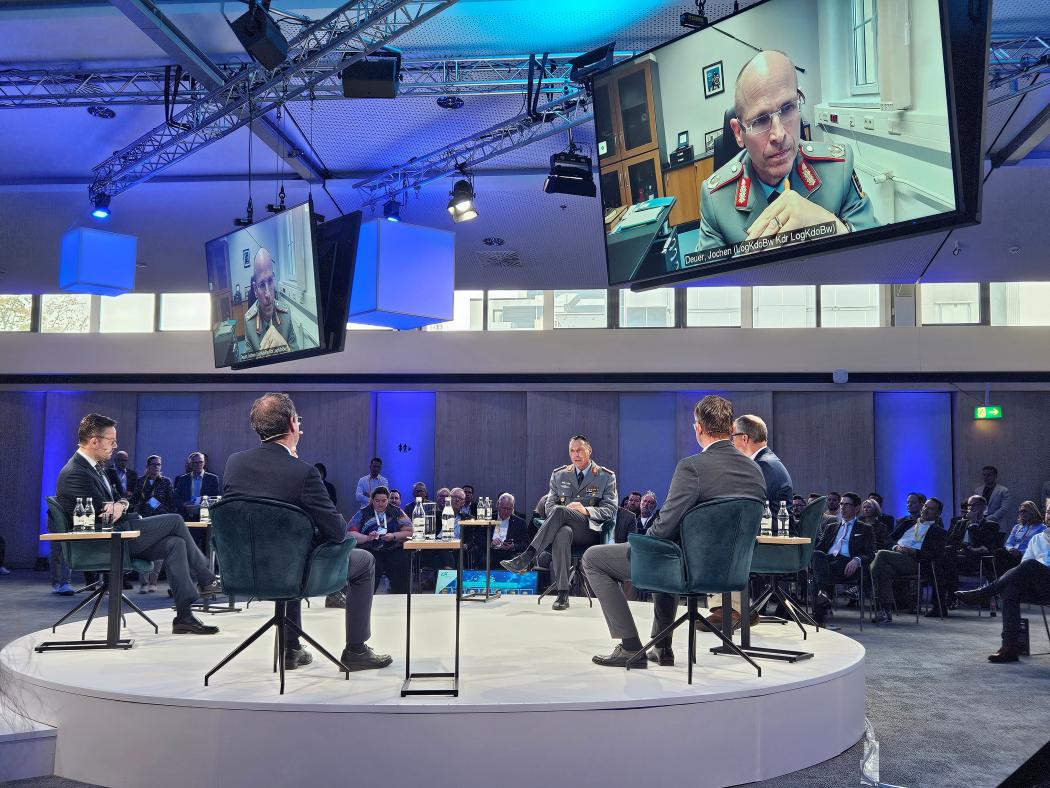
“Military meets Civilian: From the turning point to the gold rush?” asked on October 23 at the BVL Supply Chain CX 2025 in Berlin a newly launched networking forum for stronger logistics cooperation. “We want in times when combat readiness and credible deterrence gain importance, to increase mutual understanding,” explained Kai Althoff, Chairman of the Board of the Bundesvereinigung Logistik, at the outset. Central question: What is needed so that logistics service providers and the Bundeswehr as customer and client understand each other and perhaps also do business?
Fault-tolerant Logistics Systems
Generalmajor Jochen Deuer, Commander of the Bundeswehr Logistics Command, introduced in a keynote to the changed security situation. According to him, the Bundeswehr must adapt equally to national and alliance defense as well as international conflict management, while it possesses a clearly reduced troop strength compared with the Cold War era.
“We
have a compelling need to expand in logistics as well, and civil-law service providers are urgently needed,” said Deuer.
The logistics spectrum spans the Bundeswehr broadly, including procurement and maintenance as well as transport and storage. In any case, important: “The system must not fail, it must also function at 100 percent in a crisis. That is sometimes a problem with civilian providers,” said Deuer.
Not the price decides the award
“The price is often not the decisive factor for the purchase decision of a system or a service,” said Peter Scheid, Head of Services and Procurement at the Federal Office for Infrastructure, Environmental Protection and Services of the Bundeswehr. More important are, besides the short-term high availability of the services, security criteria such as, for example, that there is a security officer for classified information in the company providing the service. For
logistics service providers interested in the Bundeswehr as client, the path currently still necessarily goes via the awarding platform, as Peter Glück knows.
The director at the Federal Office for Equipment, Information Technology and Utilization of the Bundeswehr advised for the first contact to look out for concrete tenders. “Much of what we must necessarily tender,” he said in Berlin. Glück, however, expects effects from the BwPBBG Planning and Procurement Acceleration Act, which is currently being amended and is set to come into force at the beginning of 2026. It relates to all areas of the Bundeswehr, both military and civilian, and also provides for direct awards—and the possibility to adjust existing contracts faster than before.
“The dialogue with potential service providers is important to us,” emphasized Brigadier General Matthias Jozwiak, DCOS Support at the Operational Command of the Bundeswehr. In addition to
self-initiated networking meetings, they also rely on discussion rounds like these to draw attention to themselves as a client. He explained the rising logistics need also from the “Operations Plan Germany,” which is intended to ensure defense capability for land and alliance within the NATO plan. “Germany takes on a multitude of functions therein, among them that of a hub for troop movements of alliance partners,” said Jozwiak.
Michael Quaden, Program Director Defense Solutions at Fiege, and Klaus Lübbers, Member of the Management Board & Head of Defense Solutions at the Dirks Group, reported on their experience with the client Bundeswehr. “Some of the entry criteria are partly hard to meet,” said Quaden with regard to the security requirements. “Redeploying models to other industries is difficult at the Bundeswehr,” described Lübbers. “We cannot do many things 1:1 as for example in the automotive