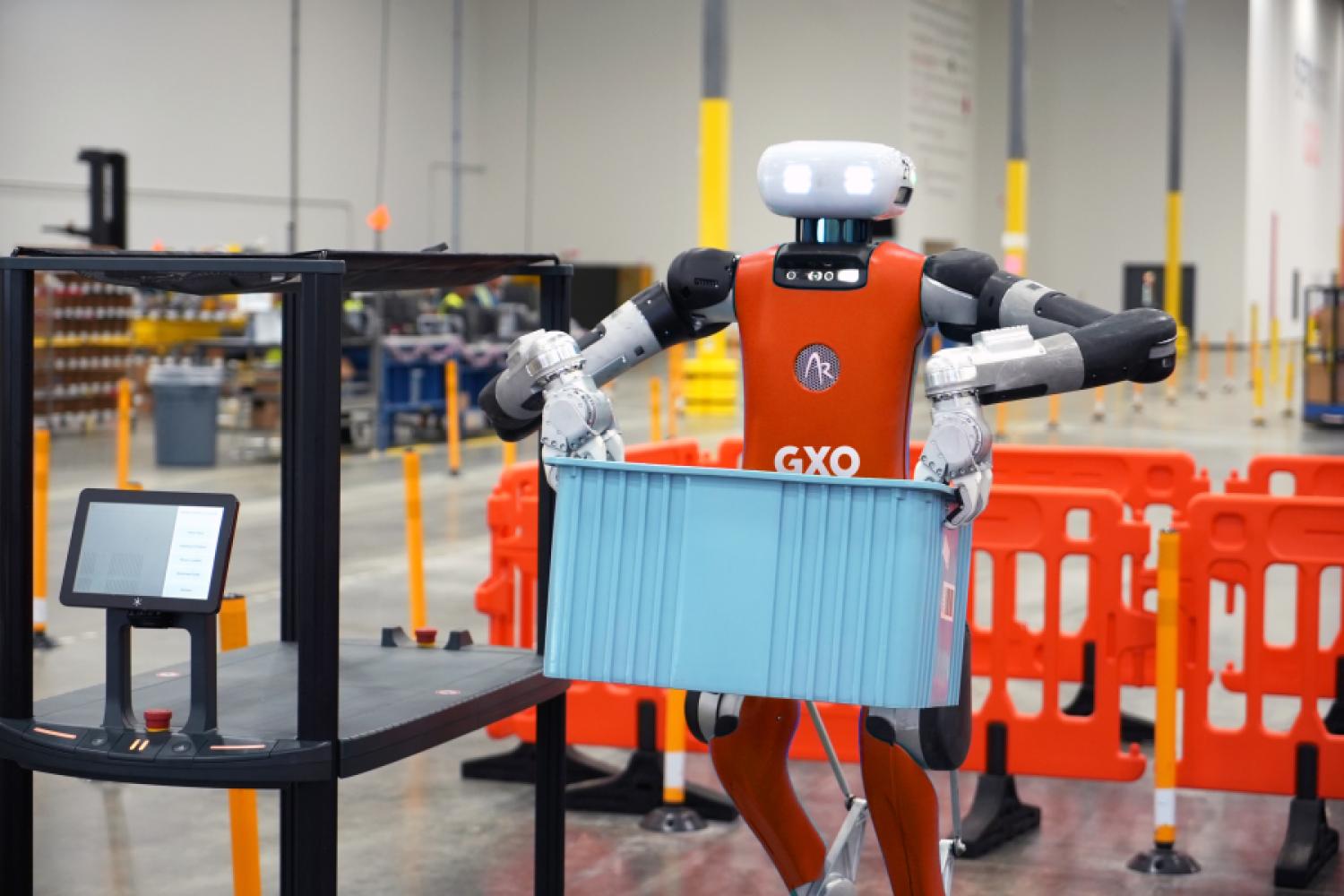
An expert panel had set its sights on the "State of European Robotics & AI" at the BVL Supply Chain CX 2025 in Berlin. The event on the congress Wednesday was moderated by Prof. Dr. Thorsten Schmidt, director of the institute at the Technical University of Dresden.
Kacper Nowicki, co-founder and CEO of the "AI Brain for Robots" provider Nomagic, posed the question why technically possible scenarios such as order-picking robots are still rarely implemented in warehouse logistics reality.
“The high complexity in warehouses with hundreds of thousands of SKUs makes further automation difficult, and for the different tasks a multitude of systems are also used,” said Nowicki.
For a profitable business case for deploying cognitive robotics to emerge, improvements in reliability, speed and the cost of the different systems are needed. The developments in
the controlling AI software and the dexterity of the robot hardware are moving in that direction.
Technology Aligned with the Customer Experience
Leah Holding, COO at Ocado Intelligent Automation, reported on the automation experiences of the British online grocery retailer:
“When we started 25 years ago, we decided to align the technology with the customer experience. With the machine-learning applications that were available on the market at that time, it was difficult to map that,” explained Holding.
Thus, Ocado decided to develop its own technological approach with corresponding software. “We have integrated our knowledge of AI into customised fulfilment engines,” said Holding. The provider now uses more than 100 different AI applications, for example operating picking robots directly in a compact warehouse.
Europe Must Catch Up
“AI needs a body and thus the corresponding training,”
explained Dr. Alexander Blass, Vice President of Strategy at Neura Robotics, a challenge for cognitive robotics. Humanoid robots, which are to operate within their task profiles, must first, for example, practise walking and require a substantial amount of data. Neura offers training in the physical "Neura Gym" to generate this data, where companies can train humanoid robots for their intended tasks with support from the Neura platform. Blass also urged European companies to engage more in developing the technology to avoid losing touch with players like China, which aims to bring 40,000,000 humanoid robots into operation by 2030.
“At the moment we are not far behind, but if we do not act quickly, given the speed of development we could be completely left behind in two years,” Blass said.
Marina Tiepermann, Vice President International Key
Account Management at Still, provided insights into the Kion Group's cooperation with chip manufacturer Nvidia on its "Mega Omniverse." Looking ahead, Kion aims to use this, among other things, for the virtual training of FTS fleets.
“For this we are building 3D digital twins of warehouses, in which various deployment scenarios can be simulated in real time,” Tiepermann explained of a project that is currently in the pilot stage.
Also in the context of controlling forklift trucks, a lot is already possible in terms of AI, but there are also significant blockers: “The safety level achieved in AI-based autonomous control is not yet sufficient for our standards. At the same time, it is difficult to obtain a sufficient amount of training data for AI models, as warehouse data are usually not publicly accessible,” said Tiepermann.