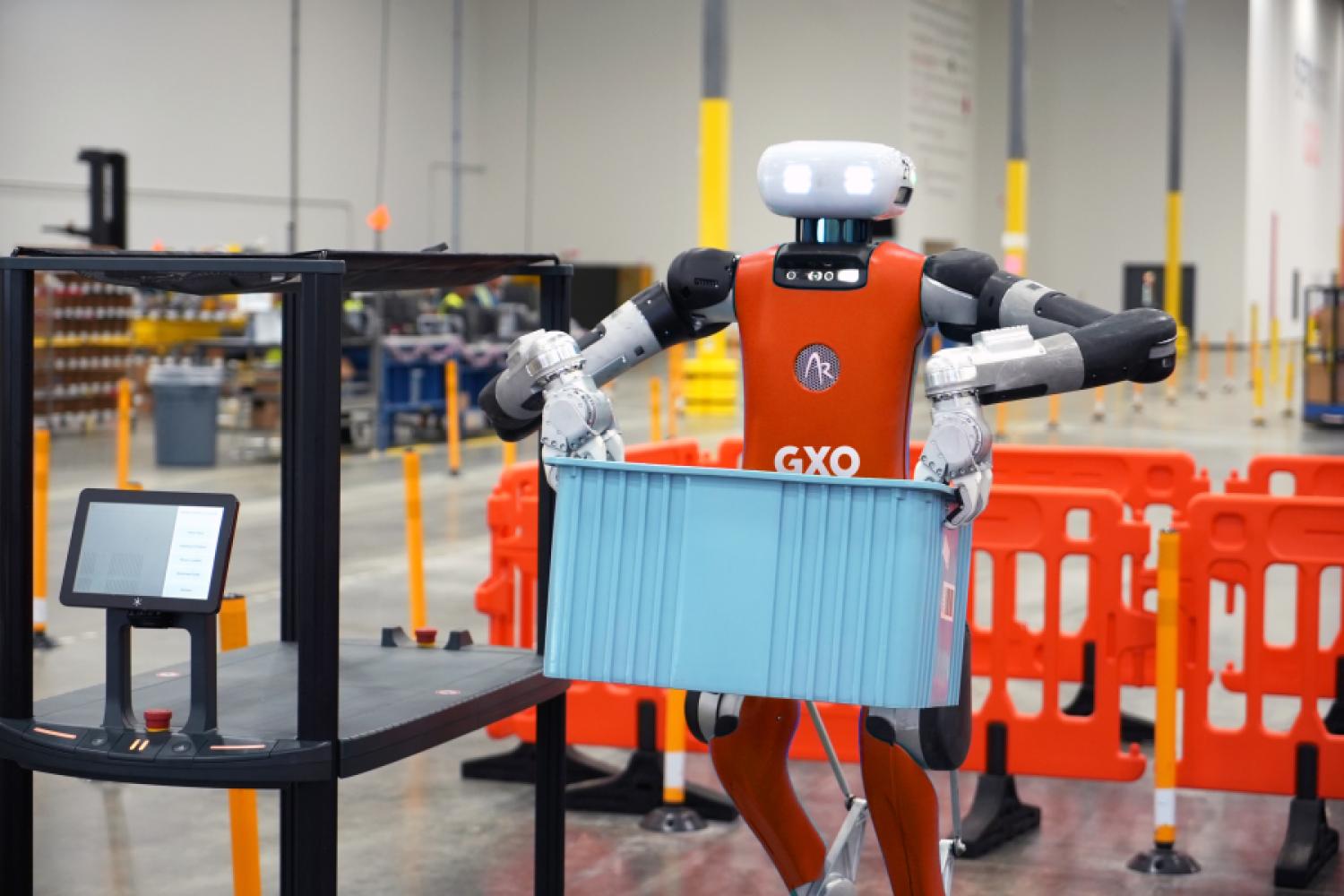
The Stuttgart-based embodied-AI specialist Sereact announced the introduction of "Cortex," an AI model that is used in more than 100 industrial applications worldwide. Cortex offers companies in logistics and manufacturing a universal AI that controls robot arms, mobile manipulators, and humanoid robots with zero-shot autonomy, according to a press release dated September 29. The model is said to be based on real industrial datasets and to enable fast, flexible automation without location-specific training.
Sereact is rolling out Cortex as a generally applicable AI for robots, which, according to the company, is based on extensive real-world data from logistics and manufacturing. Cortex is already in operation
in over 100 productive installations, including at Daimler Truck, BMW Group, Rohlik Group, Bol, MS Direct, and Austrian Post. The system is supposed to deliver production-ready performance within hours, without location-specific tuning or additional programming required.
"With our technology, robots operate situationally rather than following rigidly programmed procedures. They adapt in real time to dynamic tasks," says Ralf Gulde, co-founder and CEO of Sereact.
Core Principles and Typical Use Cases
Cortex, according to Sereact, is a general AI model for industrial robots that combines vision, language, and movement. Instead of coding tasks step by step, operators formulate goals in natural language – for example, "Clear
the container and sort by size." Cortex interprets the scene, plans the task, and executes it safely and precisely. This is intended to lower the entry barrier for teams on the shop floor and shorten the time to productive use. The basis is said to be a Vision Language Action Model (VLAM), which links visual perception with language and controls the robot's movements, according to the provider.
The application areas range from picking and sorting to controlled placement to automated fault handling in unstructured cells. Returns should also be processed more economically, because Cortex automates identification, condition inspection, sorting, conditioning, and repacking.
Fast Start, Robust
Operations, Easy Operation
A central feature, according to Sereact, is zero-shot autonomy: Cortex operates production-ready without per-site fine-tuning and without SKU scripting. This should shorten project timelines and reduce integration effort. In practice, according to the provider, robustness is particularly evident when things get messy: the system has learned strategies to handle slips, drops, deformable objects, reflections, and occlusions. This resilience results from a training base that does not primarily come from simulations, but from data from real factory and warehouse environments: RGB, depth and stereo image data, robot states, teleoperated and autonomous episodes, human annotations, VLM instructions, as well as error and recovery histories.