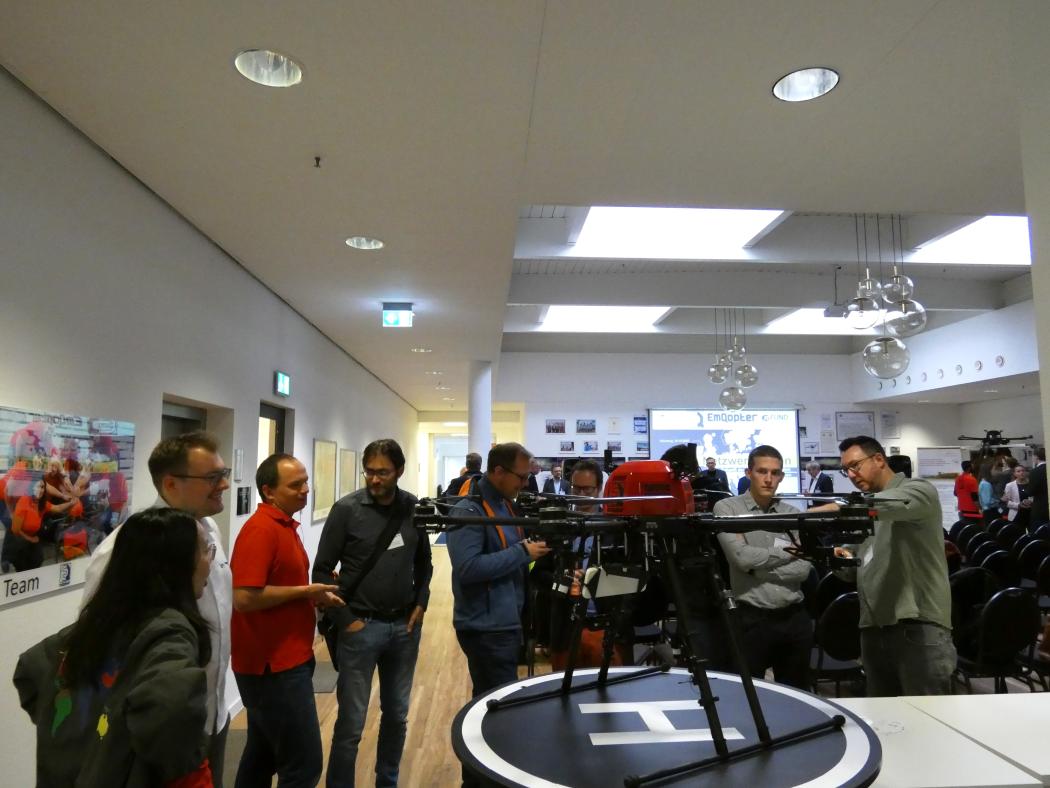
On 16 October 2025, at the premises of drone manufacturer Emqopter in Würzburg, the first drone networking meeting of the Federal Ministry of Transport (BMV) as part of the mFUND accompanying research took place. This was reported by a press release dated 16 October. Under the motto “Experiencing innovations live,” more than 100 industry visitors from politics, science, business and the Bundeswehr gathered to discuss the latest developments, opportunities and challenges of unmanned aviation.
Drones in Integrating into Existing Structures
Integrating drones into existing structures was at the center of attention, focusing on how drone technologies—from urban air mobility to use in transport and logistics to monitoring and inspection applications—can be integrated safely, efficiently, and sustainably into existing frameworks.
After a welcome by Dr. Jan Dirks, policy official at the BMV, and by Dr. Nils Gageik, managing director of Emqopter GmbH, several keynote talks
offered a practical insight into current projects and research results.
The first keynote presentations of the day dealt with the topic “Drones for Transport and Logistics.” Michael Witting Schipper from Hamburg Aviation and Lukas Ostermann from Karl Koerschulte GmbH presented a blueprint for drone traffic management. Subsequently, Fabian Baader from Fly-Xdrive explained the central role that drones can play in the transport of medical goods. Marvin Bihl, commercial managing director of Emqopter GmbH, illustrated in his talk how artificial intelligence as a key technology can decisively advance the autonomy of drones.
Drones for Monitoring and Inspection
After a short networking break, the second round of keynote talks began with a focus on monitoring and inspection through drone technology.
Katrin Birgy from DHL/European Air Transport Leipzig opened with a contribution on drone-based inspection of aircraft. Following this, Andreas Hecker from the Technical University of Dresden
presented the topic “Drone Flights Beyond Visual Line of Sight” (BVLOS). The closing was provided by Mirco Alpen from the Helmut Schmidt University (HSU) of the Bundeswehr Hamburg, who presented the use of drones for technical inspection.
Particularly notable, according to the press release, were the live demonstrations of modern drone systems and current research projects, which offered space for professional exchange and new networking opportunities. The presentation of the drone port on the roof of Emqopter’s company headquarters was well received by the audience.
Also of great interest were the projects DNeD and MISDRO, which arose from close collaboration between Emqopter and the Helmut Schmidt University – University of the Bundeswehr Hamburg. Both projects develop concrete applications for the use of drone technology in the Bundeswehr environment. While DNeD targets autonomous inspection of high-voltage lines, MISDRO focuses on automated bridge inspection to detect
stability problems and damage. Both endeavors provide important insights for the so-called dual-use environment, i.e., the combined civilian and military use of unmanned aerial systems.
At the center of the event was the mFUND project ISEKIS, a collaborative project by Emqopter, Swift and RWTH Aachen, which deals with GPS-independent autonomous navigation. Its aim is to detect material fatigue and possible failures early, enable preventive maintenance measures, and, using a flight data recorder, provide revision-safe documentation of the AI’s operation as well as potential hardware or operator errors.
The meeting underscored how large the potential of unmanned aviation is for the economy and society, and how important close cooperation among all actors remains to harmonize innovation, safety and sustainability.
With events like the network meeting, the BMV has made it a priority to set impulses for knowledge transfer and the future of mobility within the


