The European Packaging and Packaging Waste Regulation (PPWR) brings new requirements along the entire supply chain. The goal is to avoid packaging waste, better recycle materials, and significantly increase the proportion of recyclable and bio-based materials. For many companies, this means rethinking existing packaging solutions, adjusting processes, and finding alternatives.
Coplax Verpackungen AG from Zug presents five current customer examples with proven solutions that demonstrate how demanding packaging tasks can be solved sustainably and efficiently. The company relies on cardboard instead of plastic and combines robust materials with intelligent construction. The focus is on creating functional packaging that meets both ecological and economic requirements.
Modular Cardboard Solution with Corrosion Protection
An automotive supplier was searching for a packaging solution for a newly developed machine component that is sensitive to abrasion and corrosion. The requirements included high product protection, environmental compatibility, cost efficiency, maximum space utilization, and suitability for automated filling by robots. Coplax developed a reusable transport packaging made of corrugated and gray cardboard in close coordination with the customer. The solution is stackable and features removable single-use grid compartments that can be flexibly adapted to different component sizes. Elements from VCI corrosion protection paper were integrated to protect against corrosion. An ultra-thin PE film minimizes potential abrasion, while a welded aluminum composite hood reliably protects the component against moisture during storage and transport. The result is
a well-thought-out, modular packaging solution that combines high protection with sustainable materials and process-optimized handling.
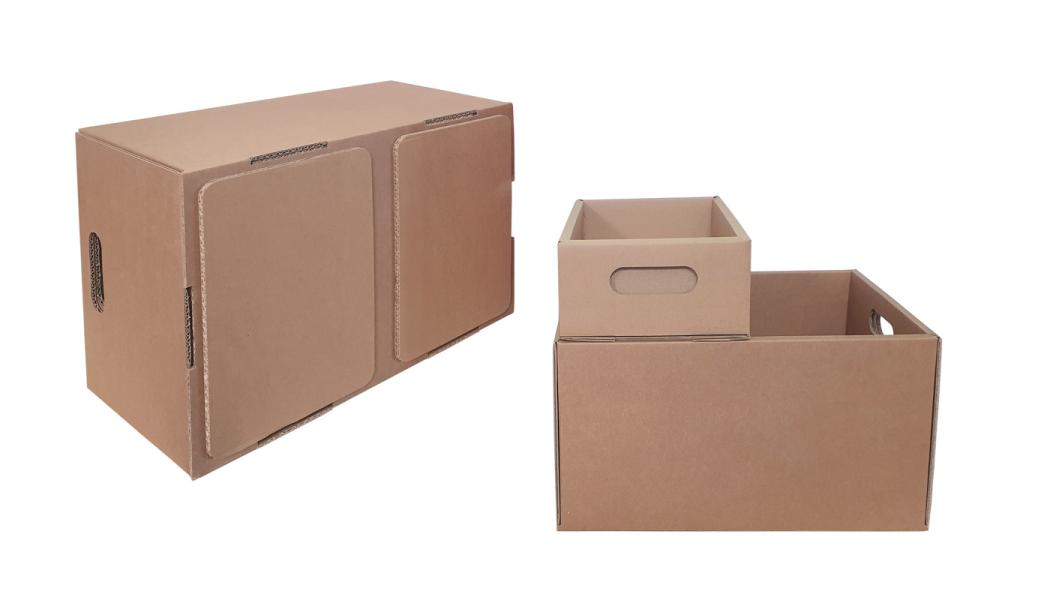
Cardboard Euro Boxes as an Alternative to Plastic KLT Containers
A company from the machinery and plant engineering sector was looking for a sustainable solution for storing and keeping small parts, individual parts, and semi-finished products. The goal was to replace the previously used plastic Euro boxes with a more environmentally friendly cardboard variant without compromising key requirements such as stability, transport safety, and stackability. Moreover, the new solution had to be cost-effective and seamlessly integrate into existing logistics and handling processes since cardboard and plastic boxes should be used in parallel. Coplax then developed a packaging solution made of single and double-wall corrugated cardboard in four standardized sizes. A special construction feature is the so-called "double bottom": an additional cardboard layer on the bottom of the box, which fits precisely into the opening of the box below, preventing slipping when stacking – even in mixed operation with conventional plastic containers. Practical handles also facilitate handling. The fully cardboard-made packaging can be easily disposed of in the waste paper after use and does not require extensive cleaning measures like plastic containers. The solution combines sustainability with functionality and fits seamlessly into existing processes.
Mono-material Solution from Block-glued Cardboard Replaces Cardboard-Foam Packaging
An internationally operating manufacturer of electronics production equipment was searching for
an environmentally friendly and more economical packaging solution for sensitive components, which were previously packaged in a combination of cardboard and foam. The goal was to develop a mono-material solution that does not compromise on functional product protection. The biggest challenge was to replace the protective properties of flexible foam with a form-stable cardboard solution. Coplax then developed custom-fit, block-glued cardboard form parts made of solid corrugated cardboard. This single-material solution is characterized by high compression and impact resistance with low self-weight. This makes handling easier, shortens packing times, and reduces both material and disposal costs. To ensure an optimal fit, developers used CAD-supported prototype creation and tested the packaging directly at the customer's site.
Cardboard Packaging with Unboxing Experience
A garden center with an attached online shop was looking for a sustainable and functional packaging solution for shipping bouquets and potted plants. The requirements included reliable product protection and transport safety, user-friendly handling, and an aesthetically pleasing appearance. Coplax then developed packaging that combines a stable shipping carton with a flexibly foldable cardboard insert. This securely fixes different plant formats and ensures an attractive presentation. An integrated tear tape allows easy opening, and the complete cardboard construction is recyclable. Thanks to a well-thought-out implementation, the usual tool costs for tear perforation were eliminated. The flat delivery of cartons and inserts saves storage space and reduces logistic
effort. The packing process has also been optimized and is efficient. The desired brand image was implemented with a high-quality, multi-color print, providing a convincing unboxing experience.
Fruit and Vegetable Tray Made of Cardboard
A Swiss producer of organic fruits and vegetables needed a sustainable packaging solution that is both functional and moisture-resistant while maintaining the freshness and quality of delicate products until sale in supermarkets. The packaging had to be robust, food-safe, and adaptable to different product types. Furthermore, it needed to account for seasonal fluctuations, individual printing requests, and highly varying order quantities from buyers. Due to the company’s ecological focus, only a cardboard solution was considered. Coplax then developed a food-safe cardboard tray with an environmentally friendly lacquer coating that protects against moisture and can be completely disposed of through the waste paper cycle. In close collaboration with the customer and based on intensive product testing, a packaging was created that meets the complex requirements. A carefully coordinated production and delivery plan ensures timely supply in the appropriate quantity – without delays in the supply chain. The result is an economical and ecologically sustainable solution that now also extends to other product areas of the company.
The five cases exemplify how sustainable packaging solutions made of cardboard are already a reality today and how companies can actively and successfully meet the challenges of the