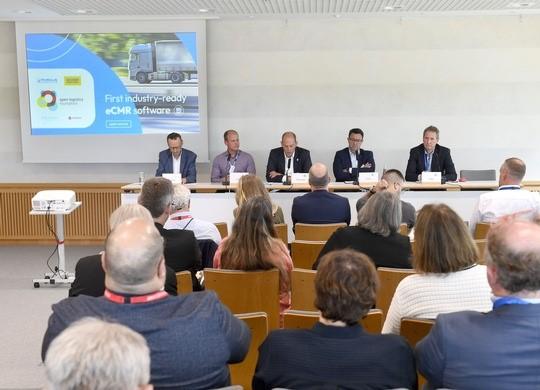
At transport logistic 2023, the Open Logistics Foundation (OLF) presented its plans for the "eCMR". At transport logistic 2025, there was now a concrete result to present: an industrial-grade software that standardizes the digital consignment note (eCMR) into a common standard. The Open Logistics Foundation members Rhenus, Dachser, Blue Yonder, and Markant jointly unveiled the solution in Munich on June 2 during a press conference. According to OLF, the new software is legally compliant, interoperable, and suitable for companies of any size and industry—available for free on an open-source basis.
The eCMR software from the Open Logistics Foundation is understood as an open-source development by companies for companies: 28 member companies of the Open Logistics Foundation have advanced, tested, and validated the software in the Working Group "Electronic Transport Documents" and its associated project "eCMR". The Open Logistics Foundation procedurally accompanied the project in its role as a non-profit organization and secured it with technical and legal expertise. The project originated from an initiative by the Fraunhofer Institute for Material Flow and Logistics IML.
According to OLF, the new eCMR software is legally compliant, interoperable, and suitable for companies of any size and industry. The use of a standardized eCMR data model allows for the exchange of eCMR documents via federated platforms. Neither a central authority nor a mediator or broker is required for this: Every company and organization can become part of the network. For signing and validating eCMR documents
at the company level, the software uses advanced electronic seals.
Developing Commodities Together
"The eCMR software developed by member companies in the Open Logistics Foundation provides the long-demanded foundation for the digital and efficient design of international freight transport," explains Andreas Nettsträter, CEO of the Open Logistics Foundation. "The success factor for the new open-source standard is the community. For such so-called commodities, companies still too often develop their own solutions today, instead of pooling their strengths with other companies within the framework of the Open Logistics Foundation."
In addition to Nettsträter, Jonas Kassan, Team Lead Global Project Management Office & EDI at Rhenus, Stefan Hohm, CDO Dachser, Robert Recknagel, Head of Operations, Blue Yonder, and Reiner Sailer, Lead Service Owner SupplyChainServices Markant, participated in the press conference during transport logistic 2025. After the proof of concept at the end of 2023 on two transport routes between Rhenus and Dachser, the industrial-grade eCMR software has now been rolled out within two joint use cases. Logistics service providers Dachser and Rhenus collaborated with Markant and Blue Yonder in this process.
More Efficient and Better Through Digital Freight Documents
"We believe that we can better address some challenges in the digitization of logistics together," says Jonas Kassan from Rhenus. "The development of the eCMR has the potential to show that we as an industry benefit if we tackle the problems together. Of course, Rhenus could have technically solved the task alone, but only
in the group could we create a legally and organizationally accepted solution. That we as members of the Open Logistics Foundation rely on open source is not an end in itself. The open-source approach is primarily intended to create added value by having the solutions used by many participants. Digitization and better interoperability lead to cost savings, quality gains, and efficiency increases. This is also shown by the tests with the eCMR solution, for example, with our partners Dachser and Blue Yonder. Rhenus, for instance, has calculated that depending on the use case, savings of one euro per document can be achieved. Processes become more transparent and less error-prone—from start to finish in payment processing."
Time Gains Lie in Standardization
"The new eCMR standard shows: Open source simplifies the entry into digitization and is a driver for standardized commodities in digital value chains," explains Stefan Hohm from Dachser. "The time gain from using the eCMR software is up to 60 percent in tests with our IT partner Markant in some reference cases. This means significant relief for everyone involved in the transport chain—from drivers to dispatchers to recipients of the goods. More than 25 logistics service providers, transport platforms, and logistics and IT service providers—many of them market competitors, some with existing individual eCMR solutions—have worked together on the new eCMR standard. The software benefits from taking many different perspectives into account. Our successful pilot applications with our partner Markant have
also shown that we have a great opportunity to digitize many more transport documents and information with this open-source approach. The developments and organizational decisions related to the eCMR are highly relevant for this and therefore the perfect starting point."
Andreas Nettsträter adds in conclusion: "The new open-source software brings the digital consignment note to a common standard—not a formally standardized one, but a standard legitimized through collective development and company support, a so-called de facto or industry standard." Every company can download, customize, and use the eCMR software from the foundation's repository, thereby being compatible with other users of the open-source software. Companies can implement the software into their existing systems themselves or commission suitable IT service providers to do so. No license fees are incurred. "The eCMR is our first flagship project since the foundation's establishment in 2021," says Nettsträter. "With the support of our approximately 50 members and network partners (as of May 2025), future members, and a growing logistics community, many more successful new industry standards on an open-source basis will follow. Everyone is welcome to help shape them."
Members of the Working Group Electronic Transport Documents
Aventeon, Blue Yonder, CargoLedger, Cargo Sign, Collect + Go, Dachser, DB Schenker, DSLV Bundesverband Spedition und Logistik, duisport, Editel, Fraunhofer-Institut für Materialfluss und Logistik IML, Gebrüder Weiss, GS1 Germany, iteratec, LKW WALTER, Markant, Pionira, Rhenus, SITRA, TradeLink, Trans.eu, TransFollow, Translogica, Transporeon, TriNet, ZeKju, ZUFALL logistics group (as of May 2025).