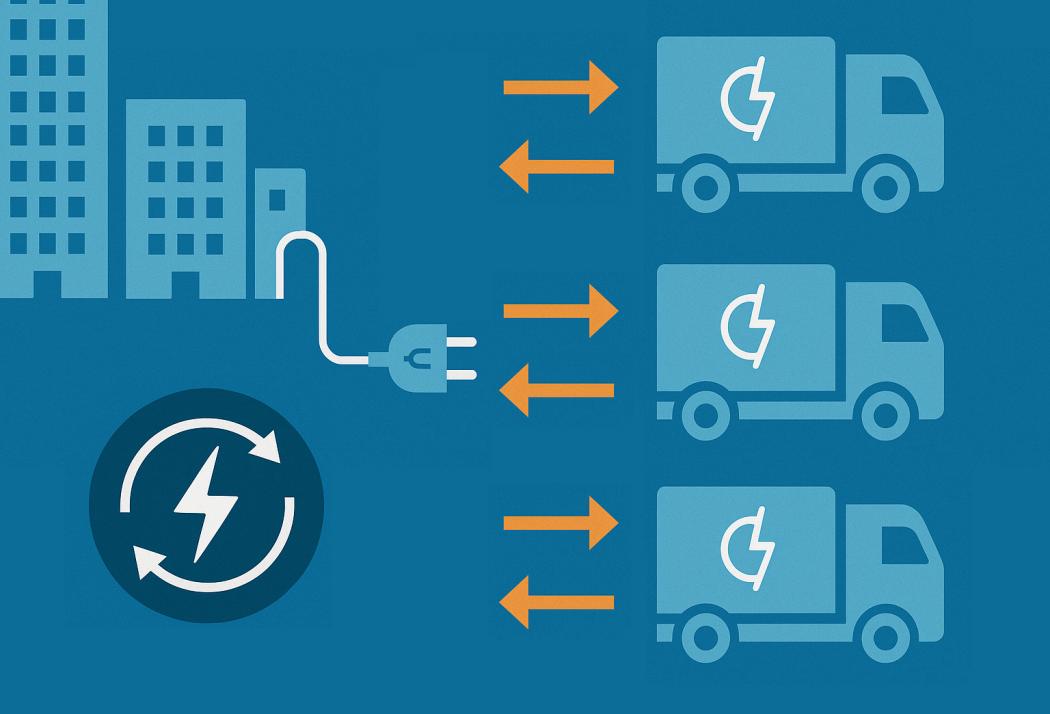
According to the International Energy Agency (IEA)*, between 200 and 300 million electric vehicles will be on the roads worldwide by 2030, with a rising trend. This makes their role in intelligently controlled power grids – the so-called Smart Grids – increasingly significant. Electric vehicles can not only consume energy, but also store it and feed it back into the power grid as needed. They thus act as decentralized buffer storage to balance fluctuations in the supply of renewable energy and to enhance grid stability. The technical foundation for this bidirectional energy exchange (Vehicle-to-Grid, or V2G for short) is the communication protocol ISO 15118.
ISO 15118: Technological Enabler for Bidirectional and Intelligent Charging
As a cross-manufacturer standard, ISO 15118 defines the communication between electric vehicles, charging infrastructure, and – if available – backend systems such as energy management platforms. As part of the Combined Charging System (CCS), the protocol uses Powerline Communication (PLC) via the charging cable to enable secure and smooth data transmission during the charging process.
With ISO 15118-20, bidirectional charging is fully supported for the first time. Electric vehicles can thus be flexibly integrated into the power grid as decentralized energy storage. In the so-called V1G mode (supported by ISO 15118-2) – that is, planned, unidirectional charging – the charging process can, for example, be shifted to grid-friendly, low-cost time windows. The system dynamically responds to signals such as electricity prices, grid load, or user preferences.
The V2G mode goes one step further: Here, discharging processes are also enabled. External energy management systems can make decisions based on current and forecasted grid conditions about when and how much energy should be charged or
fed back. Infrastructure operators and grid operators thus receive a new tool to control grid utilization – for example, by specifically reducing the charging power or by feeding electricity during peak load times.
New Business Models for Fleets
For fleet operators in the logistics sector or public transport, this opens up new business opportunities: The battery capacity of unused vehicles can be temporarily made available to the grid and marketed as a flexibility service.
Furthermore, ISO 15118 enables encrypted communication and standardized automatic authentication – the basis for convenient Plug & Charge processes at public charging points.
Creating Common Standards for True V2G Interoperability
For scalable V2G implementation, all involved stakeholders must work closely together: vehicle manufacturers, charge point operators (CPOs), grid operators, and mobility service providers. The technical basis for this is formed by interoperable standards that enable unified communication across the entire system landscape.
Three key protocols play a crucial role here:
ISO 15118: regulates communication between vehicle (EV) and charge point (EVSE), including Plug & Charge and bidirectional energy transfer.
OCPP 2.x (Open Charge Point Protocol): regulates the interface between the charge point (EVSE) and the backend system of the CPO – serving as a universal "language" for managing charging stations. With the version OCPP 2.1 expected in 2025, ISO 15118-20 as well as expanded V2X functions like the integration of decentralized energy resources (DER) and battery swapping will be supported.
OCPI (Open Charge Point Interface): standardizes the communication between CPOs and E-Mobility-Service-Providers (EMSPs) – for example, for roaming and service provision across network boundaries.
True V2G functionality can only be economically and technically feasible if all three protocols are integrated. Only the
joint implementation by OEMs, CPOs, and EMSPs creates the necessary interoperability for a scalable, intelligent energy grid. As an experienced partner in software engineering, Intellias supports companies along the entire value chain – from standard compliance to the development of intelligent backend solutions for smart charging and V2G.
The potential role of electric vehicles as active participants in grid stabilization and as decentralized energy storage is evident – and the technological foundation is largely in place. But what about practical implementation in the industry?
V2G Worldwide: Regional Strategies and Challenges
More and more automakers are equipping their electric vehicles with ISO 15118, especially newer model generations. V2G capability is becoming the new standard. However, implementation shows regional differences:
Europe: Here, legal requirements drive V2G development forward – for instance, through the "Fit for 55" package, the Alternative Fuels Infrastructure Regulation (AFIR), or EU directives regarding the Trans-European Transport Network (TEN-T). Pilot projects in the Netherlands, Denmark, France, and the United Kingdom are currently testing the technical and economic feasibility.
USA: The market is decentralized. Individual states, utilities, or companies initiate projects. Funding programs for EVs and charging infrastructure in some states make V2G more economically attractive – despite the lack of nationwide regulation.
China: As the world's largest EV market, China pursues a state-led, technology-focused approach. The goal is to use the national EV fleet for grid stabilization, to meet the growing energy demand, and to integrate renewable energy sources. A clear roadmap for V2G has been defined – supported by close cooperation between the government, state grid operators, and the domestic vehicle and battery industry.
Despite different approaches, all markets face similar challenges: high costs
for bidirectional chargers, concerns about battery degradation, and the need for secure, robust communication interfaces.
Infrastructure as a Bottleneck
The charging infrastructure remains a major barrier: While the vehicle side quickly upgrades, most of the currently installed charging stations still rely on older, incompatible systems. Although some components can be retrofitted via software update, in many places a hardware replacement will be necessary – with corresponding investment requirements and time expenditure.
Only a few manufacturers – including Siemens and ABB – currently offer charging solutions with full ISO 15118 support. Even as open standards like OCPP and OCPI continue to evolve, the road to comprehensive V2G integration is still long.
Practical Insights: V2G Projects Worldwide
- Numerous stakeholders are already testing V2G under real-world conditions. Three examples illustrate the diversity of possible applications:
- In Utrecht (Netherlands), a fleet of 500 Renault 5 with Mobilize V2G technology is used in a car-sharing model – a European first.
- In Massachusetts, a school district uses bidirectional chargers to buffer peak loads in the summer and generate revenue.
- And Ford already enables V2H with the F-150 Lightning via "Intelligent Backup Power." GM plans to introduce V2H for all Ultium EVs by 2026. Nissan continues to rely on V2G and has certified a bidirectional charger from Fermata Energy for 2024.
What Does This Mean?
V2G is seen worldwide as an opportunity and is being implemented in initial projects. Now it's about quickly setting up the necessary frameworks and standards so that project participants can finally move beyond pilots – for which everyone must pull together!
https://www.iea.org/reports/global-ev-outlook-2024/outlook-for-electric-mobility
Research on the topic was conducted for us by Volodymyr Zavadko, Delivery Director, Transportation at Intellias.