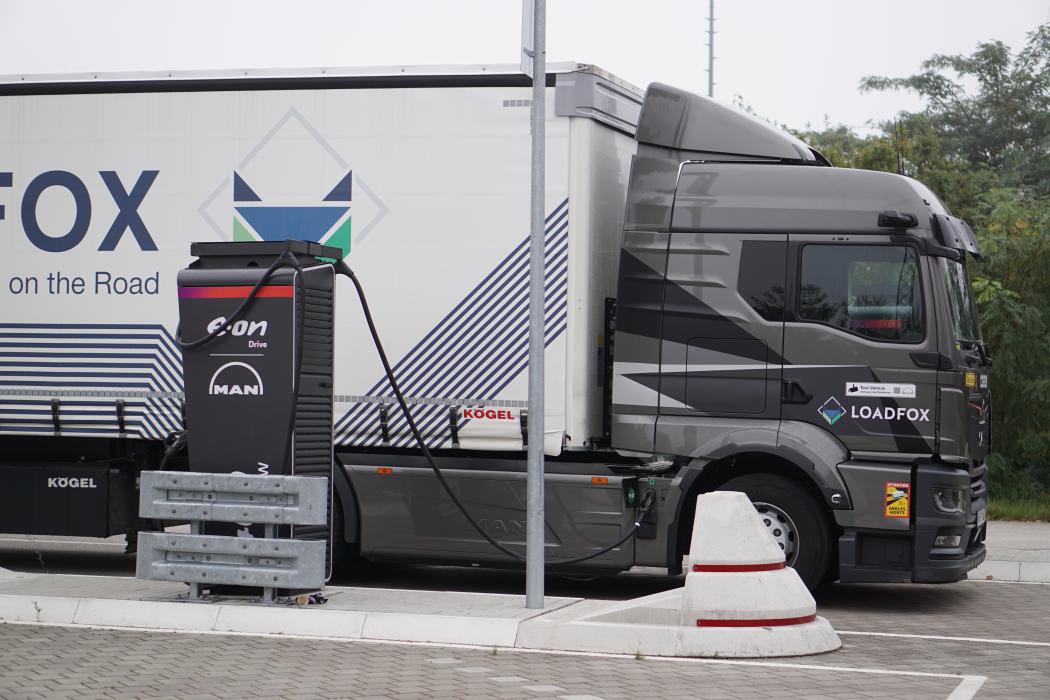
E.ON is piloting a reservation system for charging points for electric trucks. The goal is to enable plannable charging without waiting times and better coordination with statutory rest periods, according to the company. The first reservable charging columns are located at the MAN Service Center Karlsfeld near Munich, close to the A99. Further locations are to follow; in the long term a nationwide, comprehensive offering is planned. The project targets fleets in road freight transport. E.ON is collecting practical data with transport companies for this purpose.
Web booking of the charging stop with a 15-minute tolerance
Dispatchers or drivers plan charging stops before or during the tour. The start time is booked in a web app, including a 15-minute tolerance before and after the slot. The charging point is exclusively blocked within the reservation window. On site, the charging column is unlocked in the
app. Unused bookings expire after the grace period. In the event of congestion or route changes, the reservation can be adjusted at short notice.
The approach by E.ON aims to reduce idle times and stabilize delivery windows. Companies could use this to tighten rest periods and energy demands, as stated. This would facilitate the planning of electric tractor-trailers and distribution vehicles. At the same time, the utilization of charging infrastructure would increase. The benefit mainly arises at hubs with high truck volumes. There every minute in the turnover counts.
„A central challenge for transport companies and professional truck drivers in switching to electric trucks is planning the charging stops. Orders and delivery times are tightly scheduled in logistics, which is why vehicles should not stand idle any longer than necessary. Our reservation system should solve exactly this challenge,“ said Arjan van der Eijk, Managing
Director at E.ON Drive Infrastructure.
By booking charging points proactively, one ensures that electric trucks will in the future not have to wait for a free charging column – at the same time, it enables drivers to charge during their legally mandated rest breaks.
Co-Innovation project with UnternehmerTUM of the Technical University of Munich
At the same time, a co-innovation project is running at the UnternehmerTUM startup center of the Technical University of Munich. The focus is on connecting additional partners via technical interfaces. The goal is an open, scalable system with many charging-point operators from the truck sector. This should create a broad reservation offering for electric trucks.
„In collaboration with UnternehmerTUM, the integration of additional partners and solutions via technical interfaces, i.e., APIs, should be advanced in particular. The aim is the joint development of an open, scalable reservation system that, in
the long term, includes a large number of charging-point operators from the truck sector, in order to provide a nationwide reservation offering for E-truck drivers,“ said Lioudmila Simon, Vice President E-Mobility Innovation at E.ON Group Innovation.
Public charging points: EU funding for the DRIVE-E project
Anfang 2025 hatte ein von E.ON geführtes Konsortium rund 45 Millionen Euro EU-Fördermittel für das Projekt „DRIVE-E“ erhalten, das bis 2027 rund 1.400 öffentliche Ladepunkte in 13 EU-Ländern schaffen soll. Darunter sind 430 Ladepunkte mit mindestens 350 kW speziell für schwere Nutzfahrzeuge. Gemeinsam mit den Partnern ZSE und Eldrive baut E.ON ein Netz entlang zentraler Güterverkehrsrouten auf, das sowohl Lkw- als auch Pkw-Standorte umfasst und bestehende Infrastrukturlücken schließt. Die über 250 geplanten Standorte liegen unter anderem in Deutschland, Österreich, Italien, den Niederlanden und Osteuropa. DRIVE-E wird im Rahmen der EU-Initiative AFIF II kofinanziert, die den Ausbau der Ladeinfrastruktur im