Ammonia has so far mainly played a role in fertilizer production. But in the future, the gas could also play a key role in the energy transition as an efficient hydrogen carrier and climate-friendly substitute for fossil fuels, according to the Fraunhofer Institute for Microengineering and Microsystems IMM, as it can be produced CO2-free from nitrogen and hydrogen. Additionally, it offers many advantages for transport and storage.
“Ammonia holds great potential for a sustainable transformation of our energy system,” explains Dr. Gunther Kolb, Head of the Energy Division and Deputy Director of the Fraunhofer IMM in Mainz.
How is loss-free transport achieved?
According to him, the challenge of the energy transition lies not only in sufficient emission-free energy production but also in the loss-free transport to less energy-intensive locations – as green electricity can be produced in large quantities especially in very wind- or sun-rich locations, such as Chile or Australia.
The use of ammonia could therefore bring some advantages. According to IMM, green hydrogen H2 – as a storage option for green electricity – can be converted with nitrogen N2 in a 3:1 ratio into ammonia NH3 and can be stored and transported in this form with significantly less loss.
Ammonia remains liquid at atmospheric pressure and at a pressure of only 7.5 bar or a cooling to just about -33 degrees Celsius. Pure hydrogen, on the other hand, must be led into a vacuum
and cooled to -253 degrees Celsius for liquefaction under low pressure – and this requires a high energy expenditure.
Moreover, ammonia has a higher volumetric energy density than liquid hydrogen, meaning it can transport more energy per volume unit.
“For the production of ammonia from hydrogen and nitrogen, you only need about five percent more energy than for the production of hydrogen from green electricity,” explains Kolb, adding: “And both the production and the splitting of ammonia are completely CO2-free.”
He points out that ammonia is toxic as well as flammable and is therefore considered a hazardous material with corresponding safety precautions. However, around 25 million tons are already being safely transported by ship and rail worldwide, primarily for fertilizer production.
For use in the chemical industry or as an energy carrier, ammonia must, according to IMM, be split back into its components nitrogen and hydrogen at the destination, as "cracked" – with as little energy loss as possible.
The gas is directed over an inorganic nickel-based catalyst with a high internal surface in a reactor at about 600 degrees Celsius.
“Currently, the first large electrolysis plants are being built in green electricity-rich locations like Australia or Chile to produce ammonia. On the European side, one of the first large cracker plants is being built simultaneously in Rotterdam,” says Kolb.
Hydrogen core network under construction
The recovered hydrogen is to be distributed to application sites via
pipelines. However, interested buyers, especially smaller companies, often do not have access to hydrogen pipelines. The hydrogen infrastructure is currently being established in Germany.
By 2032, a hydrogen core network with a total pipeline length of around 9,000 kilometers is to be created – mainly by converting natural gas pipelines. However, according to IMM, large areas would remain unconnected to a hydrogen supply even after this.
Local supply through decentralized cracking technology
For this reason, the Fraunhofer Institute for Microengineering and Microsystems IMM is dealing in several research projects with the question of a space-saving, efficient, and above all decentralized ammonia cracking technology.
According to Kolb, decentralized cracking technology is intended to efficiently and emission-free close this supply gap for demand amounts between 100 kilograms and 10 tons of hydrogen per day.
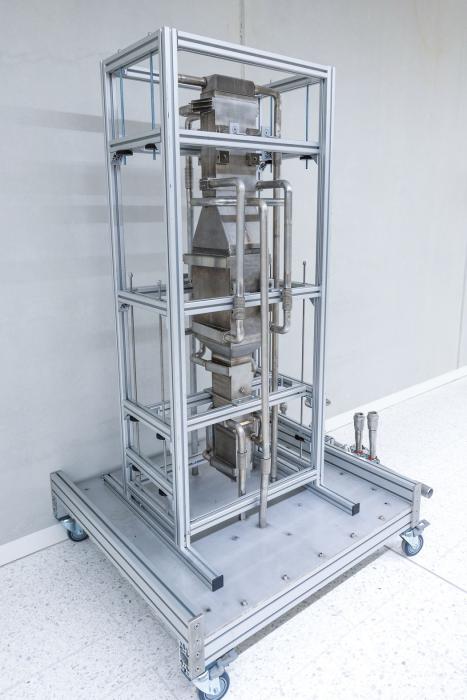
“In the Ammonpactor project funded by Rhineland-Palatinate, we have already developed a compact ammonia cracker together with the Fraunhofer Institute for Industrial Mathematics ITWM, which, through our innovative plate heat exchanger technology and an integrated exhaust gas combustion for the pressure swing adsorption used for cleaning in the reconversion process, achieves an efficiency of 90 percent – compared to 70 percent for conventional technologies,” explains Kolb.
No additional fuel or electricity is required for cracking: The energy for heating the reactor is directly generated in the cracking reactor using the exhaust streams. According to the researchers, the Ammonpactor reactor is also about 90 percent
smaller than conventional reactors – advantageous for mobile and space-constrained applications.
Another advantage: The exhaust gas utilization is intended to provide the technology with a smaller carbon dioxide footprint than electrically heated reactor concepts.
The innovative plate heat exchanger from Fraunhofer IMM, coated with a catalyst, also makes a difference.
“Instead of the usual energy-intensive externally heated pipe system at about 900 degrees Celsius, the heat required for splitting in our technology is generated directly where it is needed. This gives our plant a significantly better heat transfer. This means tremendous energy savings.”
A finished prototype is already available at the Fraunhofer IMM site in Mainz, which is expected to enable hydrogen production of about 75 kilograms of hydrogen per day – which corresponds to the daily output of a 50 kW fuel cell.
“With this amount, for example, you could already supply a small hydrogen filling station,” says Kolb.
Research projects
And what is the next development goal? Scaling up to a daily production of up to ten tons, among other things, within the framework of the five-year maritime EU project Gamma as well as the Fraunhofer lead project AmmonVektor.
The latter deals with the entire value chain of green ammonia to make hydrogen available on a decentralized and as cost-effective basis as possible. The three-year project started at the beginning of 2024 and is led by the Fraunhofer Institute for Environmental, Safety, and Energy