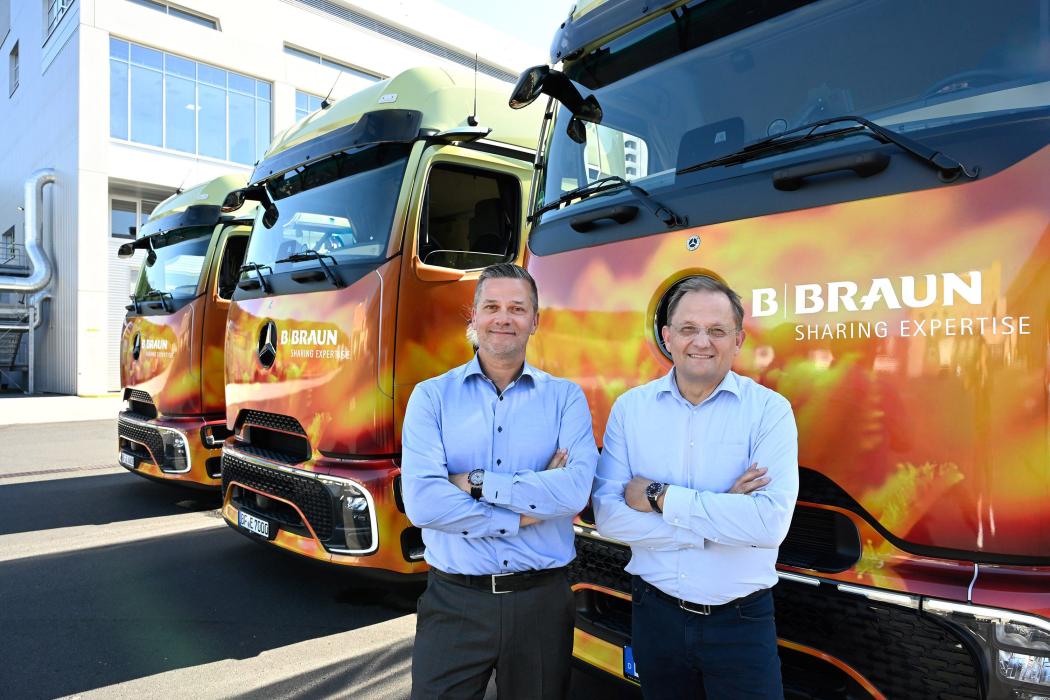
With twelve locations, Frigosped GmbH is represented in Germany and Spain. The fleet has now been expanded by three electric trucks, specifically three eActros 600, for the transportation needs of the company B. Braun, which operates in the medical technology sector.
“Like all other tractor units in daily use, the electric trucks will cover about 10,000 kilometers monthly in long-distance transport,” says Michael Bähr, Director Finished Goods Logistics at B. Braun.
According to the information provided, Frigosped serves B. Braun's distribution centers in Germany daily with more than 80 tractor units and around 120 thermo trailers. Additionally, it handles procurement logistics and in-house relocations between the plants.
Real Use
To ensure the continuous picking and shipping process, the logistics provider operates a swap trailer pool in Melsungen. Michael Bähr came up with the idea of testing the use of electric
trucks on suitable routes—a proposal that resonated with Logisped, as the company had already gathered initial experience with two electric tractor units.
“The e-trucks regularly travel from the B. Braun distribution center in Melsungen to the Glandorf location near Osnabrück and to the distribution centers in Recklinghausen (North Rhine-Westphalia) and Eggenstein (Baden-Württemberg),” explains Bähr.
Daily, three of around 50 tours would be switched to pure electric propulsion. B. Braun had previously gathered positive experiences in in-house traffic with an e-truck at the Melsungen location.
Long-term Data
“For us, it is important to test the e-trucks under our specific conditions and gather our own experiences,” affirms Bähr, who draws a first positive conclusion after four weeks: “Loading, technology, and punctuality are working flawlessly,” he explains.
Data will be collected over a period of three years to allow for a more extensive
use of the vehicles in the future. According to the information given, the three recently acquired Mercedes eActros 600 have a range of up to 500 kilometers and a battery capacity of 621 kilowatt-hours.
Charging Situation
In the future, the vehicles should be able to be charged to 80 percent in about 30 minutes via megawatt charging, it is stated. Currently, charging takes place at Frigosped and external stations with about twice the charging time. According to Bähr, an independent charging infrastructure at the B. Braun locations is conceivable “if the new technology proves itself.”
According to Bernhard Heinrich, the preloaded trailers are immediately transported to the transshipment points by Frigosped's own fleet according to a fixed schedule during the night after loading.
“Thanks to digital support and real-time monitoring, a punctuality rate of 99.8 percent is achieved,” says the
Frigosped Managing Director. According to Heinrich, besides environmental awareness, customers are increasingly focusing on digitization.
Before the switch to e-propulsion, suitable routes were selected that offer regularity in the outbound and inbound freight. Topography, load weight, and recharging options were also considered. Additionally, sufficient energy reserves are needed for winter operations.
“Although the main loading of the trucks takes place during the drivers' shift breaks, an intermediate charge is still required on two tours,” reports Heinrich.
What's Next?
The e-vehicles have sparked significant interest among drivers. Before switching to the electric truck, the selected drivers receive an introduction. A comprehensive analysis of the actual costs and CO2 savings is planned.
Many aspects and seasonal influences play a role, according to Bähr. Based on the long-term data collected, it will then be decided whether and how the fleet transformation will be