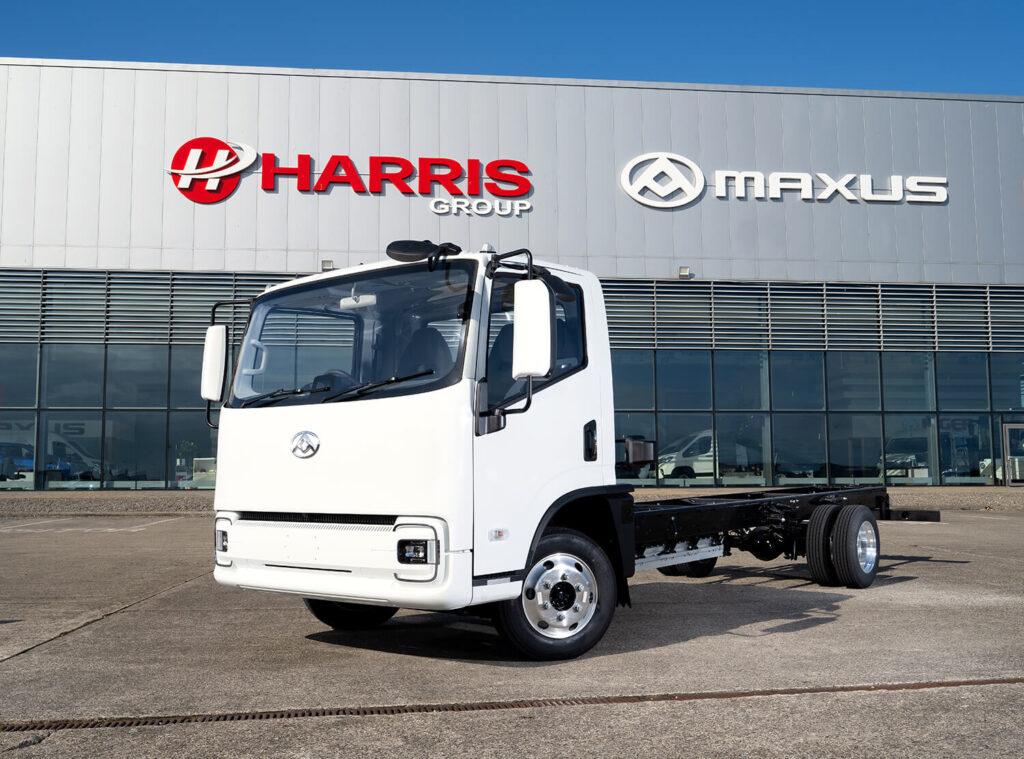
The light-commercial-vehicle subsidiary of the Chinese state-owned SAIC group SAIC Maxus continues to push ahead and has now unveiled its new electric distribution truck eDeliver 75 for the UK. The vehicle formally replaces the 2023-presented EH300, is expected to reach the continental European market soon and would then complement the now broad portfolio of light commercial vehicles. This ranges from the light eDeliver 3, through the new eDeliver 5 and 7, up to the eDeliver 9 as a classic 3.5-tonner. In addition, three pickups are in the program: the fully electric T90EV and eTerron9, and the new diesel pickup T60 Max. As with models of the SAIC brand, the eDeliver 75 also comes with a five-year warranty on the vehicle and an eight-year warranty on the battery. Deliveries to the UK are expected to begin in October, with the first vehicles rolling out to customers in December, accompanied by preparations for the dealer network.
Smaller battery, more range
The electric distribution truck features a reportedly robust 120-kWh LFP battery (EH300 128 kWh), a 120-kW DC fast charging function, a WLTP range increased by 40 kilometers compared
to the predecessor to 250 km (155 miles), and two wheelbase options (LWB 4,500 mm) on the British market. As usual, the mirrorless model is 2.15 meters wide and almost eight meters long, with front and rear leaf springs (max 8.33 m with body) and well equipped, featuring a spacious and modern cabin. Standard equipment includes a cruise control, heated multifunction steering wheel, keyless start, and Vehicle-to-Load (V2L) function for outdoor use with up to 6.6 kW of power. For propulsion, there is a 150-kW electric motor on the rear axle (EH 300 110 kW), delivering up to 440 Nm of maximum torque.
120 kW charging for short dwell times
The charging power of 120 kW is intended to ensure a charge window from 20 to 80 percent within 30 minutes, which also increases fleet utilization and reduces downtimes. Optional to the 11-kW AC standard charger is a practical 22-kW AC charger, which reduces the time to reach 100 percent from 11 hours to 6.8 hours. The payload of 4,590 kilograms (EH300 4.3 t) for the empty three-tonne chassis is high and still above diesel levels,
especially for a fully electric model. In addition, a respectable towing capacity of 3.5 tonnes and high axle-load reserves of 3 tonnes on the front axle and 6 tonnes on the rear. The turning circle is 13.8 meters, which is at a good, i.e., compact level.
Full safety equipment
As a GSR II-compliant (General Safety Regulation) vehicle, the electric distributor features a wide range of advanced driver assistance systems (ADAS), some of which go beyond the legal requirements. These include lane departure warning and active lane-keeping, forward collision warning, automatic emergency braking, blind-spot and rear-cross traffic alert, fatigue detection, and preparation for an alcohol interlock. Other safety features are traffic-sign recognition, driver and front passenger airbags, and a 360-degree camera system integrated via a 12.3-inch infotainment display with rear parking sensors, and it supports DAB radio, Apple CarPlay and Android Auto connectivity.
„The market introduction is not only a decisive moment for MAXUS UK but also for the future of emission-free logistics at the national level. This is more than just a new truck; it is a bold statement of intent. With its class-leading range, rapid
charging capability, and outstanding payload efficiency, the eDeliver 75 redefines what operators can expect from an electric 7.5-tonner," says Brian Patterson, Managing Director of the Harris Group.
Ross Davies, Head of Sales for MAXUS UK, sees the e-distributor as "an agile, versatile, safe and comfortable truck for all requirements in mid- and end-stage distribution and delivery. The chassis design should also predispose it for integration of bodies and prepare it for special applications. As charging infrastructure remains a limiting factor for the introduction of electric trucks, the manufacturer has developed a dealership-neutral approach for depot charging solutions. It is based on the brand's long-standing experience electrifying vans, gained with large fleets in the UK. The approach is neutral with respect to charging hardware, software and operators.
"All of our most important customers for electric vans have invested in an AC charging infrastructure that is ideal for 7.5-ton operation, which largely takes place during the day and where the trucks are parked overnight at the home depot. For larger fleet operators who require faster turnaround times, we can quickly connect them with providers of DC charging infrastructure,"


