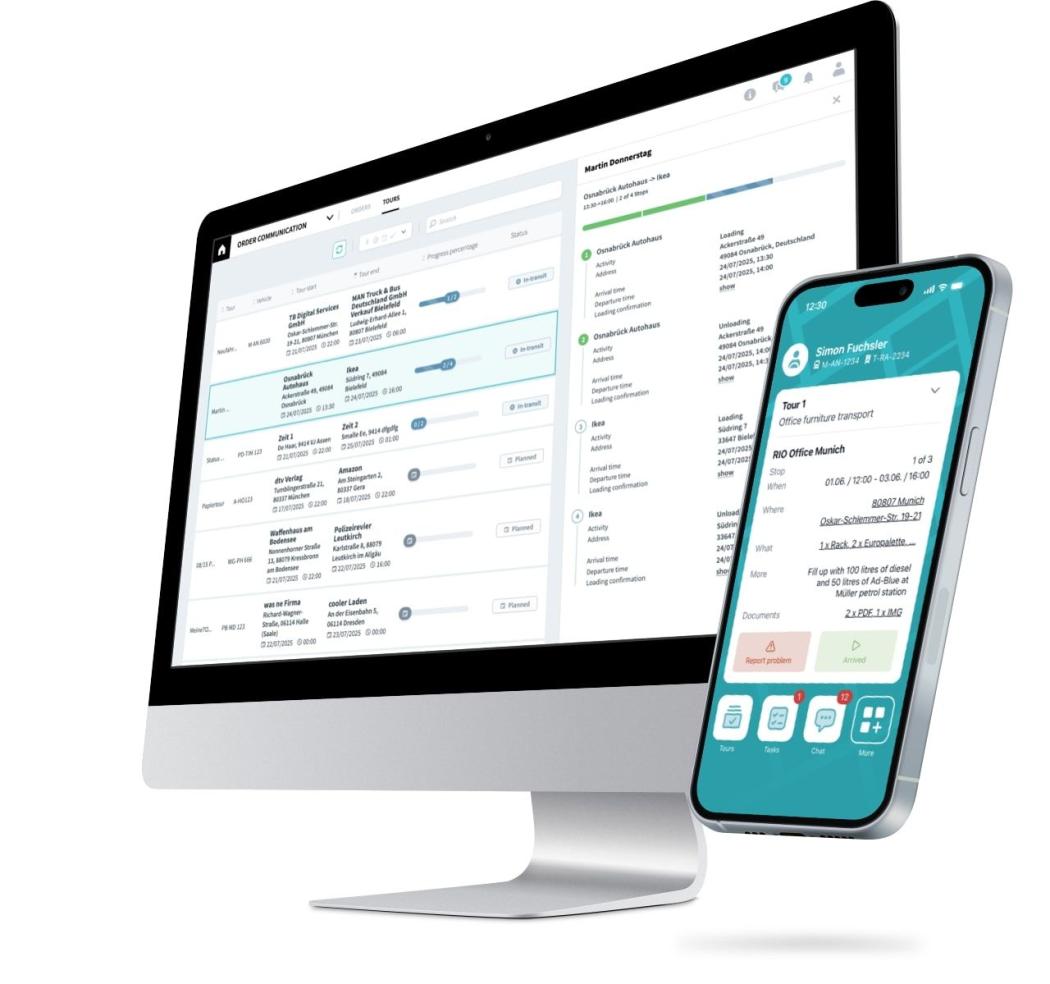
The integrated solution Order Communication from RIO is now available on its own platform as well as in the in-house Transport Management System (TMS) Cartright. With Order Communication the order processing and driver communication are linked seamlessly for the first time, according to the software house.
Companies could immediately record orders in the RIO account, plan tours, and automatically transmit them to their drivers. In addition, the application can be flexibly integrated into external TMS.
From order entry to the last mile
According to RIO, Order Communication will create a new bridge between dispatch and driving personnel. Thus information about tours, stops or problems is transmitted digitally, in real time and in compliance with data protection regulations, via
the Pocket Driver driver app.
Dispatchers receive current status updates directly from the vehicle, while drivers see all relevant information about the tour concisely on the smartphone. Data fragmentation, follow-up questions or misunderstandings could be significantly reduced in this way. Daniel Strucks, Managing Director at RIO:
„Our customers want less manual coordination and more transparency. That is exactly what Order Communication provides: the communication between dispatch and driver is efficient, traceable, and stress-free, regardless of which system is running in the background.”
Particularly smaller fleets benefit from the integrated order management directly on the platform. There, tours and orders can be entered manually, tracked in real time, and sent immediately to the Pocket Driver app. Device login is
simply via QR code, and disturbances can be reported using predefined text blocks and documented with photos.
For larger transport service providers, the solution is available as an interface in Cartright, so that even more complex dispatch data can be transmitted digitally to the drivers. In addition, the software company offers an API through which Order Communication can also be connected to other third-party systems.
Information instead of questions
Dispatchers can track the tour progress in real time, respond immediately to problems, and if needed, communicate directly with the driver via an integrated chat function, it says. This works thanks to AI-based translation technology to enable language-barrier-free communication.
Each user can communicate in their mother tongue, yet the
context remains preserved. Drivers, in turn, would receive from the app clearly structured information on time windows, loading positions, and stop-specific peculiarities with direct navigation. Photos, status updates and documents could be exchanged as easily as feedback on loading deviations or damages. The digital signature as proof of delivery is also integrated.
Overall, the economic added value according to RIO lies in the clear reduction of administrative effort: paper-based processes disappear, follow-up questions are minimized, and transparency in the tour progress enables better information for customers and easier replanning. Instead of Excel lists, emails and constant phone calls, the communication runs in a structured and traceable manner for all vehicles in the fleet, according to the software company.