The Berlin consulting firm for electromobility, M3E, in cooperation with the East Frisian freight forwarder Nanno Janssen, has published a free guide for the logistics industry. The whitepaper "Sustainability as a Competitive Advantage: Electromobility for Shippers and Transport Clients" explicitly addresses strategic decision-makers and operational managers of shippers, who, as a central link in the logistics chain, are greatly affected by the ongoing mobility transition.
The Whitepaper outlines the current situation and provides practical information and recommendations for action as a guide to position oneself as a manufacturer, wholesaler, and depot operator with and without their own fleets competitively and future-proof. The paper details extensively in text and graphics the current market situation, the use of e-trucks, the construction of depot charging
infrastructure, as well as subsidies and regulations.
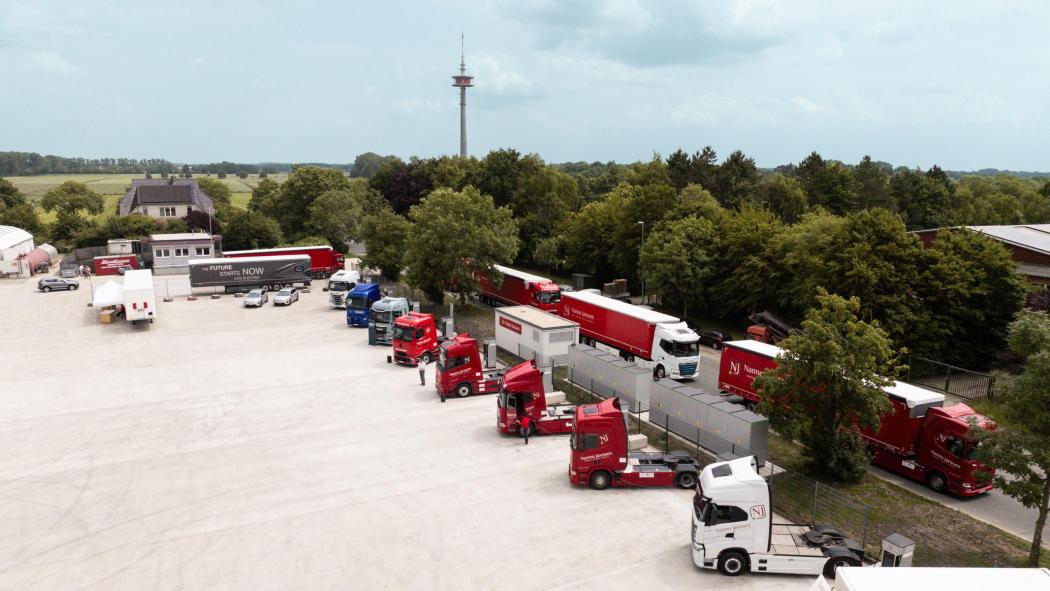
Focus is placed on the CO₂ tax and the substituting emissions trading system EU-ETS 2, which currently occupies the industry or will continue to do so significantly. The conclusion is formed by specific recommendations for action as well as a best practice example of the freight forwarder Nanno Janssen, which has made a name for itself as an electro-pioneer through the consistent use of e-trucks, providing an exciting practical perspective.
"For shippers, there's no way around electromobility anymore. In view of dynamic market developments and a high degree of political volatility, those responsible today must master the balance between flexible structures and long-term strategic decisions. Increasing regulatory pressure as well as continuously rising fuel prices
and toll costs make transport with conventional diesel trucks more expensive and increasingly position e-trucks as an economic and, with a view to the future, an indispensable option," explains Christian Milan, founder and managing director of M3E GmbH.
The transport revolution in the sector also includes a rethink in established market processes, such as pricing in tenders, which usually orient towards diesel prices and disadvantage electric supply chains. However, it can be done differently, as demonstrated by the freight forwarder Nanno Janssen, which relies on fixed price agreements in negotiations with shippers – and can now actually cover almost all usage scenarios. Nanno Janssen, Chief Strategy Officer of Nanno Janssen GmbH, confirms that the use of e-trucks is not only possible and
sensible in local and regional transport.
"We also utilize our growing e-fleet in regular long-distance transport. With a mix of our own depot charging and the use of public charging infrastructure on our well-planned routes, this is no longer a problem. The statutory rest breaks are used for charging, resulting in hardly any time losses compared to diesel. Therefore, our e-trucks have already completed trips not only to the Benelux countries, Denmark, and Sweden but also to Switzerland, Austria, Italy, France, Spain, and the UK without any issues. The trips are not only more environmentally friendly but also less stressful for our drivers, who greatly benefit from the comfort gain of e-trucks and do not want to switch back," Janssen describes from