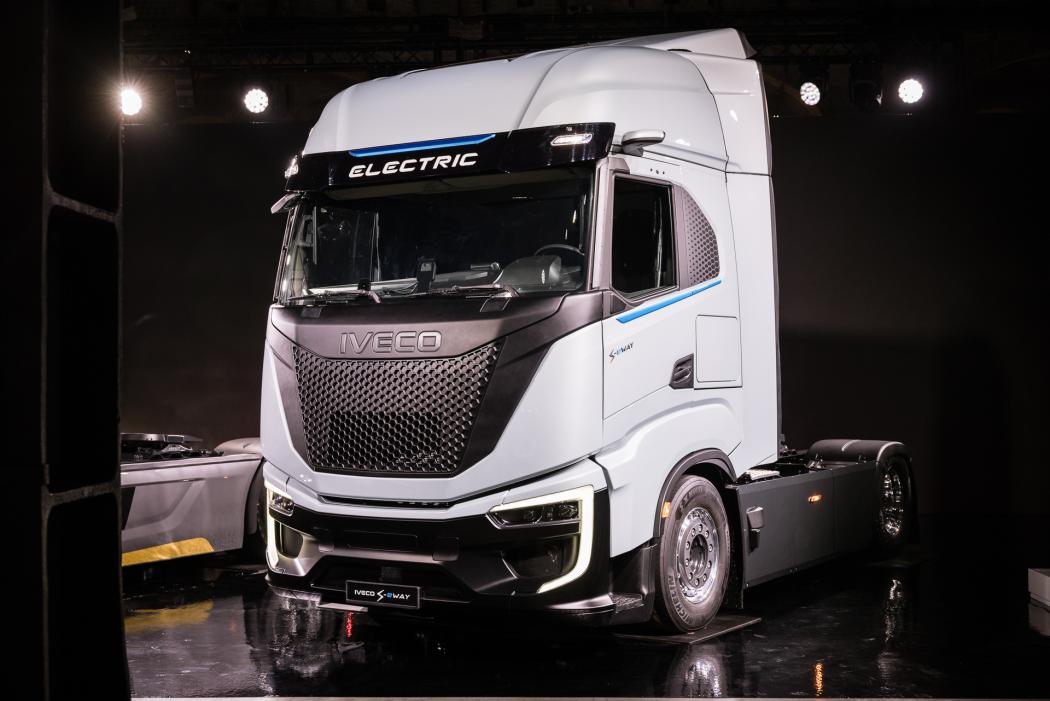
Truck manufacturing is currently a bit like a poker game: Diesel continues to dominate, but alternative drive solutions are increasingly gaining ground, and you should have many different trumps in your hand. Because the industry is also asking for fuel cells, CNG/LNG, and is increasingly electrified: Quite literally, an electric articulated truck recently left the plant in Ulm for Madrid to investigate how to manage charging through Europe with a length of 18.75 meters. Another poker game with an uncertain outcome? No, the trump card won: Both in France and Spain there were always free charging lanes and the trailer never had to be uncoupled. So, it's fundamentally working! But wait, IVECO isn't building electric chassis yet, is it?
The plant in Ulm is being extensively rebuilt – for heavy electric trucks
Time for an "inspection" in Ulm: The hall is spotlessly clean and fully digitalized: Every step of the work is precisely defined, and as soon as you pick up the impact wrench, it sets the correct tightening torque. If you try to use it too early, it won't work, because the workflow is also precisely defined. And only when step one is confirmed can you
proceed to step two. Everything is secured and documented down to the smallest detail.
If necessary, Iveco can assemble up to 3,000 heavy electric trucks in Ulm in three-shift operation, and if there is even more demand in the future, another equally large hall could be added – which is currently rented to the fire protection colleagues at Magirus, who no longer belong to the consortium – and up to 6,000 electric trucks could be assembled in Ulm. Until recently, the battery-electric Iveco S-eWAY tractor unit and a small series of the Iveco S-eWAY FuelCell tractor unit were built in Ulm. The plant is currently switching production to the Iveco S-eWAY chassis presented at the IAA Commercial Vehicles and the second generation of the S-eWay tractor unit. The last gamma prototypes are rolling off the production line. In addition, a brand new ultra fire-protected battery storage is currently under construction. To reassure: There was already a smaller battery storage with all necessary safety precautions and there have been no incidents to date. The batteries and the self-developed FPT e-drives still present an exciting challenge – because they are evolving at a rapid pace and constantly opening up
new possibilities!
Currently, flexibility clearly takes precedence over size
A bit like in card games, where you just thought you had the best trumps in hand, but a few moves later that no longer applies. Basically, the development leaps are currently (still) so large that you actually have to secure a completely new package every five years, which is very little time for a long-term investment like a truck: Well, the first owners return the machines after three to four years anyway and are always up to date, but then what? Residual values can hardly be represented cleanly and certainly cannot be calculated... a bit like the super-fast card game Split. Hardly everything has been laid down, it is reshuffled, dealt, and played again.
Drives? In perspective, everything please!
Which is why Iveco is positioning itself as broadly as possible, broader than ever, because: In addition to the powerful electric vehicles, fuel cells, CNG/LNG, and of course Diesel/HVO and even hydrogen combustion engines in the future. And it is massively expanding the range downwards: With the Hyundai group, the eMoovy is being built as a chassis with a ladder frame for any superstructure and with Stellantis, they
will be cooperating in the future with the lighter vans. The new additions here are called eJolly and eSuperjolly.
Similar to Ford, Mercedes-Benz, Renault, and VW respectively MAN, distributing their delivery vans through both the passenger car AND commercial vehicle network. The latter has the advantage of basic 24/7 emergency availability and longer opening hours.
2028 will bring a completely new generation of cabins
Which brings us to a look into the future, which will also bring new heavy trucks: Due to the changed EU legislation with the larger crash box at the front, IVECO will also launch completely new heavy trucks by 2028 and finally retire the structural design dating from 1990. The new cabins are to be developed with Ford Trucks, where there are similar needs.
At the Iveco 50th-anniversary celebration in Turin and at the ADAC Truck Grand Prix, it was previewed: The second generation of the Iveco S-eWay tractor unit.
What does this mean?
Even though the brand is once again a "small" commercial vehicle manufacturer on a global scale, it holds all the cards with many partners – no matter what drives and weight classes are involved. May there be many trumps!