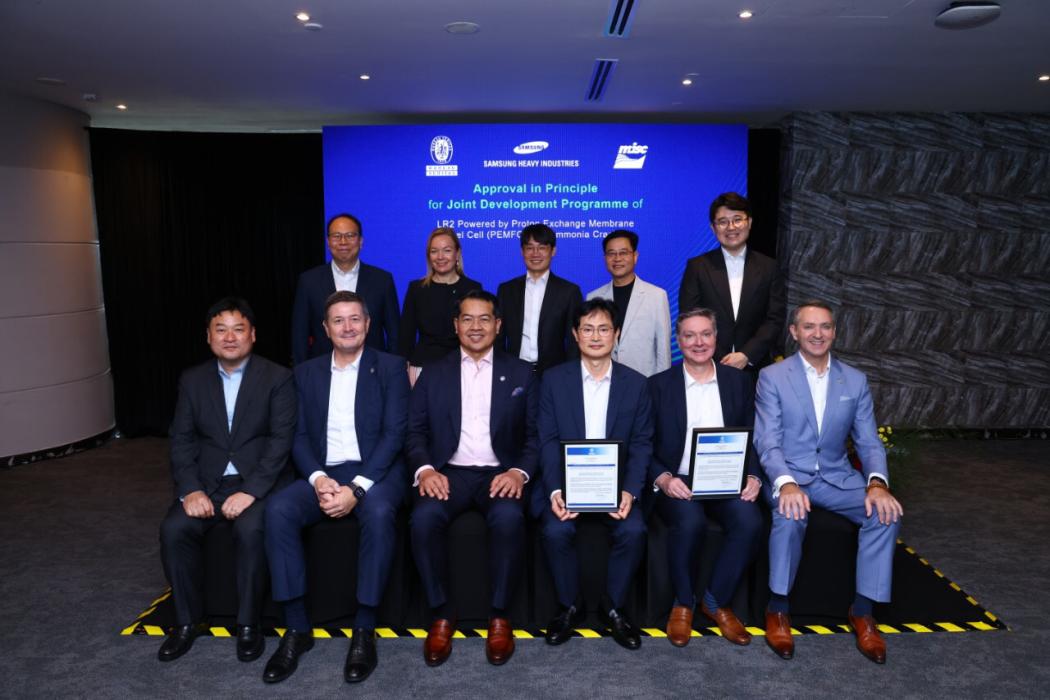
The South Korean company Vinssen states that it is participating in the development of the world's first fuel cell-powered ship that uses ammonia as a hydrogen carrier. A 115K-LR2 tanker is planned, whose propulsion is fully based on fuel cells.
Technical Implementation
Vinssen is providing for the project a fuel cell system with a total output of twelve megawatts. This system consists of six modules of the type 2MW MEGA FC 2.0.
The modular design allows the power to be adapted to the different requirements of various vessel types.
Project partners and certification
The ship development is commissioned by MISC Berhad and Samsung Heavy Industries. Bureau Veritas has issued the two companies a basic approval for their concept. This, according to the involved partners, confirms the technical feasibility and compliance with international safety and regulatory standards.
Combination of technologies
The proton-exchange-membrane fuel cell technology
from Vinssen is combined in the project with an ammonia cracking system from Panasia. This system serves as an upstream source for the hydrogen supply of the fuel cells. According to the project partners, this approach marks progress over previous applications, which to date have mainly been limited to smaller ships or auxiliary power plants.
"With the integration of PEM fuel cell systems into the world's first ammonia-powered ship concept, Vinssen sets
new standards for clean propulsion in commercial shipping," said Chilhan Lee, CEO of Vinssen. "This success reflects our mission to drive the industry's transition to emission-free solutions while ensuring safety, reliability, and scalability for the future of global shipping."
Safety and legal framework
As part of the collaboration, alongside technical development, safety concepts as well as legal foundations were developed. These, according to the company, align with the standards of the international


