As part of the BANULA research project, the project partners have succeeded for the first time in practically demonstrating the charging of an electric truck using the so-called throughput model. The venue was the company premises of Vector Informatik GmbH in Stuttgart. The demonstration took place as part of an application meeting of the project coordinated by the Fraunhofer Institute for Industrial Engineering IAO. The goal of BANULA is to create barrier-free, transparent, and user-friendly charging options for electric commercial vehicles—with a particular focus on cost transparency and flexibility.
Throughput model separates charging infrastructure and electricity supplier
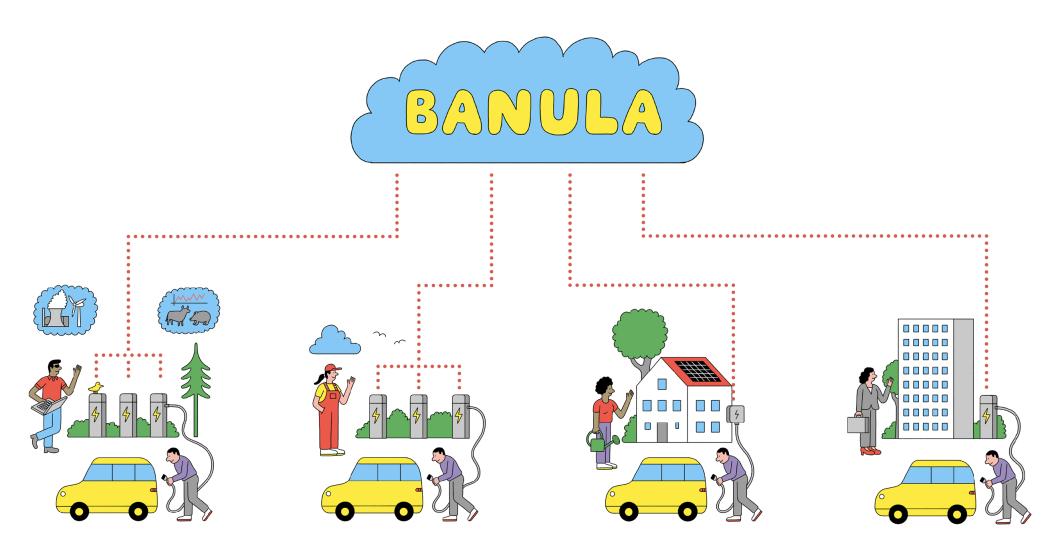
The throughput model is a central component. It fundamentally differs from conventional charging and billing models: The operation of the charging infrastructure (Charge Point Operator, CPO) and power procurement (via so-called e-Mobility Service Providers, EMP+) are separated from each other.
Charging point operators focus solely on the availability and technical operation of the infrastructure and provide it for a fee. Responsibility for electricity supply lies with the power supplier,
which the user can choose freely. The chosen electricity contract is essentially "brought" to the charging station, similar to taking a mobile phone contract into a public WiFi.
Use self-generated photovoltaic electricity on the go
For logistics companies and fleet operators, this model offers several advantages. The electricity purchased at the depot—whether from low-cost direct marketing or own photovoltaic—can also be used on the road. This significantly increases profitability, especially with regard to high charging capacities and increasing cost pressure in freight transport. Surplus energy generated at the depot can be fed into the grid or consumed on the go. At the same time, energy providers retain direct access to their customers and can tap into new markets.
The live demonstration at Vector was a pilot project with a signaling effect. Unlike previous tests, the initiative did not come from a BANULA project partner but was implemented by Vector as an associate member out of its own business interest. This shows the concept's market and practical
proximity. The in-house load and energy management system "vCharM" was used, which dynamically controls the charging infrastructure and plans in a network-friendly manner. The billing logic of the throughput model was provided by the software company OLI Systems, which is a key project partner in development.
Highway fast-charging network: Throughput model meets key requirements of Autobahn GmbH
In the long term, the project also aims to build a nationwide e-truck fast-charging network along the highways. The throughput model meets the key requirements of the tender by Autobahn GmbH of the federal government. At the same time, the model is extended to other scenarios: In the future, employees can use their private electricity tariffs at work—the company only provides the charging infrastructure. This eliminates for companies the fringe benefit that has so far arisen from the free supply of electricity to employees.
The regulatory basis for the throughput model was created by the Federal Network Agency as early as 2020. With the decision BK6-120-160, location-based electricity delivery
was abolished. Electricity can be obtained independently of location since then, breaking the link between the charging point and the electricity contract. The implementation is technically complex but promises significant advantages for network operators, fleets, and end customers: Network operators gain transparency over charging load, charging point operators delegate energy volume responsibility to the power provider, and fleets can control their energy flows across multiple locations.
Renowned project partners from research and industry
The BANULA consortium consists of eight partners from the science, energy, and IT sectors as well as logistics: In addition to Fraunhofer IAO, TransnetBW, SmartLab, OLI Systems, Schwarz Group, the University of Stuttgart, the law firm Becker Büttner Held, and the energy supplier badenova are part of the project network. With Vector Informatik GmbH, a leading company in automotive IT is involved as an associate partner in practical implementation. The project already operates several demonstration sites nationwide, where scenarios such as workplace charging, company car charging, and e-truck charging under real conditions are