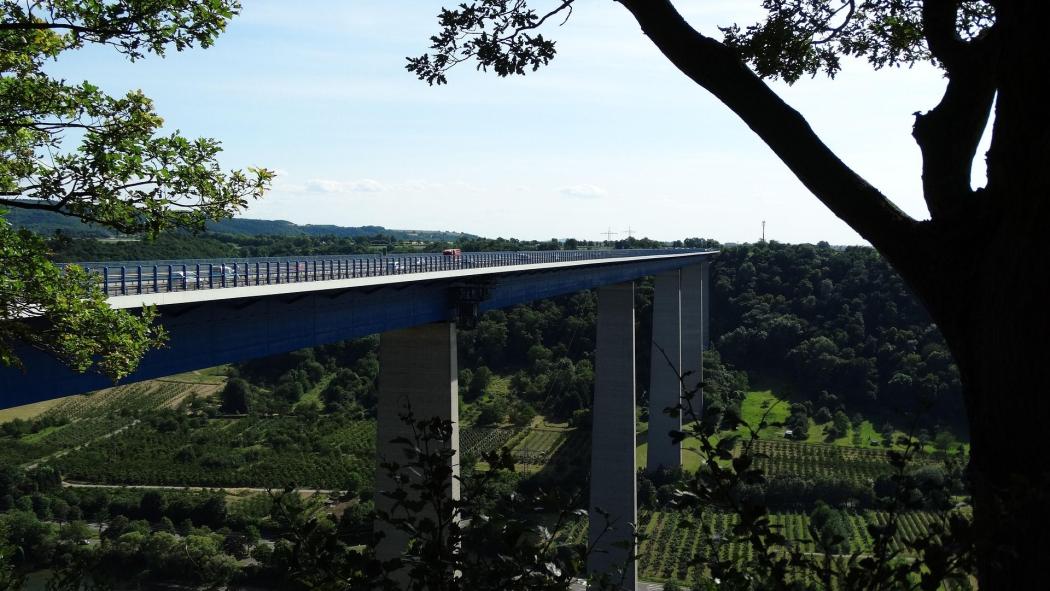
According to the German Federal Environmental Foundation (DBU), more and more deteriorating bridges and resulting road closures are increasing traffic pressure in Germany. Additionally, according to the DBU, required bridge demolitions and new constructions consume enormous resources and generate additional greenhouse gases as well as high costs.
However, if a report were submitted to the responsible road administration at the first occurrence of minor damage, it could be inspected and repaired locally in an environmentally friendly manner in a timely manner, according to the foundation.
This is now to be investigated by a DBU-funded project at the Karlsruhe Institute of Technology (KIT) using vibration measurements. The question: How can automated real-time monitoring be implemented?
Bridge Rehabilitation
The DBU refers to figures from the Federal Ministry of Transport. Accordingly, there are almost 40,000 bridges in the federal highway network, 86 percent of which are made of steel and prestressed concrete. However, many bridges from the 1960s and 1970s were originally designed for significantly lower traffic loads.
Additionally, heavy goods traffic has increased enormously according to the Federal Highway Research Institute, leading to
premature material aging. Consequently, according to the bridge modernization program, 4,000 of the 40,000 bridges in the heavily loaded core network of highways urgently need rehabilitation.
For example, the Rahmedetal bridge near Lüdenscheid and the Ringbahn bridge in Berlin had to be closed due to significant damage. Resource-intensive replacement constructions are unavoidable there.
"We need methods in bridge construction to mitigate an already looming wave of comprehensive overhauls," explains DBU Secretary-General Alexander Bonde.
Early Repairs
The concrete needed for this raises the emission of climate-damaging greenhouse gas carbon dioxide (CO2) and resource consumption – global cement production contributes about six to eight percent to worldwide CO2 emissions.
"If damage is repaired earlier, it relieves traffic, the environment, and health," says Bonde.
Bridge Inspections
A permanent and automated damage detection is a prerequisite. DIN 1076 prescribes regular bridge inspections in Germany: every six years, a labor-intensive and time-consuming main inspection must be carried out, followed by a simple inspection three years later.
"Experienced engineers inspect structures, many of which can be entered from the inside, and note abnormalities and damage," says Prof.
Dr.-Ing. Alexander Stark of the Institute of Concrete Structures and Building Materials (IMB) at KIT.
According to the project manager, the concrete components are tapped to detect voids, for example. However, not all damage can be detected in this way. For example, asphalt covering mid-span supports hides damage to the bridge superstructure, making visual inspection not easily feasible.
In case of suspicion, special bridge inspections are conducted in addition to regular visual examinations: pressure sensors, drone cameras, ultrasound measurements, or computer simulations and models are used.
"These controls usually only capture part of the bridge as a snapshot or require long calculation times, so checking by this method is only really sensible for few structures of outstanding importance," says Stark.
Measuring Vibrations
Therefore, practical automated real-time monitoring methods for bridges are urgently needed, which can effectively report the location and size of damage. Such a permanent monitoring method is now to be researched in a KIT project using vibration measurements.
"Every structure has a characteristic vibration behavior, influenced by mass and stiffness. Significant cracks in the concrete change the stiffness and
thereby the vibration behavior," says Stark.
With the help of so-called acceleration sensors, the characteristic vibration behavior could be recorded. "Through this metrological evaluation of the entire bridge, crack formations can be localized and simultaneously quantified for the first time - before they are even visible and a regular inspection is due," explains Stark.
No speed limits or bridge closures are necessary. In addition, early repair measures can be quick, precise, and cost-effective.
"In addition to ensuring reliable and safe infrastructure, this also saves greenhouse gases and resources," emphasizes DBU specialist advisor Franz-Peter Heidenreich.
According to DBU, in line with a comprehensive circular economy, existing materials like steel and prestressed concrete, as well as bridge components, should be used, reused, and repaired as long as possible.
Project Goal
The project now starting aims to establish the initial foundations - in a second step, the introduction with a company consortium is planned to create the conditions for road administrations to equip bridges with sensors.
Other advantages expected include shorter planning times and lower bureaucratic hurdles due to more precise and efficient repair