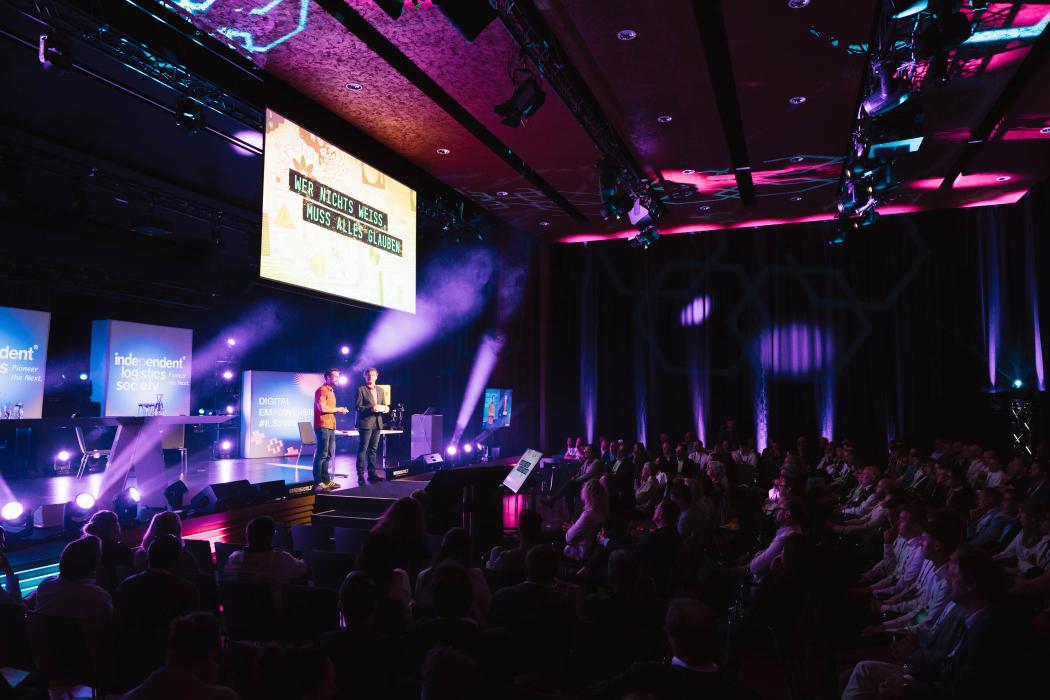
The International Logistics Summer 2025 (#ILS2025) in Leoben brought together from September 16 to 18 around 350 participants from business, science and politics. The focus of the three-day event was the digitization of logistics processes, sustainable mobility solutions, and the transformation of corporate competencies. Under the lead theme “Digital Empowerment – Redefining Movement for a Sustainable Future” the symposium offered an extensive program with technical lectures, discussion rounds and thematic panels.
Organized by the Independent Logistic Society (ILS), the format addressed challenges that are relevant beyond the region. The topic areas ranged from artificial intelligence in logistics to geopolitical risks of digital infrastructures to questions of circular economy. Representatives from companies, research institutions and associations from the German-speaking region provided insights into current developments and presented approaches to solutions for discussion.
At the outset, the organizer, moderated by former ski racer and now TV host Armin Assinger, invited eleven personalities from research, business and logistics to a culinary warm-up at the restaurant The Kitchen.
“With the joint cooking at the ILS Kitchen Talk 2025 we bring people together on equal footing in a tasteful way and open up space for authentic content in the coming days,” said Kajetan Bergles, Managing Partner
& ILS Project Lead.
Digitization as a Driver of Transformation
Several contributions illustrated that digitization in logistics cannot be viewed in isolation. Shell manager Hans Jörg Einfalt advocated for a comprehensive view of the life cycles of mobility solutions. Representatives from ÖAMTC, Transporeon and Knapp AG also addressed the interfaces between technology, infrastructure and user behavior. The use of artificial intelligence was named as a potential efficiency instrument, but at the same time pointed to risks and limits—particularly in the area of cybersecurity.
“Digitization, logistics and forward thinking come together uniquely at the annual #ILS. It is about sharing knowledge, strengthening competencies and jointly taking the next steps into the AI future,” said Wolfgang Eder, CEO of Evolution GmbH.
Sustainability and Circular Economy
A focus was on concepts of sustainable logistics and the implementation of principles of the circular economy. Based on concrete projects from industry and research, reuse strategies, resource-conserving procedures and social accompanying measures were presented.
“It is not a matter of size whether you can move something in climate protection. Often a single person who takes the first step is enough. Companies that do not consistently pursue sustainability will lose relevance in the long term. Therefore, sustainability for
us is not only an attitude but also an economic mandate,” said Oskar Zettl from forklift manufacturer Toyota Material Handling.
Contributions from Rewe International, Montan University Leoben and “Die Tafel Österreich” demonstrated the diversity of approaches currently being pursued. Also discussed were the prerequisites for the scalability of corresponding models.
“Instead of primarily looking at the tank-to-wheel process, we must consider the entire life cycle of mobility as a whole. Electric mobility is a relevant building block, but not the sole solution. What is decisive is to realistically weigh the advantages and disadvantages and to give the end consumer the choice of how they want to contribute to climate protection,” said Hans Jörg Einfalt, Sales Manager Commercial Road Transport AT/CH at Shell.
Education and Competences
In the area of securing skilled labor, topics such as “Future Skills”, training formats and communication strategies came into focus. Representatives from media companies, industry and educational institutions discussed how competencies change in the course of digital transformation processes and what requirements will be placed on employees in the future. Talent development was addressed within the framework of the ILS apprentice program, in which young professionals presented their own projects.
“As a company but also as
a society, we invest in our own know-how for progress. Especially because we are not only users but also want to actively shape things. A development in which politics is conducted less and more togetherness is fostered can certainly positively support this process,” said Gerald Hofer, CEO of Knapp AG.
Logistics as a System Theme
The event positioned itself as a platform for professional exchange between different sectors. The contributions made clear that logistics is increasingly perceived as a cross-cutting systemic topic – with interfaces to energy, environmental and digital policy. Accordingly, the spectrum of topics discussed was broad.
“In our work as safety and crisis consultants, it is increasingly evident how strongly crisis events influence the logistics of our industrial clients. Whether in preventive risk assessment or in case of emergency – logistics remains a central core process,” said Wolfgang Bachler, managing director of security experts Bachler & Partners.
The organizers’ conclusion: The International Logistics Summer 2025 has shown that logistics must be further developed in the interplay of digitization, sustainability and societal change. It is essential not only to have technological innovation but also the ability to think processes holistically and coordinate across sectors.
(Source: Independent Logistic Society, ILS)


