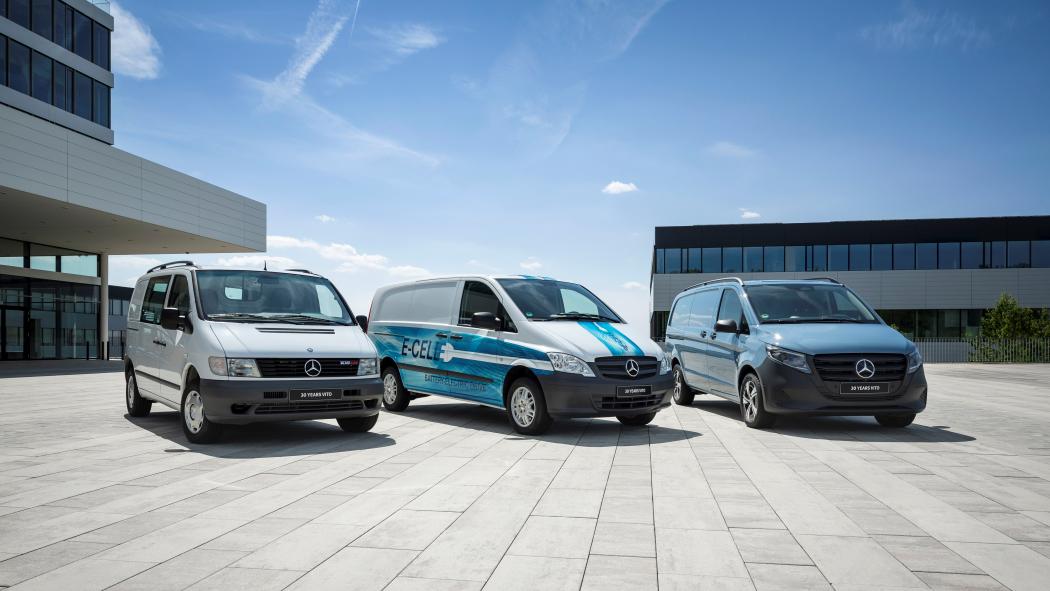
The Mercedes-Benz Vito has been rolling off the production line in Vitoria-Gasteiz, northern Spain, for 30 years. The location is inextricably linked with Mercedes-Benz's mid-size transporter. Today, alongside the Vito and eVito, the V-Class and EQV are also produced on the approximately 373,000 square meter factory site. With over 4,800 employees, the plant is one of the most important in the global production network of Mercedes-Benz Vans.
In 2024, the foundation stone was laid for the expansion of the plant: from 2026, models on the new all-electric platform VAN.EA are to be produced here. Before that happens, let's take a look back at the history of the Mercedes-Benz Vito.
1995–2003: The first generation of the Vito – compact, handy, safe
With the premiere of the Vito in 1995, Mercedes-Benz entered the segment of commercial midsize vans. The new transporter with front-wheel drive was designed for a gross vehicle weight of 2.6 to 2.8 tons. The compact dimensions (1.89 meters in height) allowed for
use in inner-city areas – such as in parking garages and narrow streets.
The first generation offered a comprehensive safety package for the time as standard: driver airbag, disc brakes on all wheels, anti-lock braking system (ABS), automatic brake differential (ABD), and power steering. Customers could choose between economical four-cylinder petrol and diesel engines. The maximum payload was around one ton, and the cargo volume was five cubic meters.
In 1996, the Vito was awarded the title "Van of the Year." A facelift in 1999 brought a modern design and new equipment options. According to Mercedes-Benz, around 473,000 vehicles of this generation were sold by 2003.
2003–2014: The second generation of the Vito – more comfort, more power
The second generation of the Vito marked a fundamental technical transformation in 2003: instead of front-wheel drive, Mercedes-Benz switched to rear-wheel drive. The payload was increased to up to 1,295 kilograms, and the driving behavior was improved. An all-wheel drive variant was also offered for
the first time.
With three lengths, two roof heights, five engines, and numerous equipment lines, the variety of variants increased significantly. More powerful engines, including V6 units, complemented the offering. The second generation again received the "Van of the Year" award in 2005.
A technical milestone was the introduction of the Vito E-CELL in 2010: as one of the first fully electric transporters, it was produced in small series and achieved ranges of up to 130 kilometers. It was used primarily by parcel services and municipal fleets. In total, almost 750,000 vehicles of the second generation were sold by 2014.
2014–present: The third generation of the Vito – digital, electric, versatile
With the third generation from 2014, the Vito received a new design and an even wider range of drive options: customers could choose between front, rear, and all-wheel drive. The maximum length increased to up to 5.37 meters, and the payload to up to 1,369 kilograms. The safety equipment was further expanded,
including standard airbags, seatbelt alerts, and the crosswind assist.
In 2018, the series production of the fully electric eVito started. It was available as a van and tourer and built on the experiences of the Vito E-CELL. A technical update in 2020 brought new engines of the OM-654 series, the 9G-TRONIC automatic transmission, and assistance systems such as DISTRONIC and the optional AIRMATIC air suspension.
2024: Digital connectivity and new drives in the Vito
On the occasion of its 30th anniversary, the Vito received a comprehensive facelift in 2024. The MBUX multimedia system, digital services, a new exterior with LED headlights, and an enhanced interior bring the Vito to a new level of comfort and connectivity. Additionally, a petrol engine with mild hybrid technology complements the drive offering.
Prices start at 32,284 euros gross for the Vito, with the eVito starting at at least 43,055 euros. With a range of up to 480 kilometers (according to WLTP), the eVito is designed for urban