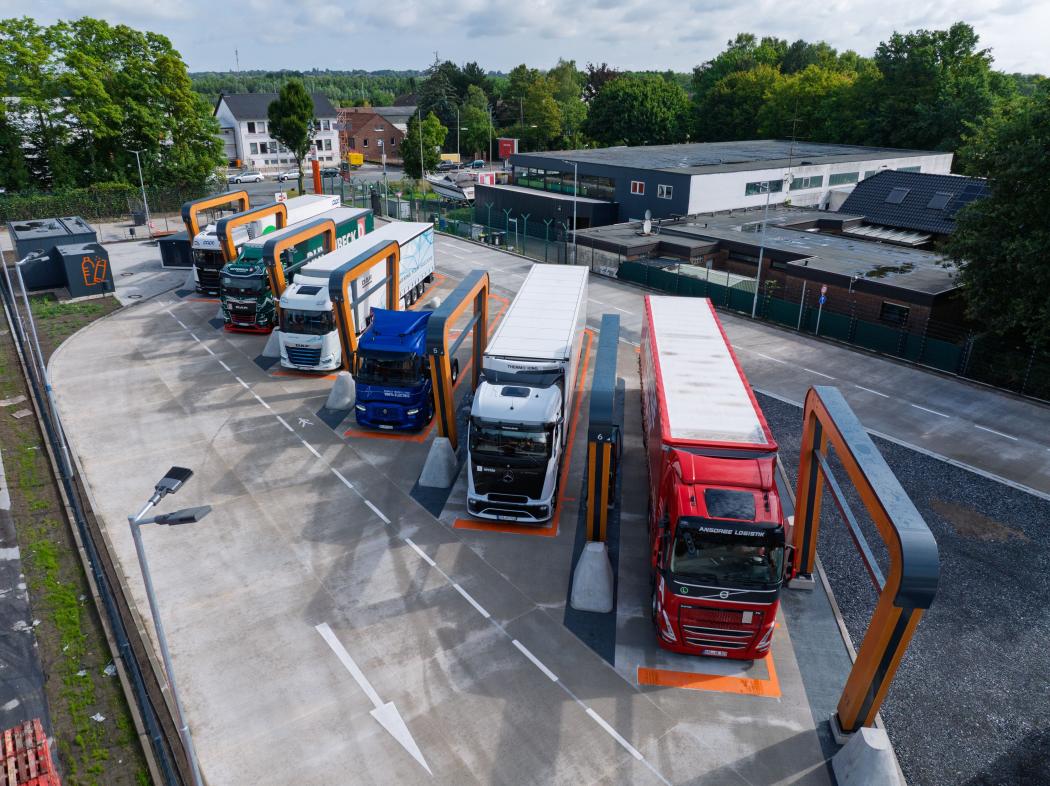
Thus, Recklinghausen is the company's fifth charging park in Germany. The strategically conveniently located charging park on the northern edge of the Ruhr area is intended to serve as an important hub for heavy electric vehicles along the trans-European transport network (TEN-T) in western Germany. It has six CCS charging stations (Combined Charging System) with up to 400 kW. The charging capacity is to be increased in the second phase by the introduction of a Megawatt Charging System (MCS), it is said. Toilets, showers, and vending machines provide further comfort and relaxation for drivers.
Drivers can pay with a variety of common charging cards, independent of brand. Direct payment via terminal or with the Milence Card is also possible. The standard rate is 0.399 euros/kWh (plus VAT). Anja van Niersen, CEO of Milence:
“Germany is the heart and central hub of European road freight transport. Today's opening of our charging park in Recklinghausen is an important step towards closing the gap
for the electrification of freight transport in western Germany. With this expansion, an even more robust charging infrastructure is now available in the Ruhr area, making it easier for fleet operators to switch to electric trucks and providing them with the necessary planning security for their routes. Emission-free transport is not only feasible, it is also slowly becoming economically viable and offers clear economic advantages. Milence is proud to actively shape this transformation in Germany and to pave the way for a sustainable future.”
The three new charging parksAll new charging parks are located at heavily frequented traffic junctions and enable electric freight transport along the TEN-T core network corridors of Rhine-Alps and Scandinavia-Mediterranean:
- Recklinghausen (A2, 6 CCS charging points) connects the North Sea ports of Rotterdam and Antwerp with Hanover or Berlin and Poland
- Koblenz (near A61, 8 CCS charging points) connects the regions of Cologne and Frankfurt
- Kirchberg an der Jagst (A6, 8 CCS charging points) is located on
- the A6 and connects southern Germany with the French border as well as the metropolitan regions of Rhine-Neckar and Nuremberg
Development of charging infrastructure With one of the highest market shares of battery-electric long-haul trucks in Europe and its central location in the continental logistics network, Germany is said to be a particularly relevant market for the electrification of road freight transport. With the opening of the new charging parks, the company aims to triple its number of German charging points and further promote the expansion of a comprehensive charging network for electric trucks.
By the end of 2025, Germany is expected to be one of the largest markets in the Milence network with a total of eight operational charging parks. NRW Minister of Economics and Climate Protection, Mona Neubaur:
“With the first charging park for electric trucks in NRW, we are making a big step towards climate-friendly delivery traffic. Here, electric trucks can be charged with clean electricity – this
protects the environment and reduces noise in our cities and communities. It's clear: The future of logistics is electric. That's why we actively support this change – for better climate protection, for a strong, competitive economy, and for a sustainable North Rhine-Westphalia.”
Planning security for logisticiansElectric freight corridors are forming in Europe, including long-distance routes such as Barcelona-Lyon, Paris-Hanover and Antwerp-Stockholm as the first corridor with megawatt charging stations (MCS). The company’s own charging parks are important hubs on these routes and form the foundation for the first European electric corridors.
By the end of 2025, Milence plans to operate over 30 charging parks in nine markets. In line with the EU funding initiative for alternative fuel infrastructures (AFIF), 284 MCS charging points are to be installed at 71 locations in ten EU member states by 2027. In the future, a booking tool is to facilitate the planning of charging processes and further increase efficiency for fleet operators, according to the