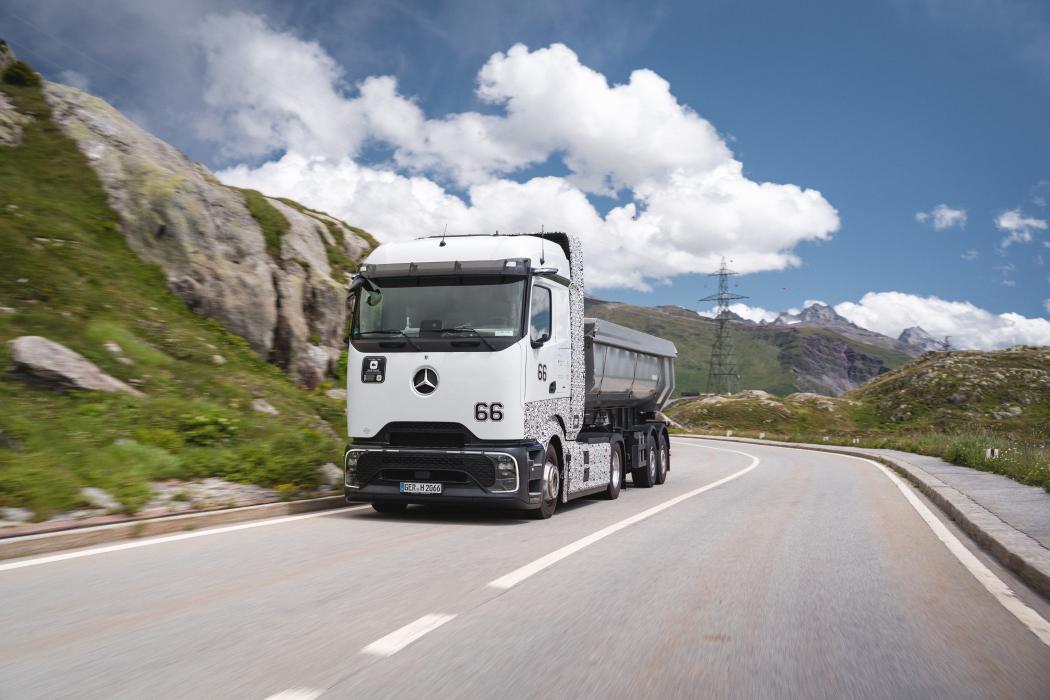
Daimler Truck has returned to the Swiss Alps in the summer of 2025 after successful winter trials with four further-developed prototypes of the next generation of the Mercedes-Benz GenH2 Truck. According to the company, the Valais region, with pass roads at elevations between 600 and 2,478 meters, served as the testing environment. The combination of high-summer temperatures above 35°C and thin air at altitude posed particularly demanding conditions. The aim of the
trials was to verify the reliable operation of the vehicles under extreme loads and to collect data for further development.
Tests under extreme conditions
The development team examined, according to the company, vehicle behavior, the dynamics on the pass roads, the performance of the electric powertrain and the thermal management. Also, the interplay of fuel cell, battery and tank system was tested under real peak-load stresses. Moreover, the further development of the
digital assistant system Predictive Powertrain Control was at the center. The system uses geobased route data to anticipate inclines in advance and adjust the drive power early.
Results of the Alpine drives
The fuel-cell trucks were refueled during the test runs via a mobile fueling station from Air Products with liquid hydrogen to the sLH2 standard. The test fleet covered more than 10,000 kilometers and 146,000 meters of elevation. According to Daimler
Truck, the vehicles demonstrated a stable and reliable performance.
Next steps in development
The company announced that from the end of 2026 it will produce a limited run of 100 further-developed tractor units at the Wörth plant. These vehicles are to be tested in practical operation with selected customers. The large-scale serial production of fuel-cell trucks with a focus on the European market is planned by Daimler Truck for the early 2030s.