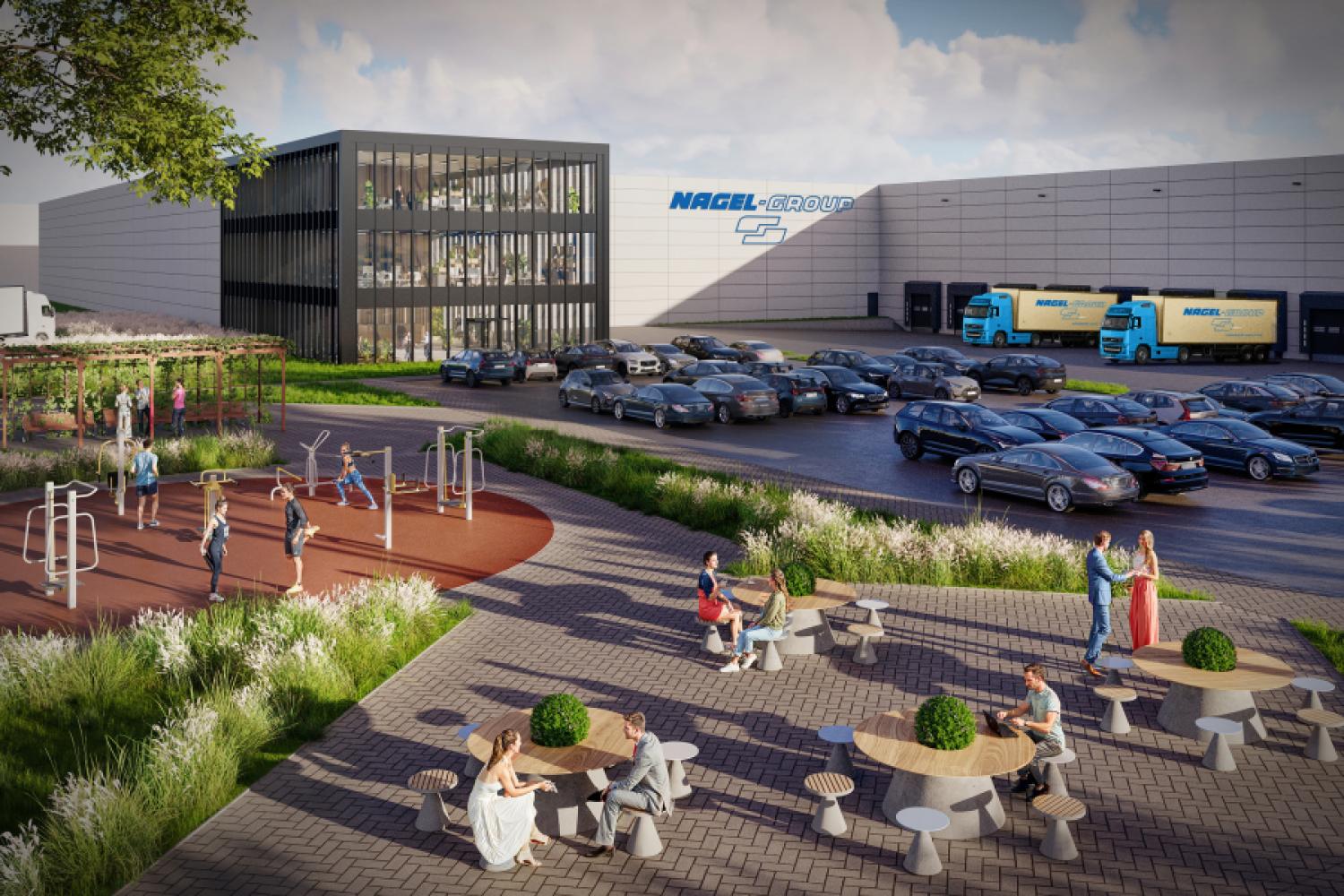
In Diest in the Belgian province of Flemish Brabant, the heart of Toyota's parts logistics beats. From here, at the Toyota Parts Centre Europe (TPCE), more than 500,000 items are shipped daily with 200 truck trips on their journey to 13 regional depots. Each year the TPCE handles around the clock about 120 million parts and accessory articles. Its logistics activities cover 44 European markets and ensure the delivery of the required components across the continent. The around 2,000 employees supply not only the regional depots, but also, via this hub, more than 3,000 Toyota dealers on the continent.
VDL Special Vehicles on board
To date, as in the rest of the parts logistics worldwide, this is still done with diesel trucks. But a first small, sustainable sprout has seen the light of day in May at Toyota: for the past six months the Japanese automaker has four fuel-cell trucks of the type DAF CF with a special frame from the Dutch vehicle manufacturer VDL – known especially for its city, intercity and touring buses – in operation. This marks a beginning at Toyota Motor Europe, which is intended to culminate in the corporation's CO2 neutrality by 2040.
No longer is it a large-scale operation; for a mid-sized manufacturer experienced with alternative drive systems like VDL, brought on board in the form of its subsidiary VDL Special Vehicles. For a giant like DAF it would hardly be worth dragging out its machinery and spitting out only a few vehicles. The VDL frame carries seven 350-bar Type-4 tanks stacked behind the cab in tower construction from the Northern French specialist Plastic Omnium with a total of 39 kg of hydrogen. According to Toyota, this arrangement does not require compromises in
dimensions and payload, so ISO trailers can continue to be used and the logistics standards can be maintained. At the same time, hydrogen capacity was maximized by the integration of the high-temperature cooling system into the tank tower to enable more than 400 km of range.
In addition to the high-voltage batteries from the Chinese world market leader CATL with a total capacity of 210 kWh in six packs, the frame carries two 80-kW fuel-cell modules, which conveniently come from the company's own Japanese house. The drive is completed by a 360-kW Siemens e-motor in the front area.
Start 2022
Strictly speaking, the fuel-cell parts logistics journey at Toyota did not begin in May 2025, but already in January 2022. For then the project began with a feasibility study and the search for partners. In March of the same year, the official kickoff with selected partners, including VDL Special Vehicles, followed. Prototypes were built, and by the end of 2023 vehicle evaluation began.
The project presented its progress during the Olympic and Paralympic Games 2024 in Paris, where the VDL fuel-cell truck supported Coca-Cola's logistics to supply the event with beverages. After handing over the four vehicles to the Toyota logistics partners in early 2025, the trucks began permanent daily operation in May 2025, as mentioned.
Hydrogen price as a problem
Since May, the four H2-40-tonners have together covered more than 80,000 km on four routes in four countries, i.e., on average 300 to 400 km per vehicle per day. From Diest, depots in Amsterdam, Rotterdam, Lille and Cologne were served. One vehicle has already logged around 36,000 km, which corresponds to more than 350 km per day and speaks to the range and the technology on board. More
than 80 t CO2-emissions have already been saved in total – by using green hydrogen produced by the Belgian specialist Virya Energy at its wind farms. Refueling takes place at nine hydrogen fueling stations along the four routes.
The actual operation has, however, also shown bottlenecks in hydrogen mobility, in particular due to the limited coverage by fueling stations and the volatile price of hydrogen – especially due to the different tax treatment in the various European states. It fluctuates by country between 9.90 and more than 18 euros per kilogram. It is cheapest in Belgium, most expensive in the Netherlands. In Germany, prices are typically quoted between 13 and 15 euros. Even at 9.90 euros/kg, operation of fuel-cell trucks can hardly be sustained in the face of the growing battery-electric counterparts, especially since they are closing the range gap rapidly. At 18 euros/kg, economic operation is clearly not guaranteed. Therefore, as Toyota also says:
“An eco-cluster approach is essential to ensure the availability of hydrogen and the competitiveness of prices.”
Along with this, a reliable infrastructure for green hydrogen is as necessary as tailored subsidies.
Next steps
The next steps on its H2 parts logistics journey have already been planned by Toyota. Future vehicles are to receive the third generation of its own fuel-cell module, which is expected to enter the market in 2026. They hope for a performance increase as well as efficiency improvements. In addition, they plan to use 700-bar tanks to achieve weight savings, increase range, and increase space in the cab area, which currently does not allow for a sleeping cabin, so as not to have to compromise on cargo volume. The partner logisticians, however, would like sleeping cabins, low-deck configurations and auto carriers
with a low cab. They also aim to shorten refueling time by using a Mid-Flow double-tank station. Liquid hydrogen is currently not an issue for them; they see it more suitable for long-haul routes or refrigerated transport.
First driving impressions
We had the opportunity in Diest to gather first driving impressions with one of the four hydrogen-powered 40-tonners. What stood out immediately: the quiet operation. Only when you press the button to switch on the fuel cell does the noise level rise slightly, but it remains very tolerable and is no comparison to a similarly sized diesel truck. In pure electric mode the vehicle covers around 100 km, with the fuel cell activated it can add another good 300 km. Of course, it makes sense to use the electric mode mainly in sensitive areas such as inner cities, which we also traversed on our short test drive, as well as highway sections. At 85 km/h the vehicle was locked, while a hysteresis function on downhill stretches allowed speeds of up to 90 km/h.
As one would expect from electric vehicles, the fuel-cell DAF is also quick off the mark – and we certainly drew surprised looks from other trucks following us on highway acceleration lanes. We also praised the finely responsive, hanging pedal arrangement. This was particularly helpful on the tight city sections of our test route and during a wild maneuver in front of the entrance gate to the Toyota Parts Centre Europe in Diest, when parked trucks blocked the view of oncoming trucks and we had to squeeze into a narrow gap.
Whether Toyota, with its hydrogen concept, is on the right track will be shown in the coming years. We will stay on the ball. (Source: