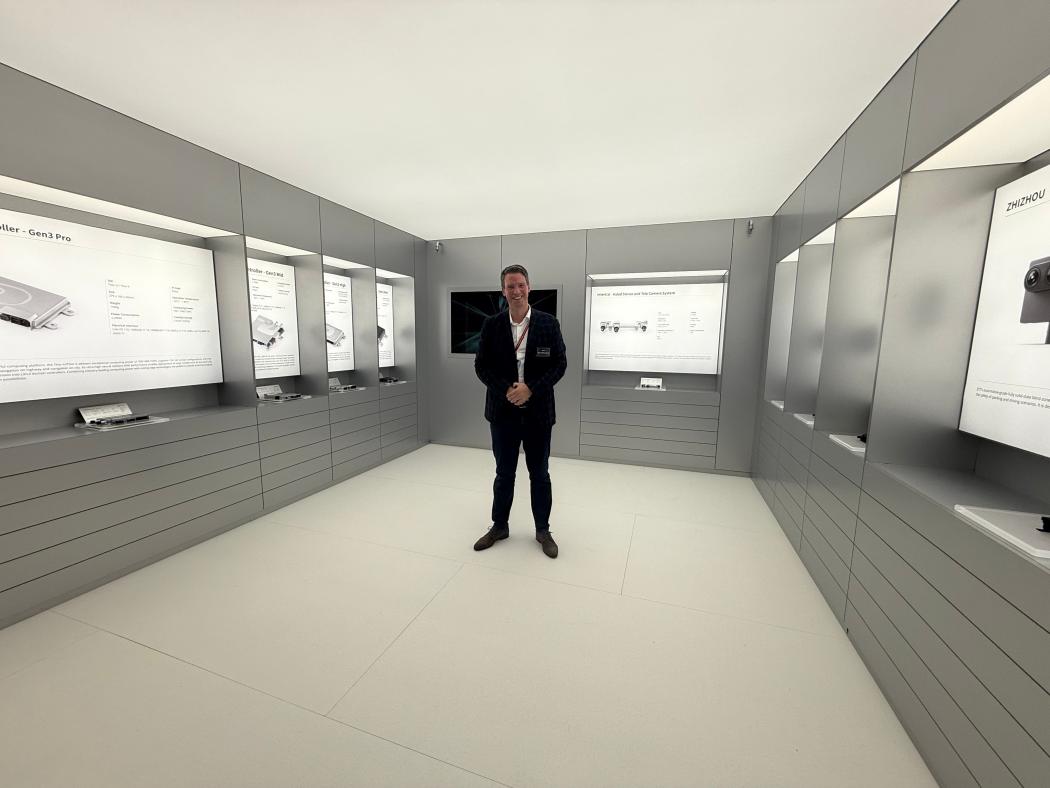
Since the name “Zhuoyu” is very hard to pronounce in Europe, it was decided to start here with the three letters ZYT. ZYT belongs to the still-young full-service providers in autonomous driving, which are already represented in China in many brands and are now venturing the leap to Europe. We were able to experience a first largely autonomous tour from the Messe München to Bogenhausen and back again – in a Hongqi EH7. It had previously been trained on the routes for four weeks and drove the route almost flawlessly: Twice it could not decide whether to overtake a bus and a truck: The truck parked in the second row was identified by the Hongqi as “standing at the traffic light” and waited for it to start moving again. It spontaneously wanted to pass the bus when it activated its turn signal and pulled out of the stop.
In both cases the systems here still lack the “feeling” that humans have. What could already be trained by AI: to take an on-ramp in such a way that it does not make all passengers sick, by not strictly adhering to the boundary lines, but interpreting the radius a bit more freely and then accelerating properly at the on-ramp, very different from China, where it is usually from congestion to congestion or glides, even on large highways.
One still has to intervene in the typical situation “standing cars” at the end of a traffic jam: Here the monitoring driver braked hard when he noticed that the cars in front of us suddenly slowed down extremely and our Hongqi still did not react. Otherwise, the vehicle drove the sometimes complex route, on which there were also nasty road subsidence and hardly marked bus lanes, very confidently!
Afterwards we wanted to know more and went deeper in an interview with ZYT Germany chief Nils Oldemeyer.
How is autonomous driving developing from your perspective?
Nils Oldemeyer: Very good and dynamic! It all started with robotics, that is, strictly rule-based. But with the generative AI, a major upheaval occurred, and we are now developing data-driven. That means the system acts self-learning. You have to imagine it like a child that is repeatedly rewarded for its efforts and achievements and learns. Although we obviously do not have to reward the AI, we can always give it new learning loops.
How did the decision come about to use a vehicle from Hongqi today?
Oldemeyer: That was availability and a bit of luck: The Hongqi EH7 comes with ten cameras, a radar and the new Qualcomm-8650 chip. The car actually arrived only four weeks ago by train to Duisburg, and in the meantime we uploaded the data and then began to “train” here. It was also interesting for us to see how much the vehicle could already teach itself in this time.
Can’t the data and “learnings” simply be transferred from China?
Oldemeyer: No, the data may not be transferred to other countries or regions so simply. They are stored for Europe in a local data center. And: There are completely different driving situations in Germany than in China, and these must be learned. Therefore, it is not the amount of driven kilometers and data that determines success, but the quality of the data. The aim is to find as many “pink elephants” as possible here, such as sign bridges or poorly marked road markings – i.e., special and challenging situations that must be learned.
And how long does one have to train there?
Oldemeyer: We want to be able to drive in Europe in the second quarter of 2026 and offer demos.
Does Zhuoyu only offer complete systems or also individual components?
Oldemeyer: That depends on the OEM. What is
surely unique about us: We offer a complete software stack. Typically the OEM determines which chipset it uses – that can be Qualcomm, Nvidia or Texas Instruments. We then basically sell the box with the chip, and the software stack is tailored for the OEMs.
In what sense?
Oldemeyer: Each OEM has particular preferences for how the cars should behave. Some more high-performing brands or models may perhaps have a slightly “longer leash.” In general, 80 to 90 percent are the same, but there are differences in driving performance. We work this out in collaboration with the OEMs.
How long does it take for such a software stack to be trained?
Oldemeyer: Our “Europe trainings” we want to complete by mid-2026 – so roughly speaking, about a year. But it also depends on the conditions and the fleet. We started with four cars, will soon double to eight, and in the end will have 15 vehicles running. In general, the cars adhere very well to all rules, but in fine-tuning it is about how one drives as a human: that one perhaps approaches a motorway on-ramp or off-ramp that closes later by going a little further to the outside. It is also important to accelerate quickly on German highways and to know that there can also be very fast motorcycles on the road. Or that buses or trucks are reliably detected. They are larger in Europe and the USA than in China, where urban traffic is mainly distributor traffic. You should know: basically your brain is much better than any computer chip. Now it’s about achieving as human a driving behavior as possible – with software that is not as powerful as the human brain and that still has great difficulty with anticipating and “feeling” situations.
Is urban driving probably harder than on the highway?
Oldemeyer: Correct! The German motorway is,
despite sometimes high differential speeds, well “learnable” and relatively simple. With this driving demo from end to end – i.e., from the fairgrounds to the fairgrounds via highway, rural roads and lots of city traffic – we wanted to give a glimpse of what is technically feasible. For this time we only had four weeks, but that was also exciting for us: How far can we get in four weeks?
Already quite far. Many details and critical points the car has already recognized well and implemented accordingly…
Oldemeyer: Thanks to AI one can achieve very rapid progress here in months, as the vehicles generate more and more data for “learning.”
How do you assess the sensor setup without Lidar? Is that enough?
Oldemeyer: We believe, eventually not. For example, in 2026 the laws in China will be tightened again. There is a dark tunnel there where standard objects have to be detected – and they are getting smaller! For that, 4D radars or Lidar are needed. And after we manage to produce Lidar systems that take little space, fit between the cameras in front of the rearview mirror and are 20 to 30 percent cheaper than the competition – with better performance – we firmly believe in the Lidar system.
And you also spare the “taxi sign” on the roof!
Oldemeyer: You will laugh: In China customers love this “taxi sign,” because they like to display technology and signal to neighbors that they are using the latest Lidar technology. There are such Lidar boxes even as “fake” in the aftermarket there. In Europe it is different: Here we prefer to keep our technology hidden. It is also behind the windshield, especially since it can always be cleaned there by the wiper. It is many details like these that make autonomous driving!
The interview was conducted by Gregor Soller, Editor-in-Chief of VISION


