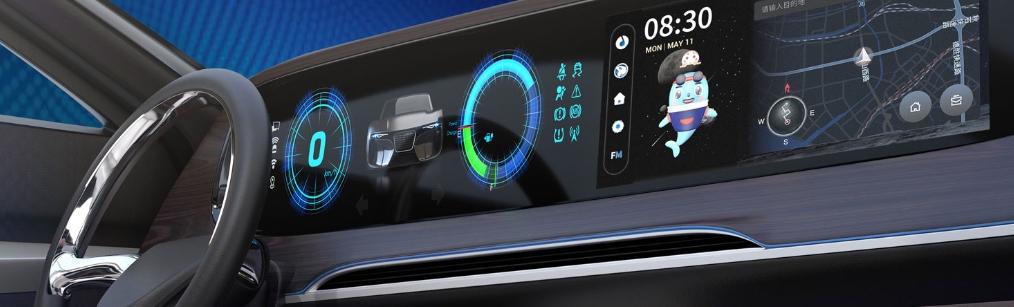
Desay is one of the “hidden champions” in interior solutions. And it also plans to strengthen its European activities. The Desay SV Automotive Europe GmbH is headquartered in Weimar and develops solutions for the original equipment of vehicles in the areas of electronics, antennas and software. The company is part of Huizhou Desay SV Automotive Co., Ltd. with headquarters in China, a global provider of technologies for Smart Cabin, Smart Drive and Smart Service.
As one of the top-100 suppliers to the automotive industry, Desay SV works with manufacturers around the world. With its technical expertise, the company supports the further development of mobility – with the goal of making vehicles safer, more comfortable and more efficient. The portfolio ranges from complex ADAS and camera systems to digital interior systems that offer innovative and diverse displays, opening up new aesthetic and functional possibilities, for example with wood texture – keyword “Shy Tech.” Edgar Yang Yong, Executive Vice President of Desay SV, gave us some interesting insights and background in an interview.
Among the showcased products are, among other things, the AI-powered Intelligent Cabin G10PH platform, the body control unit iBCM 2.0, a 48.2-inch Remote Display (larger than some living-room televisions), a dual 15.6-inch Ultra-Slim Mini LED Display, a 3D-AR-HUD, and various full-stack ADAS solutions.
On a test track in Munich, Desay SV also demonstrated its ADAS total solution: The system reacts to different traffic situations – from highways through urban traffic to unmarked intersections. Traffic signs are recognized, speed limits are automatically taken into account. Right-of-way situations are also adapted to regional rules, so the vehicle remains safe not only technically but also legally. All of this is still future work in the final expansion stage, but at Desay one could also see: this future is becoming noticeably more tangible again.
As part of the trade fair, Desay SV also participated in various industry dialogues. He Zhiliang, Executive Vice President and General Manager of the “Intelligent Cabin” business unit, spoke at the World New Energy Vehicle Congress (WNEVC) 2025 about the transformation of the industry. And Yang Yong, Executive Vice President and General Manager of Desay SV Europe, participated in a panel discussion organized by IBM and contributed global market perspectives to the exchange with European partners.
In Europe, Desay SV is represented with an R&D center, three manufacturing facilities, and several business and development centers
in Germany, France, Spain, Sweden and the Czech Republic. Cooperations with local partners are intended to create a tight ecosystem along the supply chain – true to the regional guiding principle: “In Europe, with Europe, for all.” We also used the IAA to delve deeper into the topic of “autonomous driving” with Edgar Yang Yong, Executive Vice President of Desay SV.
How are the individual fields within the Desay group developing?
Edgar Yang Yong: Smart Driving is currently developing significantly faster than Smart Cabin, and progress in environment perception is advancing rapidly: in 2024, 80 percent of our sold cameras still had a resolution of one megapixel. By 2025 the resolution of 80% of the cameras will be increased to 3 megapixels and/or 8 megapixels.
What volumes are we talking about here?
Edgar Yang Yong (pauses to think and then smiles): In 2024 we delivered 14 million and 7 million cameras, and for 2025 we plan a delivery of 16 million cameras. By 2026 the quantity will reach 40 million.
Desay is established in China; could you also name European customers?
Edgar Yang Yong: We have been working with the Volkswagen Group for almost 30 years, in addition to Jaguar Land Rover, Mercedes-Benz and Stellantis. But compared with China, the revenues in Europe are still modest…
In what way?
Edgar Yang Yong (smiles again): Worldwide we achieved €3.58 billion in revenue, Europe accounts for a very small portion of that so far. The exact figures are all in our annual report.
You offer cameras and radars; how does Desay view the LiDAR topic?
Edgar Yang Yong: LiDAR is now in development as well, because safety requirements in the EU and China continue to rise. To meet them, a LiDAR system is prospectively indispensable. An advantage is that the costs for these complex systems have recently fallen massively.
Desay is also developing smart antenna systems – how will that progress?
Edgar Yang Yong: There are now various data access pathways into the vehicle – in addition to traditional antennas also 5G, GNSS or V2X –, hence antennas are becoming smart and bundling different data access forms. We principally focus on L4 autonomous driving in the commercial vehicle and bus market segment.
Is that also a global business?
Edgar Yang Yong: Basically yes, but the access methods differ legally: while in Europe there is a tendency to connect
the smart antenna to the ECU, in China the 5G modules are integrated into the head unit.
In general, international certification efforts are increasing. How large are the differences between China, Europe and America?
Edgar Yang Yong: Regulation in China often closely follows European regulation, and the Chinese automotive association CAAM also works closely with the VDA.
A problem is also cybersecurity…
Edgar Yang Yong: Here there are very strict rules. We cannot simply transfer datasets created in China or Europe between countries. And yes, our systems require multiple security layers. Cybersecurity has been very important for about 15 years! Examples include Nanyang Technological University in Singapore, the US company Finite State, and NTT Data from Japan. Regularly we subject our products to penetration tests at White-Hat-Hacker level to ensure system security. The topic of cybersecurity has also become more important because there are many more connections into the car: besides Bluetooth, there is 5G, GPS, WLAN and much more. Therefore there are more “entry points” for cybercrime.
Most manufacturers work with various chip makers, we see this at Desay as well.
Edgar Yang Yong: It cannot be any other way. Historically, Nvidia was the first manufacturer to specialize in power-computing chips. In 2017 we were the first company to serially produce Nvidia’s Xavier chip in the industry. Later Qualcomm also entered infotainment and ADAS. Chinese chip companies now offer many alternatives, so we must be compatible with various chip brands.
A discussion also revolves around whether to use a fusion chipset for infotainment and ADAS or two separate chips.
Edgar Yang Yong: That depends on the classification. In the compact car segment, a smart entry-level fusion chipset like the one Qualcomm offers can be the right choice. In higher-priced vehicles, one tends to use two chips, and with driving assistance including high-level AI up to Level 3 you need the whole thing redundantly as a backup. That also costs money.
We would be interested to know what these chips actually cost?
Edgar Yang Yong (smiles): Computing power has grown strongly in recent years: e.g., from 500 TOPS to currently 2,000 TOPS. In the future AI systems could reach 4,000 TOPS or more. Prices vary from a few hundred to several thousand US dollars. AI can process large amounts of data ever faster – as also seen in the camera industry: at the beginning, when we
still used Nvidia chips, the best cameras had 1 megapixel resolution. Today it’s 8 megapixels, and in the future 10 megapixels are possible.
But all of this also requires much more computing power?
Edgar Yang Yong: They also have to be stable, which is why I think it will take a while before we are widely using Level 3 or 4.
Do you always need all data in the car, or how far can you outsource to the cloud?
Edgar Yang Yong: All safety-relevant data must be stored in the vehicle. The cloud is suitable for model training and for OTA updates (Over-the-Air updates). Deviating data are triggered by specific triggers, then uploaded encrypted in accordance with regulations and serve for continuous performance improvement. All uploaded data must be stored and used in accordance with applicable data protection and usage guidelines.
You also offer Smart Surfaces for the interior – among other things, a virtual cat appears on the instrument panel that you can stroke with your head to return to the main menu. There are many so-called “Shy Tech controls,” buttons or displays that lie under fabric or virtual wood. How do you access them?
Edgar Yang Yong: This intelligent interior has not spread as quickly as originally expected. In 2017 the first generation was serially produced in Geely models. Now we are at the third generation, which is even more refined and discreet in design. These technologies can be used not only in the instrument panel – some customers also see potential for new applications on the side doors and in the rear seats.
Do manufacturers order the chips themselves or do they always order complete systems?
Edgar Yang Yong: In general, the Tier Ones order the chipsets, often according to OEM specifications. They typically specify individual parts and can define everything vertically. Especially the European manufacturers are very strong in vertical specification. In China it is somewhat different, but the trend is moving in that direction.
We also heard that production costs in China must decrease by up to 15 percent per year…
Edgar Yang Yong: 15 percent sounds like a lot to me, but actually annual price reductions are also common in Europe and America. However, it’s more like three to a maximum of five percent. Yes – progress is needed here as well (smiles).
The interview was conducted by Gregor Soller,


