At Pöppelmann GmbH & Co. KG, a Lower Saxony-based manufacturer in the plastics processing industry, material transport had previously been performed manually. To meet the growing demands and increase efficiency, the company is now relying on mobile robots from the provider Safelog, according to a press release from October. They are said to take over the entire transport of load carriers in the K-TECH division and thus provide substantial relief for the staff as well as an optimization of production processes.
The plastics specialist Pöppelmann, headquartered in Lohne, employs around 2,500 people and operates around 700 plastic-processing machines at six production sites across various manufacturing stages. The company based in northern Germany offers a broad range of plastic articles, distributed across four business areas and serving numerous markets. These include the automotive, electrical/electronics and food industries, as well as medical technology and horticulture.
As part of their 'Pöppelmann digital' initiative, various business areas are regularly subjected to review to identify potential efficiency gains. The latest example concerns the K-TECH division, where high-quality injection-moulded parts for the automotive and industrial sectors are manufactured. Production in one of the production halls runs on 30 machines, which must be continuously supplied with empty containers. At the same time, the filled containers are positioned at the machines for pickup.
The process starts in the warehouse at the so-called 'station,' where
empty load carriers are prepared on twelve positions on floor rollers by an electric pallet truck. These were previously transported to production by a shuttle train with three trailers, manually detached at the target positions and filled with the injection-moulded parts. “The shuttle trains were very loud, a real nuisance in the halls,” describes Michael Czwaluk, Logistics Team Leader at Pöppelmann, the previous situation. In addition, loading and unloading the trailers was a physical challenge for the employees that was no longer compatible with ergonomic considerations. The scalability and flexibility of the shuttle train system were also inadequate. After around five years of shuttle trains, Pöppelmann decided to modernize the process with mobile robots, thereby increasing efficiency and consistently continuing to test new technologies.
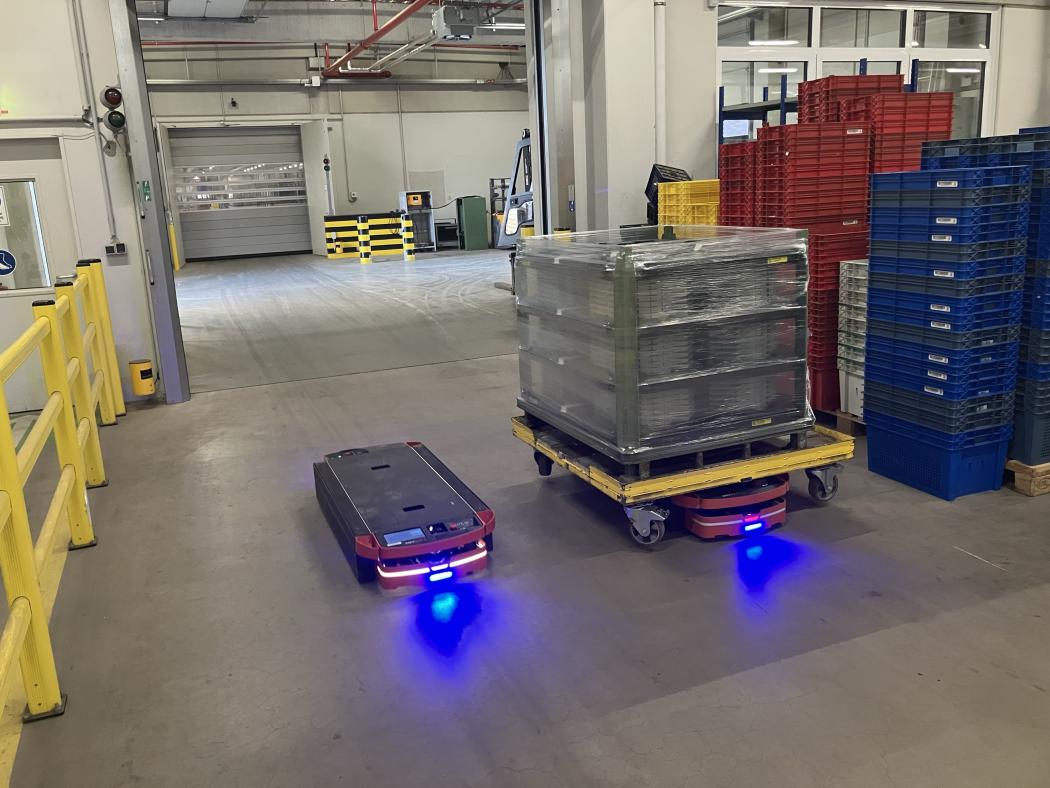
The contract for this went to the company Safelog from Markt Schwaben after a multi-stage selection process. Pöppelmann ultimately chose the mobile robot “SAFELOG M4 lift,” which can cover a broad spectrum of intralogistic tasks. Two technical features of the model were decisive for the choice, according to the company: First, the M4 lift is designed to be so flat that it can under-run and lift the floor rollers from Pöppelmann. And second, the vehicle has a turning radius of one meter, making it extremely maneuverable and able to navigate the sometimes narrow aisles at Pöppelmann without issues. “The compact design of
our vehicles is one of our strengths,” adds Moritz Schmidt, Head of Sales at Safeles. “That’s why the mobile robots also handle limited space well.” The M4 lift is rated for a maximum payload of 1,000 kilograms, which is more than sufficient for the tasks at Pöppelmann. A loaded load carrier weighs around 250 kilograms. In exceptional cases the containers reach a weight of 600 kilograms. There is also a floor roller weighing 120 kilograms per unit.
Deployment in live operation
Nowadays eight mobile robots are in operation at Pöppelmann. Vehicle number nine is used as a backup device and only inserted into the circle during production peaks. In the warehouse they pick up the floor rollers with empty containers, transport them to the production machines and set them down there. The full containers provided at the machines are subsequently picked up by the robots and taken to the station in the warehouse area, where the supply cycle closes. In this way, empty trips of the robots are largely avoided. The deployment of the robot fleet took place during ongoing operations. Not all models were implemented at the same time, but one after another went into operation. “We tacked our way in slowly,” says Dierken. “With our commissioning software we could bring individual robots online, which quickly led to success.”
Mobile robots orient themselves to contour
points
To help the vehicles find their way on their route, the halls were digitally mapped in advance and the data transferred to the robots. Based on the map, the devices now navigate using specific, immutable contour points such as columns, injection-moulding machines or hall gates. The mobile robots move along fixed, virtual routes stored in the digital map. “It works so well that we could do without an additional magnetic track,” says Dierken. At Pöppelmann, there is mixed traffic. The mobile robots therefore have to interact with other traffic participants such as forklifts or workers. To prevent accidents, the devices are equipped with safety sensors. If an obstacle is within the safety zones, the robots slow down or stop until the obstacle is removed.
Agent-based control
The mobile robots do not require a control room, because Safelog uses an agent-based approach. Each vehicle has its own computing unit on which the respective software runs. This enables the robots or agents in the swarm to communicate and exchange the necessary information with one another to complete the upcoming task. The system operates reliably, because if a robot fails, the remaining devices take over the tasks. If, on the other hand, a central control room fails, the entire fleet would be affected. “With agent-based control, in the worst case even every unit can continue on its own,”