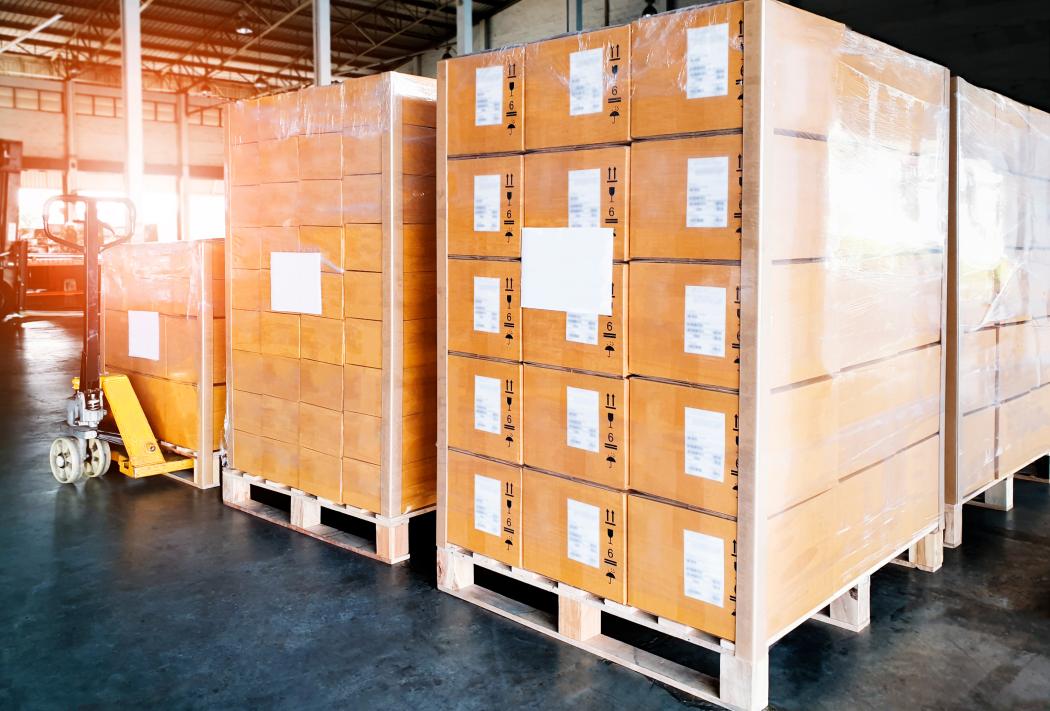
The European Commission announced on 15 October to exempt pallet wraps and strapping bands under two delegated acts from the reuse targets of Article 29.2 and 29.3 of the Packaging and Packaging Waste Regulation (PPWR).
To date, Articles 29.2 and 29.3 require that transport and retail packaging, which are used between different locations of the company as well as in dealings with other economic operators, be 100 percent reusable within a reuse system as of January 1, 2030.
„The Commission's decision to exempt pallet wraps and strapping bands from the reuse targets of PPWR Articles 29.2 and 29.3 shows how important dialogue between the Commission and industry is. Only in this way can practical perspectives be captured to find solutions that contribute to the overarching goals of the PPWR and are also feasible to implement. The path to greater sustainability and a circular economy presents all stakeholders with challenges that can only be addressed together,“ said Dr. Natalie Brandenburg, Managing Director of the German Packaging Institute (dvi) in a statement on 16 October.
„Studies have shown that an enforced blanket reuse of pallet wraps and strapping bands would increase the CO2 balance in many cases and at the same time reduce labor and traffic safety. Ultimately, however, it
must always be about finding solutions that contribute to the overarching sustainability goals of the PPWR without neglecting social and safety-relevant aspects. The most advantageous solution in this sense often depends on the concrete application. Blanket quotas are usually counterproductive“, continued Brandenburg. „Both innovative multi-use solutions and the innovative use of recyclates are indispensable for the sustainable handling of packaging and a functioning circular economy. As the largest national network of companies along the packaging value chain, we will continue to rely on dialogue between industry and regulators. This also applies with regard to Article 29.1 of the PPWR, which currently requires transport and retail packaging to be reusable at least 40 percent within a reuse system as of January 1, 2030, regardless of their use. Here the Commission has announced that it will work on the methodology.“
To provide companies along the value chain with basic orientation and assistance around regulatory aspects of load unit securing, the dvi is preparing a practically oriented information paper. It collects results from the Load Unit Securing Committee, in which member companies from the supply chain contribute their expertise.
„For some time now, the dvi has pursued the goal of unlocking important packaging industry topics through competent committees for the sector.
To this end, we pool the extensive expertise that our more than 280 member companies bring. In this way, we want to provide important support and guidance for the sector's companies and thus promote the development of new, innovative solutions. Moreover, through committee work we want to transmit well-founded impulses and information into political decision-making processes. It is important to us to always view packaging holistically. Therefore, in the Load Unit Securing Committee we address the fundamental goals and opportunities of the PPWR, address political and regulatory uncertainties, cover technical and logistical aspects, bring material availabilities and qualities into focus, identify potentials and discuss open questions“, said Brandenburg.
Also the European Plastic Films (EuPF) association, which represents the European plastic film processing industry, views the European Commission's decision as positive. Nevertheless, EuPF criticizes that Article 29, paragraph 1 of the PPWR remains unchanged. It provides that for cross-border transport packaging a reuse rate of 40 percent by 2030 and 70 percent by 2040 applies.
„We welcome the pragmatic recognition of the economic realities by the Commission in accordance with Article 29(2) and 3. The same scientific and economic findings clearly show, however, that an exception under Article 29(1) is equally justified. The IFEU life-cycle assessment shows that reusable
alternatives lead to considerably higher greenhouse gas emissions – in some application areas up to 1,700 percent –, while the RDC economic study finds annual cost increases of almost five billion euros in eight key sectors. From an ecological perspective, the logic is clear: with increasing transport distances, emissions also rise, which makes reuse for cross-border logistics even less attractive and thus strengthens the arguments for an exemption under Article 29(1). From an economic and practical standpoint, the obligation for companies to operate parallel palletization systems for the EU market and the export market would entail a complete redesign of logistics processes, which would impair competitiveness without yielding an environmental benefit“, said Thomas De Meester, Head of EuPF.
The EuPF states that it continues to advocate for a scientifically grounded and coherent implementation of the PPWR to ensure that reuse obligations truly reduce environmental impact while preserving Europe's competitiveness and operational efficiency. All future solutions must also maintain the current standards for load securing and occupational safety, which have been achieved through years of technical optimization and investment. The association will continue to advocate for an exemption for pallet packaging and bands under Article 29(1) without hindering the progress already made with regard to Articles 29(2) and 29(3).