Akkodis, part of the Adecco Group and active in digital engineering, is developing autonomous driving technologies for European port infrastructures within the EU project “PIONEERS1.” The goal of the project is to significantly reduce greenhouse gas emissions in port logistics and to make operations more efficient and resilient through digital solutions, Akkodis announced in a press release on July 16.
The EU-funded project “PIONEERS” (PORTable Innovation Open Network for Efficiency and Emissions Reduction Solutions) has been running since the end of 2021 and is coordinated by the Port of Antwerp-Bruges. A total of 47 partners from industry, research, and the public sector
are involved—including the ports of Barcelona, Constanta, and Venlo.
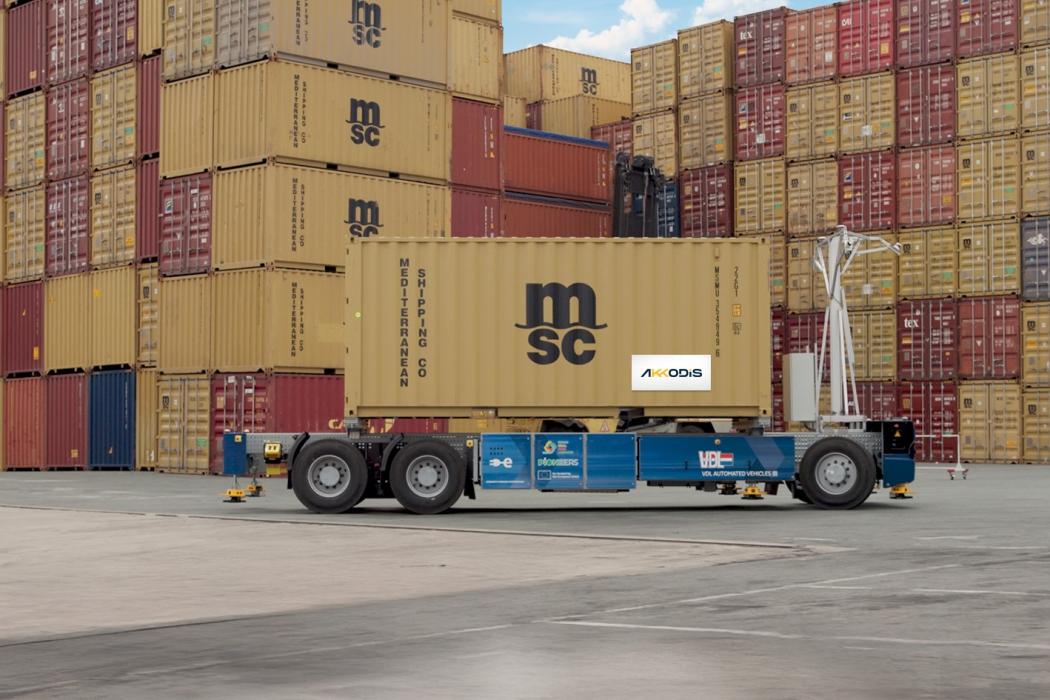
Akkodis contributes its expertise in autonomous systems and real-time control to the development of a fully electric container shuttle that automates short-distance transports within the port area. The solution is based on an Akkodis software stack, supplemented by LIDAR sensors and GNSS-supported navigation. The shuttle operates around the clock without manual control and is monitored via a central human-machine interface.
On May 15, the current development status was presented during a live demonstration at the Medrepair terminal of the Port of Antwerp-Bruges. Prior to this, the shuttle had already been technically validated in
Breda, Netherlands.
“The live demonstration showed that autonomous systems can reliably function even under real conditions—especially in complex environments such as container terminals,” said Nicolas Bonnotte, Director Akkodis Research Germany. “We are working on further developing the technology for practical use and integrating it into existing port processes.”
The technology is part of modern Logistics-as-a-Service models and addresses key challenges of the European port industry: higher efficiency, comprehensive automation, and sustainable decarbonization. According to the announcement, the use of electric drives and optimized routing can reduce CO₂ emissions by about 10 percent. At the same time, dispensing with drivers allows up to
80 percent higher automation. Akkodis research teams in Germany and Belgium are, according to their own statements, working on safe object detection, precise real-time navigation, and seamless system integration.
“The transformation of European logistics requires intelligent, sustainable, and scalable solutions,” said Dr. Peter Mehrle, CEO Akkodis Germany. “As part of the “PIONEERS consortium,” we are effectively contributing our technological expertise—with the goal of enabling tangible progress in the decarbonization of key logistics infrastructures.”
“PIONEERS” is one of several European projects in which Akkodis Research is testing innovative technologies for resilient and sustainable industrial applications—from digital mobility to low-emission production systems to AI-based