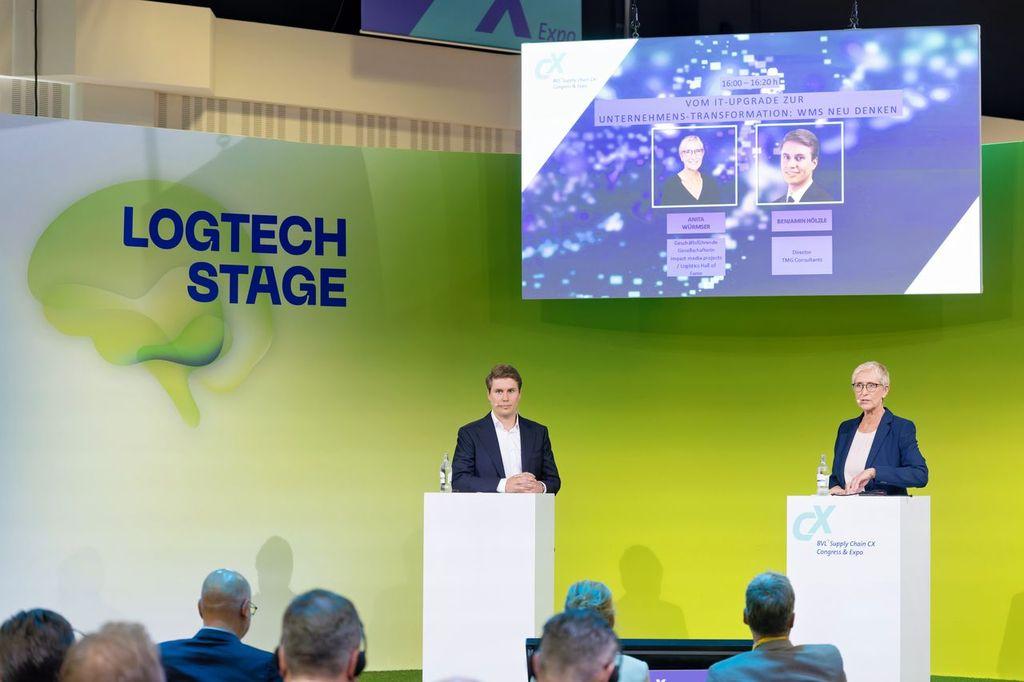
95 percent of industrial companies plan automation projects in the coming years – but many create barriers for themselves with today's system decisions. This is one of the results of the study “Transformation Warehouse-Management-System – Strategic Success Factors and the Most Common Pitfalls” by the consulting agency TMG. The investigation, which was presented for the first time at the BVL Supply Chain CX 2025 in Berlin, comes to the conclusion that short-term rollout goals are often given greater weight than long-term viability. This is associated with the risk of massively hindering one’s own innovation plans later, according to the study authors in a press release dated October 27.
For the study, decision-makers, executives and domain experts from logistics and IT in the manufacturing industry were surveyed. In the end, 50 responses made it into the study, with care taken to ensure that participants had recently engaged with the topic of WMS or were currently dealing with it.
With the phase-out of the widely used SAP WM module, numerous companies stand, according to the announcement, before a technological turning point. But instead of using the transition for a fundamental process optimization, many businesses are rebuilding their old structures. TMG has regularly observed this development in
projects, according to company information—and therefore initiated the study to provide executives and project leads with data-driven orientation.
Transformation is not an upgrade
Inadequate market knowledge, conservative project methods and short-sighted system decisions have the study identify as the biggest obstacles on the way to future-proof solutions.
“Replacing SAP WM is far more than an IT upgrade – it is a business transformation,” says Benjamin Hölzle, Director SCM & Logistics at TMG Consultants. “Our study shows that strategic course-setting must be done now: Those who do not consistently optimize processes, know too little about the market, or make system decisions too short-term will hinder their own future viability. At the same time, this opens up the possibility to redefine intralogistics excellence and gain a real competitive advantage.”
The study concludes that the main motivation for a system change is more of a technology-driven compulsion than a strategic measure. For 36 percent of respondents, the end of SAP R/3 maintenance and the discontinuation of the WM module is the decisive trigger for a WMS project. However, only about a quarter of the companies use the opportunity to specifically optimize processes and introduce new functionalities.
Gaps in WMS market knowledge
The cause: Most companies do not
know the WMS market well enough. More than 60 percent of respondents can name at most three providers besides SAP. This drastically narrows the scope of choice in the early phase of a project, according to the study authors. The consequence is a strategic dependency that can massively affect flexibility and cost control later.
Deficiencies also appear in project management. Nearly three-quarters of companies continue to rely on proven approaches such as breaking the project into phases, although modern WMS projects are characterized by high complexity and tight resources. At the same time, only 22 percent use suitable project management tools. This methodological gap leads, according to TMG, to projects frequently stalling – especially when the implementation of SAP S/4HANA ties up resources in parallel.
Transparency is often lacking
The picture is particularly critical when it comes to process transparency: 82 percent of companies document their logistics processes incompletely or patchily, according to the study. Thus, the most important basis for a successful transformation is missing. Instead of optimizing processes, inefficient workflows are cemented in the new system.
To avoid typical mistakes and invest profitably, TMG recommends clear priorities. First of all, the analysis and optimization of one’s own logistics processes should always come
first – before a system decision is made. In addition, TMG recommends reviewing the market neutrally and comparing different solution approaches such as Best-of-Breed or Single-Source to avoid dependencies. It is also important to keep the future in view: an open and flexible IT architecture ensures long-term agility and protects against over-strong dependence on a single provider, even if the start may be somewhat more laborious, according to the consultants.
Key findings of the TMG study “Transformation Warehouse Management System”:
- Fragile foundation: 82 percent of companies have gaps in their process documentation. Inefficient workflows are therefore digitally cemented into new systems.
- Dangerous comfort zone: More than 60 percent of respondents know at most three WMS providers besides SAP. The limited market knowledge increases the risk of vendor lock-in.
- Short-sighted architecture: 95 percent of companies plan automation projects, but 86 percent prioritize short-term rollout efficiency. In this way, many create their own barriers to future modernization.
- Project management in contradiction: 73 percent rely on traditional waterfall methods, only 22 percent use modern project management tools – despite high project complexity.
- Change management neglected: While 91 percent of companies have conducted training on system handling, only a few convey the strategic backgrounds – an obstacle to