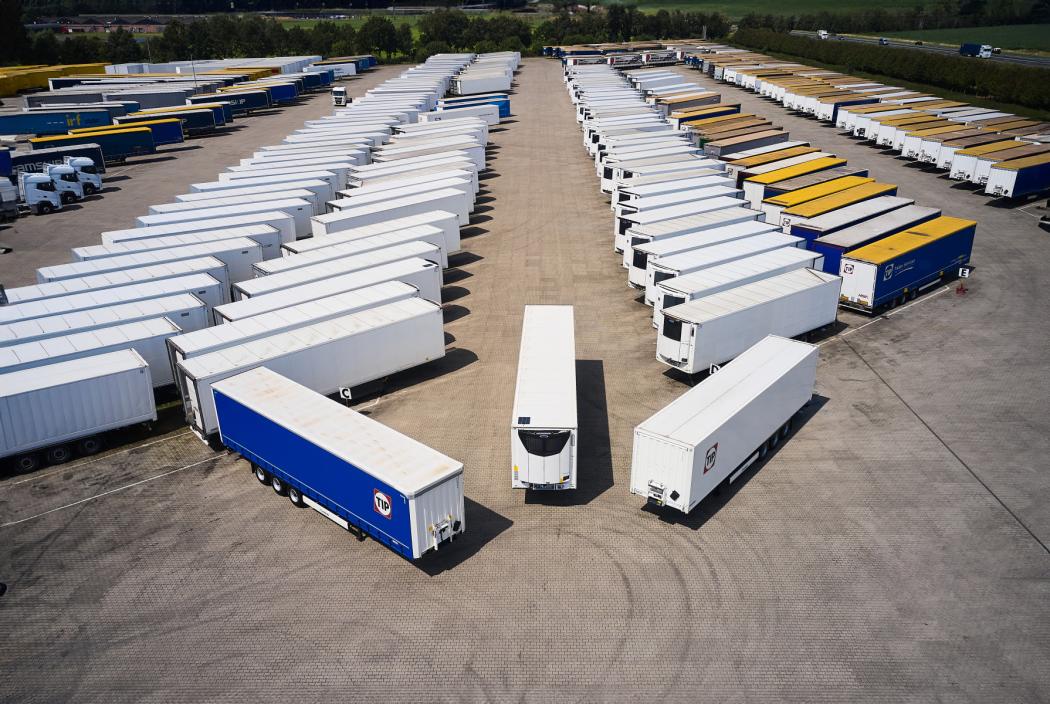
The role of the fleet in road freight transport is fundamentally changing. This is what TIP Group is convinced of. Fleet management is thus developing from a purely operational cost center into an instrument of capital management. Every decision regarding the composition and financing of the vehicle fleet today affects return on capital, liquidity, risk profile, and the assessment according to sustainability criteria.
Arjen Kraaij, who will assume the position of CEO in the company in December 2025, classifies fleet management as a company-wide task in which both the fleet manager and the management board are involved. The background is that fleet costs in many companies rank among the largest expenditure items, and even minor optimizations can measurably affect the operating result.
"In many companies, fleet costs are among the largest expense items. Even small optimizations can noticeably alter the overall result. Therefore, fleet management is today a company-wide task, from the fleet manager to the board," says Kraaij.
Rising vehicle prices are changing procurement strategies
The fleet service provider reports clearly rising prices for tractor units and trailers. In individual market segments, the acquisition costs allegedly increase by thirty to forty percent. Trucks with electric drive are said to cost two to three times as much as comparable diesel vehicles. At the same time, the situation in the workshops is becoming tighter because maintenance capacities are becoming scarcer.
Companies could
no longer order vehicles at short notice from the dealer and take them into the fleet, according to TIP Group's assessment. They would have to assess, for each procurement, which financing form is feasible in the specific case, how liquidity and balance sheet structure can be managed, and how maintenance and availability of the vehicles can be organized. Vehicle procurement thus moves from a routine task to a strategic issue that tightly connects financing, risk management, and sustainability.
Balance sheet relief through flexible utilization concepts
More and more shippers and carriers are seeking ways to finance their fleets off the balance sheet. They increasingly rely on lease contracts. Others opt for rental models. Add to that pay-per-use agreements tied to usage. The aim of these approaches is to reduce tied-up capital, create additional liquidity, and adjust fleet size more flexibly to actual transport demand.
"Data from telematics and maintenance systems become a real lever for optimizations," emphasizes Kraaij. "Performance monitoring, predictive maintenance, and lifecycle analyses not only improve availability and cost control but also capital planning."
The company explains that flexible vehicle models are increasingly serving as financial control instruments. Companies aiming for a high return on capital try to keep their balance sheet lean in order to achieve the same profit with less invested capital.
Data-driven control of the vehicle fleet
At the same time, the digitization of the fleet
more closely links the operational business with the financial results. Data from telematics systems and from maintenance provide the basis for ongoing performance monitoring. Companies can plan maintenance proactively and systematically evaluate the lifecycle of individual vehicles.
According to TIP Group, this data-driven approach not only improves availability and cost control. It also facilitates capital planning because investments, residual values, and usage scenarios can be forecast more accurately over the entire lifecycle of a vehicle.
Refurbishment as an alternative to new purchases
According to the fleet service provider, sustainability requirements have become a fixed part of fleet management. He infers from this that economic and ecological goals are coming closer together. As an example, the company cites the major overhaul of used trailers.
Refurbishment concepts are gaining increasing importance and are already being implemented in many fleets. Companies have existing trailers fully refurbished in specialized workshops. This should extend the service life and reduce investment and financing costs. At the same time, the emissions that would be incurred in the production of new vehicles are reduced.
TIP Group describes a model in which it purchases six- to seven-year-old trailers from customers, refurbishes them, and then rents them back out at a fixed monthly rate. According to the company, this reduces investment and interest costs, while freeing up capital for other priorities.
Refurbishment can also be linked to long-term rental contracts. The
company cites agreements with terms of fifteen years, in which a major overhaul is contractually anchored in the eighth year. The costs for this intervention are included in the rental rates over the entire contract term, which should increase the predictability of expenditure and performance.
New requirements through regulation and frameworks
In addition, the regulatory framework conditions for road freight transport continue to tighten. The company points to stricter environmental requirements in Europe. With the VECTO framework, the costs for trailers accordingly rise.
Companies would have to adapt to a higher level of requirements in financial and operational planning. Fleet management thus increasingly comprises capital strategy, risk management, and regulatory planning. It is developing into a strategic discipline that is anchored at the level of corporate management.
Role of TIP Group in fleet and service management
The company sees itself as a partner to transport and logistics companies in this realignment of fleet management. According to the company, it supports its customers in freeing up capital, managing risks more selectively, and linking the operational fleet more closely with financial targets.
According to its own statements, the service offering includes digital transparency solutions, flexible financing models, and service-oriented concepts with a sustainability reference. The goal is to manage the fleet not only as a cost block but as a control variable for profitability, liquidity, and the sustainable orientation of the business model.