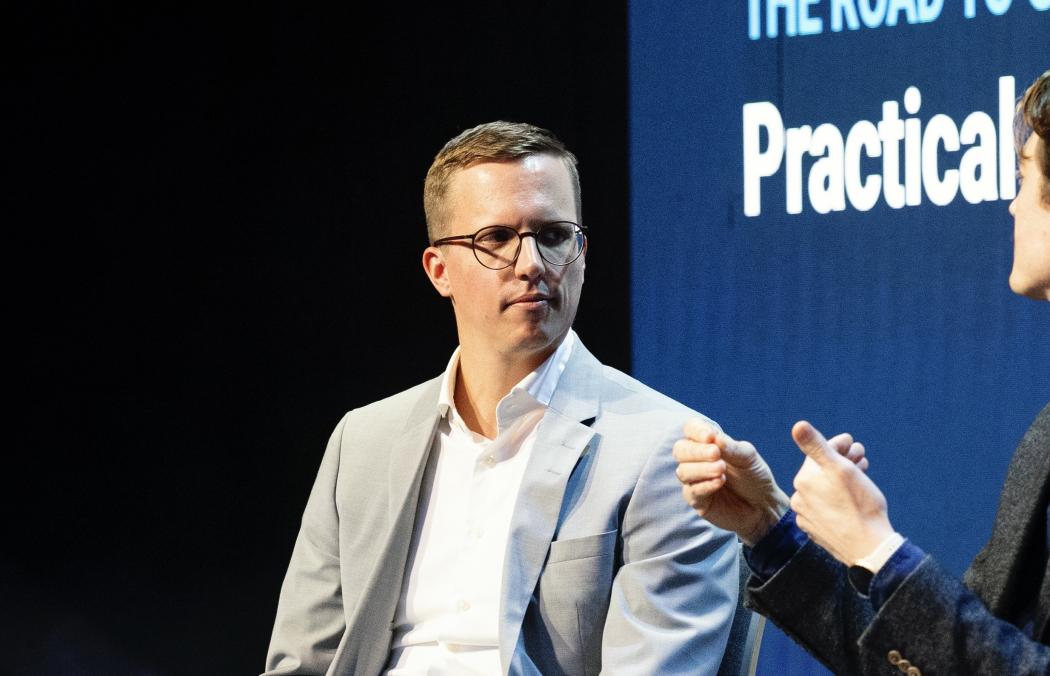
The Geotab Connect in Luxembourg was wholly focused on artificial intelligence. Fabian Seithel explained to us in a detailed interview how it can be used and how, in telematics in general, the topics of safety, fleet management, and route planning are developing.
We have the impression that the USA, Canada and in Europe also the UK are already significantly further ahead when it comes to the use of cameras in fleets – can you confirm that?
Seithel (laughs): I have a two-part answer. First: that we discussed the topic of cameras, among other things, with two panel participants from the UK, is coincidence. But in fact the video safety penetration in the UK is higher than in continental Europe. Also there, however, interest is growing, although this in the UK has tended to be higher anyway. Second: interest in proactive video telematics has generally risen significantly, though we keep finding that it is never an implementation overnight, but the participants must always be brought on board. And typically you start with pilots.
How does that typically work?
Seithel: In every workforce there are almost always volunteers who are open to new things or like to try new things. They are usually found quickly. You then only have to show that you act correctly, respect privacy, handle data with particular care, and that video telematics helps everyone by making inconsistencies easier to resolve or errors clearly documented.
I still remember the evidence presented by a truck driver in the USA who was wrongly accused of having run into a car that was turning left. The video clearly exonerated him, and he was acquitted. It was a crystal-clear case. But what can one read from proactive video telematics when things get trickier?
Seithel: A lot, I use them myself as well, and I always welcome the differentiation when someone tails another vehicle too closely. I may be at fault, but it can also be forced when someone squeezes into a tight gap right in front. Proactive AI can interpret this differently; the previous simple telematics approach lacked the context.
I remember a case that was exactly about such a situation, which then had to be clarified in court for a long time…
Seithel: Here proactive video telematics can help clarify. And since it would be insane to watch and evaluate every driving impression in large fleets for days, the AI must be trained to select only the strongest driving situations. And the AI
then also decides in which aspects to train the drivers. Example: If I’m driving on the highway with my family and I’m told that the time to impact is only 0.24 seconds, it becomes clear that that isn’t very smart. Here a real-time alert must be set that immediately points the driver— in this case me— to their mistake. Critiquing afterwards is not as effective – better to pass on the impulse directly. Usually such a “live coaching” is well received and increases safety.
The topic of safety seems to have gained substantial importance. How about the “classic” competencies of telematics – fleet or driver profile transformations?
Seithel: Generally, the topic of sustainability remains important. And here too we can use AI to analyze data, merge it, and provide a targeted assessment. For example, we have the suitability assessment for electromobility, for which I input several parameters and then can have it output at the push of a button. We run this in the background proactively in the Sustainability Center. You can also input other driving profiles or amended driving profiles for future use. Fundamentally, you should know: the data don’t change much, but the more you have, the more you can read from it. And here, above all, look for “outliers,” which is much easier and faster with AI. This is how we also determine the theoretically possible accident rate or the probability of breakdowns. The important thing is only to draw the right conclusions and derive actions from it.
Do you have a concrete example for that?
Seithel (smiling): Take, for example, a worn summer tire that we know has already run a lot. If it is also driven with low air pressure, that is especially unfavorable in autumn, during tire-change season, when tire dealers and workshops are already fully booked. So better to replace beforehand and always set the correct air pressure.
How does Geotab know how the AI needs to be further developed – isn’t that very complex for customers, who also need the prompts for it?
Seithel: Take our AI assistant Geotab Ace: Of course we also look at the questions that come in, and analyze whether our system provides precise answers. Here we can then also fine-tune the systems. The customer does not have to adjust anything with Ace; the AI is an integral part of the product. The advantage is that the return on investment with AI can be achieved faster and that, if
needed, targeted training can be initiated. There are so many possibilities, I always call it “congestual Power” or in German “gestaute Kraft”…
In what sense?
Seithel: We collect so much data that it can be combined and analyzed in many different ways…
What some users found sometimes too much and too confusing…
Seithel (smiling): …the possibility did indeed exist. But thanks to AI we now have the ability to smartly combine and precisely derive why what happened where and how. And you can then consolidate it and put it on a map or in a graphic, because people find it easier to understand with pictures or graphics. The next step therefore also goes further in visualization.
What is the feedback from your customers on that?
Seithel: They welcome it, but in the end everyone has individual demands, because every fleet is different: In car sharing different rules apply than in rental cars, parcel and express (KEP) fleets or tradesmen fleets. The latter earn their money when the vehicle is stationary, the former when it is moving! That means our platform must detect the deployment to be able to show how to optimize it.
With AI you can also simply ask questions to the system. Is that used, and what kind of questions are they?
Seithel: We started the pilot in May 2024; at that time we had 100 users on board, now it is already over 1,500, with a trend continuing upward. The questions vary depending on background, but the next step is to prepare them well so that the platform is easier to use. ACE has them very well prepared, and you just have to prompt the topics now. For example, you can also make suggestions in the Sustainability and Maintenance Center under the motto: “Did you know…?”
Could telematics thus also become a partner and advisor that proactively makes suggestions?
Seithel: Certainly! Artificial intelligence is very strong, especially when it comes to generating insights from data. That suggests action, and in practice it is then about nudging something from these data, insights, or recommendations. A good example is proactive maintenance of a car, which I can schedule for the most convenient time. That might be five minutes of effort that later saves me two days of downtime because the car fails or parts are not available.
What about the OEM side? In an ideal world, the car would sign itself up for service, or the person responsible would do
so, then the workshop would take care of everything needed and you would have minimal downtime. How far are we in practice?
Seithel (smiling): Our business is to provide data, generate insights, that allow the customer to do something with it. In maintenance we know when and whether the vehicle has been serviced, but the details are not fully integrated into our systems. Many customers try to integrate this data into systems or maintenance software, but feedback to us is lacking. Still, we can build algorithms from data to determine the chance of a potential breakdown. And regarding OEMs - we work very cooperatively with vehicle manufacturers and are now integrated with more than 80 percent of the leading OEMs, continually expanding the joint fleet offering.
Interestingly, the weighting seems to have shifted: driver safety is now the focus – also in Europe. The maintenance topic is especially in fleets that are very intensively used, a topic, i.e., in last-mile delivery, where outages are disproportionately expensive. But sustainability remains a big theme, and the switch to electric vehicles is definitely a topic: For example, the Belgian Post plans to deliver CO2-neutral on the last mile by 2030, and also optimizes the charging infrastructure. The variables here are also interesting.
In what sense?
Seithel: Let me give you an example: If electric vehicles operate in several shifts and in the afternoon only very short routes are driven, they do not need to be charged to 80 or 100%, but 40% state of charge may suffice, which after the tour may have fallen to 32%. That is something quite different from sending an electric truck on a long-haul route from Helsinki to Lisbon. Here you can also create valuable and important links to charging infrastructure.
Which brings us back to the end to the original core topic, route planning. What role does it play?
Seithel: Route planning remains a very individual topic, and it depends a lot on whether I have 20 or 200 stops, what delivery time windows are involved. This involves a lot of context – think of refrigerated goods, where time windows plus temperature windows come into play, or KEP services that are required differently around Christmas than during the rest of the year. Here you need many additional pieces of information, and there isn’t one single question the customer asks. But one thing is clear: artificial intelligence certainly helps in finding the answers!
The interview was conducted by Gregor