According to Arag, about every second traffic accident with personal injury is due to difficult road conditions and weather influences. Also in autumn there is a lot to consider thanks to short days, fog, autumn leaves on the roads, wildlife crossings, frost and ice.
Vehicle Check
Arag expert Jan Kemperdiek recommends in autumn a small workshop check to inspect the battery, lighting, windshield wipers, tires and antifreeze.
Nebel
In fog, his recommendation is “Take your foot off the gas and increase the distance.” As a rule of thumb: distance equals half the speedometer reading. At a speed of 100 kilometers per hour (km/h), one should therefore maintain at least a 50-meter distance.
According to the Road Traffic Regulations, the maximum speed is 50 km/h as soon as visibility falls below 50 meters – this also applies on motorways. If visibility worsens further, it is advisable to stop at the next parking lot and wait until the fog lifts.
Nasses Laub
Another challenge: wet leaves. Fallen leaves can, according to Kemperdiek, become as slippery as black ice when wet. Especially in curves or when braking the vehicle can quickly skid. Here too, you should adjust the speed, brake early, and drive with foresight.
Even those who have already mounted winter tires should not lull themselves into false security, says the Arag expert. It is also worthwhile when parking under trees to regularly remove leaves from the vehicle – so that ventilation slots and water drains do not become clogged.
Aquaplaning und Pfützen
According to Kemperdiek, aquaplaning also poses a
danger. The danger increases when puddles form on leaves. Then one should ease off the gas and not steer or brake abruptly.
In addition, tires should have at least four millimeters of tread so they do not lose ground contact too quickly. And the windshield wipers should also be checked regularly, the advice goes. If they smear, it is time to replace them.
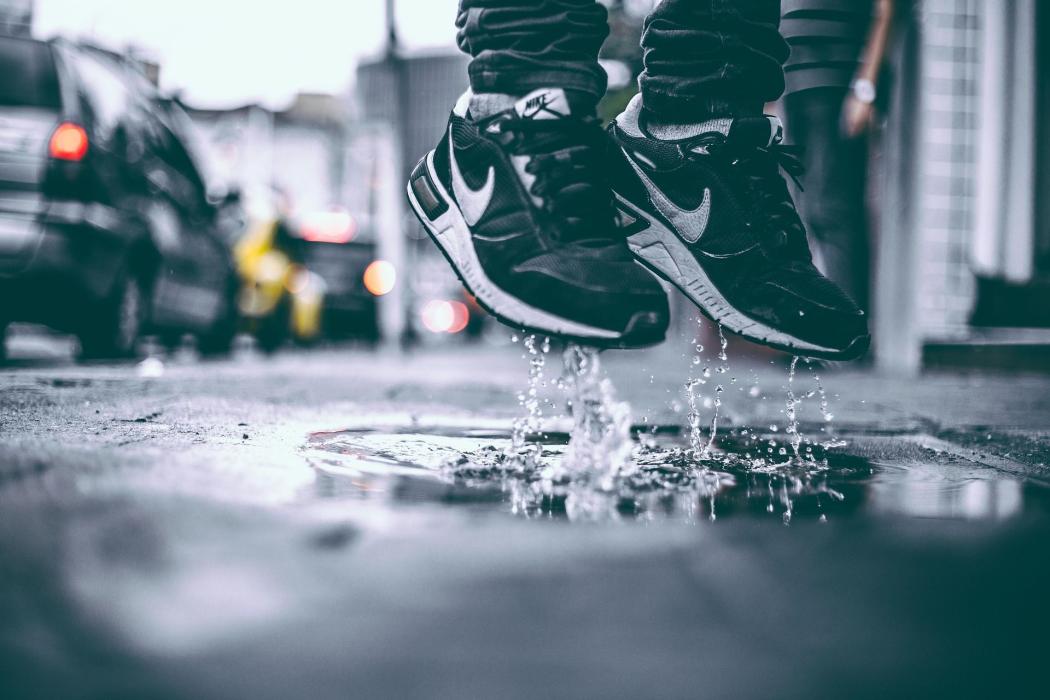
Also good to know: if you drive a puddle past pedestrians and splash them wet, Arag says this can be considered an administrative offense. You are obliged to adjust your driving to the road conditions. And whoever intentionally or negligently drives through a puddle and splashes pedestrians is violating Paragraph 1 of the Road Traffic Regulations, says Kemperdiek.
Frost und Glätte
Especially at night and in the early morning hours, roads could frost over in places – especially on bridges or in forest clearings. Those who depart early should therefore drive with adjusted speed and gentle steering movements. The legal expert also notes that ideally one should switch to winter tires when temperatures persistently drop below seven degrees.
Licht und Beleuchtung
According to Kemperdiek, fog lights may be switched on not only in fog but generally in poor visibility, i.e., also in heavy rain or snowfall. There is no obligation to do so, however. With only one fog light, the low beam must be switched on in addition. With two fog lights, the parking lights are sufficient.
The rear fog light may only be switched on when visibility is below 50 meters – otherwise you
risk a fine of at least 20 euros. It is also important to know, according to the legal expert, that the maximum speed when the rear fog light is on is limited to 50 km/h.
He also recommends regularly checking whether the headlights are properly aligned. Especially with a heavily loaded vehicle, the light beam can shift upward and dazzle oncoming traffic.
Durchblick behalten
Also against poor visibility from inside, Kemperdiek offers some tips: turn on the ventilation and air conditioning, as this would dry the air inside most effectively. To prevent moisture from remaining in the vehicle, turn off recirculation. It is also worthwhile to regularly clean windows and windshields — dirt promotes fogging.
It is also helpful to place small cloth sachets with salt or cat litter in the vehicle. These draw moisture from the air, the expert says. Newspaper or a kitchen roll on the dashboard could also help. In addition, one should ensure that wet clothing or rubber mats dry as quickly as possible to prevent additional moisture from gathering in the vehicle.
Freie Sicht
It is not allowed, according to Arag's legal expert, to run the engine to free fogged windows with ventilation or air conditioning.
According to Paragraph 30 of the Road Traffic Regulations, unnecessary noise and nuisance from exhaust gases are prohibited. Therefore, one commits an administrative offense if one leaves the engine running at a standstill to, for example, warm up the vehicle or to defog the windows – in these cases, a fine is expected.
Also the engine hardly
warms up at idle and the windows would usually fog up again because the interior is still damp. It is better to direct the ventilation or air conditioning at the windshield shortly after starting the engine with the engine off, or to pre-clean the windows with a cloth or an ice scraper.
Those who do not fully defog or clear foggy or frosted windows and still drive risk an additional fine according to Arag — especially if visibility is impaired. For quick cleaning of the window, a microfiber cloth or anti-fog cloth is helpful. Also, one should look for the cause if you frequently deal with moisture in the vehicle. Possible causes: wet floor mats or porous seals.
Nicht blenden lassen
However, visibility in autumn can be affected not only by dirty or fogged windows, but also by the low sun. Therefore the question arises: who is liable if a blinded driver, despite clean windows, has an accident?
Jan Kemperdiek also has an answer: The glare effect is often amplified by wet road surfaces. If an accident occurs because the driver is dazzled, he nonetheless bears responsibility, the legal expert points to the Road Traffic Regulations: Accordingly, every road user must adjust their speed and driving style to the current visibility and weather conditions – and this also applies under glaring sunlight.
On the one hand, one should always have sunglasses at the ready. On the other hand, when blinded, it helps to briefly look slightly to the right at the road edge and, if necessary, briefly reduce