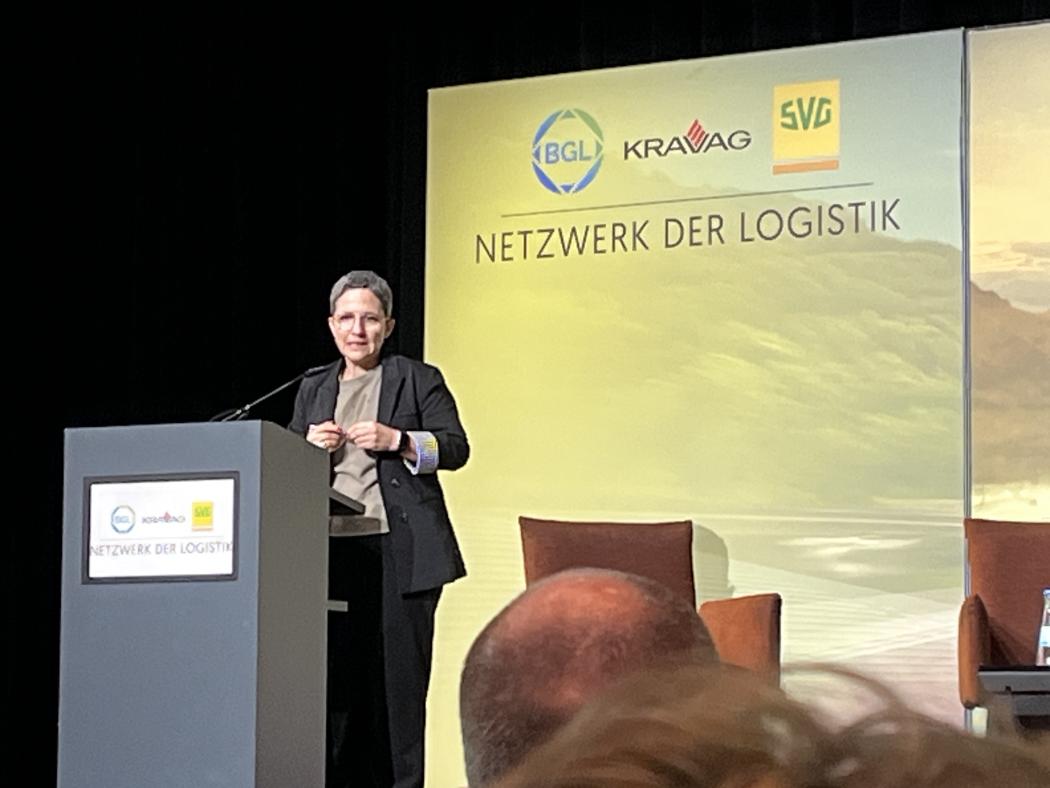
Billions from truck tolls flow into the federal budget – too little of it reaches the roads. The consequence: bridges, road surfaces, safe parking spaces and grid-connected locations wait for visible investments. Against this backdrop, policymakers, associations and companies discussed at the “Network of Logistics” 2025 on September 25 and 26 in Ingolstadt, organized by BGL, SVG and Kravag, how the funds arrive where the transport sector really needs them.
Toll revenues should have a direct effect
BGL board spokesperson Prof. Dr. Dirk Engelhardt made clear that toll revenues must flow back specifically into infrastructure: “Toll revenues must have an effect where the trucks drive: into bridges, safe parking spaces and grid-connected locations. For this we need the return to the financing cycle for roads.” Stephan Böschemeier from SVG underscored that reliability in everyday business is just as crucial for companies as it is for investments.
The industry is currently under double pressure. The truck toll performance index fell in August 2025 compared with July by 2.3 percent and is one percent below the previous year's value. At the same time, the toll exemption for zero-emission trucks ends on December 31. From 2026, only a 75 percent discount on the infrastructure toll component will apply, while the EU is examining an extension. For companies, this means that the
planning and economic viability of their fleet strategy depend directly on political decisions.
Politics aims for modernization and acceleration
State Secretary Claudia Elif Stutz of the Federal Ministry of Transport described road freight transport as the backbone of supply and the SME sector. She pointed to the high investment needs: more than 4,000 bridges must be renovated, 400 projects per year should be implemented, especially large structures. Rail is also on the agenda: major refurbishments are being adjusted, corridor refurbishments are being extended to four per year.
Central tasks of the ministry are planning and permit procedures acceleration. A draft law is expected by the end of 2025. In spring 2026, according to the ministry’s planning, a law to reduce bureaucracy will be in place. Access to the profession of professional truck driver should be facilitated, driving licenses made cheaper and further training offered digitally. The ministry wants to activate private spaces for truck parking and push the construction of new rest areas on federal land to support companies’ operational planning.
Climate protection and the drive-system transition
Dr. Filip-Alexandru Negreanu-Arboreanu from the EU Commission emphasized that the rapid expansion of charging infrastructure for emission-free trucks is a central prerequisite for the drive-system transition. To close the gap between ambitious climate targets and practical implementation, a task force works
closely with the industry. Parallel to this, existing regulations on dimensions and weights must be adjusted so that battery-related extra weight does not impair the vehicles’ competitiveness and the toll exemption for emission-free trucks can be sensibly continued.
And even if the EU remains clear on CO2 targets — State Secretary Stutz is nevertheless important that the fleet target values be reviewed and technology-open solutions implemented. Investments in alternative propulsion are expensive. The expansion of charging infrastructure, depot charging and hydrogen filling stations are therefore central tasks for policymakers. However – the portion of companies that benefit from this is currently very small. Only 0.4 percent of trucks are currently electric. This was pointed out by Florian Scharnagl of EnergyPartners. He presented concepts for holistic energy systems that combine charging infrastructure, power generation, storage and intelligent energy management. Energy hubs in industrial parks would cluster companies, semi-public networks and discounted tariffs and could also be made available to BGL members.
Roads, bridges and parking spaces
Dr. Michael Güntner, CEO of Autobahn GmbH, described the motorway as a “wear-and-tear item” and warned of the urgent investment needs: “We want, we can and we must build.” Of the 28,000 bridge components, 55 percent were constructed before 1984, and the condition of the network varies considerably between regions. For companies, this
means that planning and reliability of transports depend heavily on steady, reliable funding and a closed financing cycle for roads.
Christian Hoffmann, President of the Federal Office for Logistics and Mobility, added that clear rules and robust data are also crucial for companies. Germany accounts for around half of the legal European cabotage market, and since August 70,000 inspections have been carried out. The posting guidelines lie with customs, which has direct implications for compliance and operational planning for companies.
The parking situation remains a central issue. VEDA Managing Director Armin Simmelbauer reported that nationwide around 35,000 parking spaces are available, but building new truck parks could take up to ten years from idea to implementation. From early 2026, the Brummi card is to be accepted. Clean toilets and additional parking options are only feasible with cost sharing by the companies, which in turn affects operational planning and investment decisions.
Challenges and outlook
The event underscored that the industry suffers under both cyclical pressures and the push to transform. Politicians, administration and associations promise investments, funding programs and accelerated permitting procedures, but implementation stalls. For transport managers, it is crucial whether toll revenues actually flow into bridges, loading hubs and parking spaces. Only in this way can supply security be ensured and the drive-system transition be economically successful.