The digital transformation in Supply Chain Management (SCM) remains a central strategic challenge for companies – this is demonstrated by the results of the 22nd SupplyX Barometer, for which 150 logistics managers were surveyed on the topic of "Digital Transformation in Supply Chain Management." Although 82 percent of companies consider digitalization unavoidable, only 9 percent currently have a fully digitally integrated supply chain. The majority are in a transition phase and struggle with structural, technical, and organizational hurdles.
High costs, data protection, and cybersecurity hinder progress
The biggest barrier cited is the high investment requirement: 39 percent of respondents find the implementation costs of digital solutions to be a significant burden. Data protection requirements, cybersecurity issues, and a lack of interoperability of existing IT systems also hinder implementation. In many companies, individual digital applications also exist in isolation, which, according to the study, leads to media discontinuities, lack
of transparency, and delays in operational processes. Common standards are often missing, further hindering the integration of existing systems.
Digitalization brings advantages in warehouse and inventory management
Where digital technologies are already being applied, noticeable advantages can be seen. Particularly in warehouse and inventory management, 61 percent of companies report efficiency gains, with this figure even rising to 75 percent among companies with 250 to 1,000 employees. Digital tools also pay off in forecasting and demand planning: 48 percent of respondents see significant improvements in planning security and resource usage here. This proportion is significantly higher in medium-sized businesses at 67 percent. In addition, nearly one-third of companies benefit from digital solutions for transport and route optimization – 38 percent recognize significant added value here.
Almost a third of companies do not digitalize
Investment readiness varies greatly depending on company size and degree of digitalization. 48 percent of
companies plan investments in automated inventory control – especially larger companies see this as a lever for early bottleneck detection. 43 percent plan to use digital platforms for partner integration, while 33 percent plan investments in data analysis and Artificial Intelligence (AI). At the same time, 27 percent state that they are not currently implementing any specific digitalization measures – a finding that SupplyX manager Jörn von der Fecht describes as alarming. In his words, these companies are at risk of competitive disadvantage in the medium term, as the requirements for transparency, speed, and resilience in the logistics sector are continuously increasing.
Digital data exchange with customers remains the exception
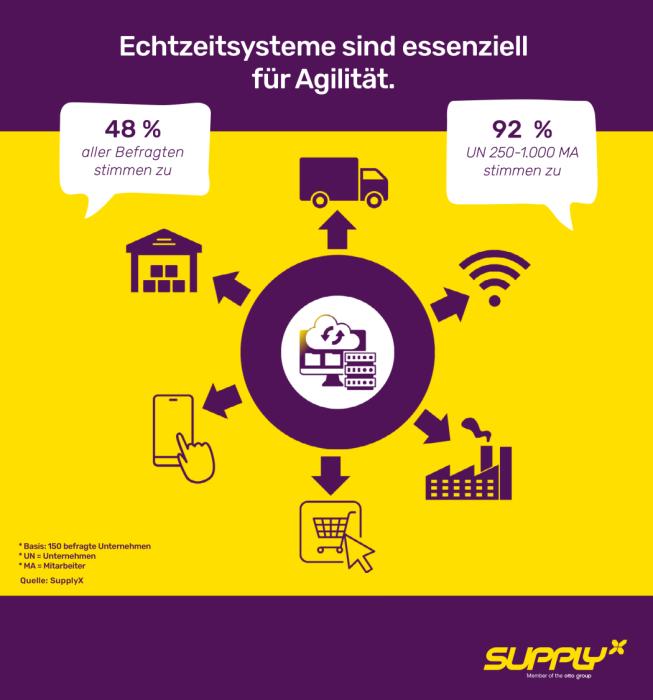
Another focus topic is the use of real-time data. 48 percent of respondents consider the use of real-time systems essential to manage their supply chains agilely. In companies with up to 1,000 employees, this share is a remarkable
92 percent – an indication of their strong operational focus. Nevertheless, digital exchange with customers and partners remains the exception: only 41 percent of companies indicate that they are already digitally connected.
The study makes it clear: the strategic will for digitalization is present, but in implementation, there is often a gap between ambition and reality. Progress is evident especially where digital technologies quickly lead to efficiency gains operationally – such as in warehousing, planning, or transport optimization. But without interoperable systems, investments in IT infrastructure, and consistent partner networking, many potentials remain untapped.
SupplyX is a subsidiary of the Otto Group, specializing in freight forwarding and supply chain optimization, based in Hamburg. With a branch in Vietnam and partners in Asia and the USA, the company offers comprehensive services in international procurement logistics and strategic supply chain management.
The entire 22nd SupplyX Barometer is available here for