The data specialist Dataforce has once again taken the transporter market under the magnifying glass and checked the state of electrification, which is progressing only slowly. In relation to new passenger car registrations, the volume of light commercial vehicles newly registered in Germany is smaller. On the topic of electric transporters there is currently still a greater need for catching up than in the passenger car market, according to the assessment, even if progress is indeed being made, the analysts conclude.
New registrations in the German transporter market this year are almost exactly on last year's level. For the period from January through August inclusive, there is a decline of 0.7%. With just under 341,000 registrations of commercial vehicles up to 7 tons as well as passenger car utilities, the market is thus slightly down, but at the same time surpasses the comparison values of the years 2020 to 2023. For the fleet channel, by far the
most important, there is a decline of currently 4.6%. It is notable that the registration volume in the small fleets is quite stable, while the larger fleets are currently registering fewer new transporters. The fleet market continues to be dominated by the three market leaders. Mercedes, Volkswagen Nutzfahrzeuge and Ford were able to further expand their share and account for no less than 71% of all transporter new registrations in this customer group in the first eight months of 2025.
Ford continues to gain ground, including electrically
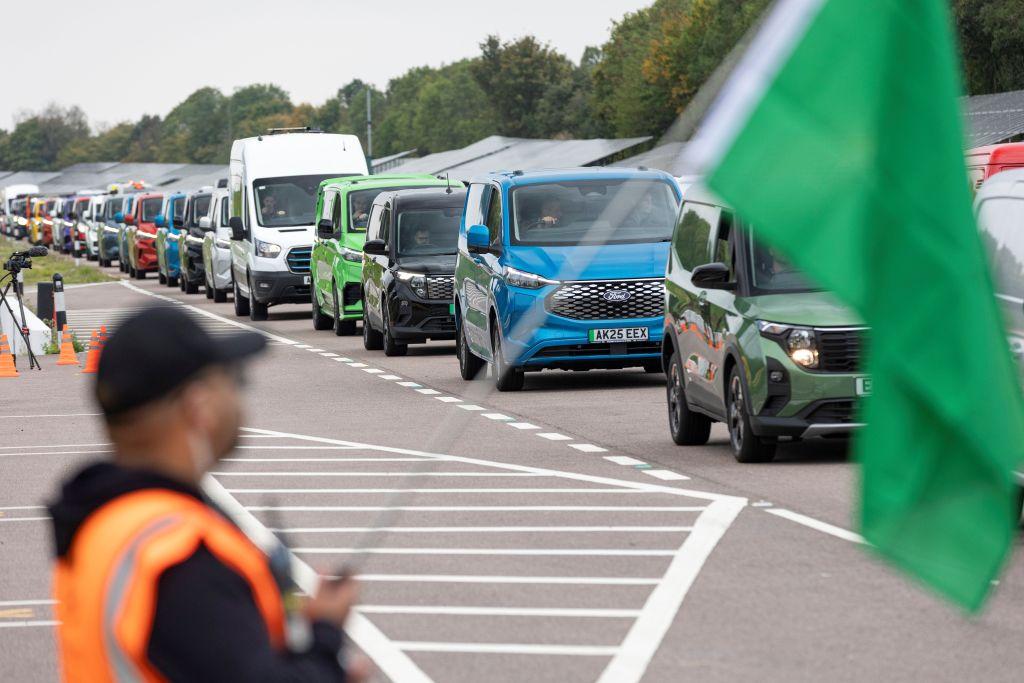
In particular, Ford shows a remarkable upward trend with an increase of 24.9%. A major share of this is due to the new Transit Custom, which moved from position six to rank two in the model ranking, and there were fewer than 50 units to the top spot (held by the Mercedes Sprinter). With 12.4% the electric share for the Transit Custom is above average. While this is positive for
Ford, it also makes clear that the BEV share overall still has a lot of room to grow. An electric share of 10.3% overall may not seem particularly impressive, but it is still considerably higher than last year (6.5%). The dominance of diesel engines remains a reality, even though their share has fallen by more than five percentage points.
Are fleet decision-makers ready for BEVs?
Whether fleet managers are still skeptical about electric models or have become more open to them is addressed by the current Dataforce study “E-Mobilität 2025.” The study covers, among other things, the use of transporters, purchasing behavior, and the evaluation of individual brands by fleet professionals. It also assesses the use of electric transporters in daily practice. Currently, all-electric transporters are represented in about 7% of fleets. As a rule of thumb: the larger the fleet, the higher the penetration. But even in the large fleets, these vehicles remain only a supplement,
as few companies have already converted their fleets completely to electric.
But they do exist, such as the shining example Deutsche Post DHL. And according to the study, the experiences with it are predominantly positive. The deployment of such models is unlikely to hinder a further spread of electrification, the analysis continues. Of course, requirements such as space availability/loading volume and charging capacity/payload are among the second and third most important procurement criteria. With a clear lead at the top is the price-performance ratio. Thus, profitability is currently the biggest obstacle to a rapid ramp-up of electrification; in addition, the clearly higher prices for electric models compared with similar internal combustion models deter many fleet customers. Here, the manufacturers are of course obliged to offer better and, above all, more price-attractive models, according to the authors. Only in this way can the EU's tightened fleet limits be met and thus possible penalties for the period 2025-2027 be